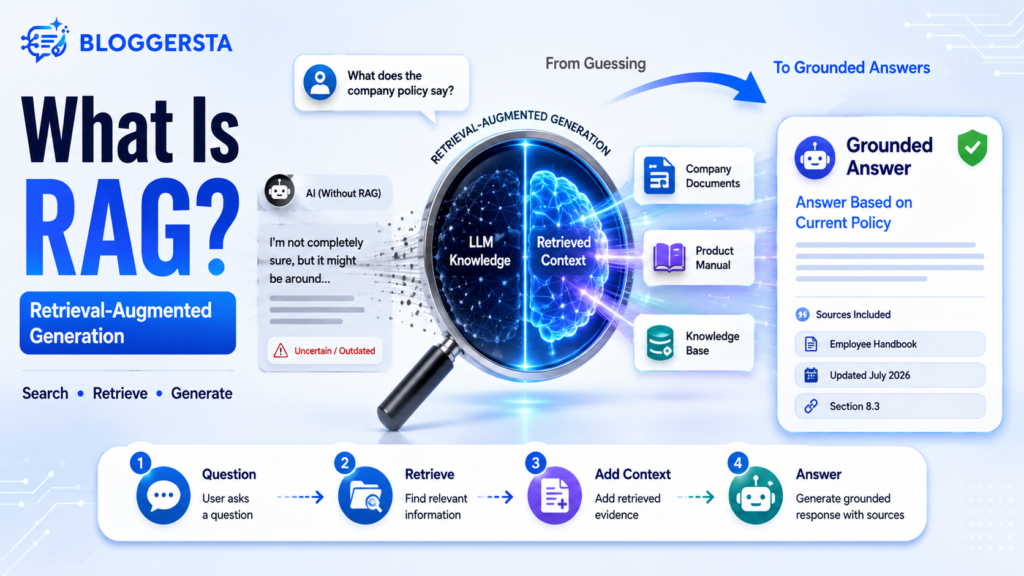
Ask an AI about a private company policy, and it may guess. That information might never have appeared in its training data. Retrieval-Augmented Generation (RAG) changes the process by letting the system search approved sources before answering. But what actually happens behind the scenes?
RAG works much like an open-book test. The language model does not need to memorize every company document. Instead, a retrieval system finds useful passages and places them beside the user’s question. The model then writes its answer using that extra context. This guide explains retrieval, embeddings, vector databases, practical examples, ChatGPT, pipeline building, and common limitations.
Quick Answer
Retrieval-Augmented Generation (RAG), is an AI method that retrieves relevant information from an external knowledge source before an LLM produces an answer. It searches documents, databases, or websites, adds useful passages to the prompt, and asks the model to respond using that evidence. RAG can make answers more current, specific, and easier to verify.
What is Retrieval-Augmented Generation (RAG)?
Retrieval-Augmented Generation (RAG) combines information retrieval with language generation. A large language model still writes the final response, but another part of the system first searches for information the model may not know.
A RAG system can connect an LLM with:
- Internal company documents
- Product manuals
- Help-center pages
- Research papers
- Public websites
- Customer records
- Policies and procedures
- Structured databases
The basic formula is:
User Question + Retrieved Evidence + LLM = Grounded Answer
The original Retrieval-Augmented Generation (RAG) research combined knowledge stored inside a language model with information retrieved from an external document index. This made facts easier to update and helped provide evidence for generated answers.
AWS also describes RAG as a way to provide an LLM with external data, including private organizational documents, before generation begins.
Also Read: How to Use ChatGPT for Beginners: A Step-by-Step Guide (2026)
What Does Retrieval-Augmented Generation (RAG) Mean in AI?
The RAG meaning in AI becomes clearer when each word is separated:
- Retrieval means finding information related to the question.
- Augmented means adding that information to the model’s input.
- Generation means producing the final written response.
RAG does not usually rewrite the model’s permanent knowledge. Instead, it temporarily gives the model extra reading material for one request.
Imagine a business changes its return policy. A normal model may still rely on older knowledge. A RAG system can index the updated policy and use it immediately. The company does not need to retrain the entire language model whenever one document changes.
That flexibility makes RAG useful for fast-moving information and private business knowledge. AWS notes that RAG allows foundation models to reference authoritative custom documents outside their original training data.
Also Read: Gemini vs ChatGPT vs Claude: Which AI Is Actually Best?
How Does Retrieval-Augmented Generation (RAG) Work?
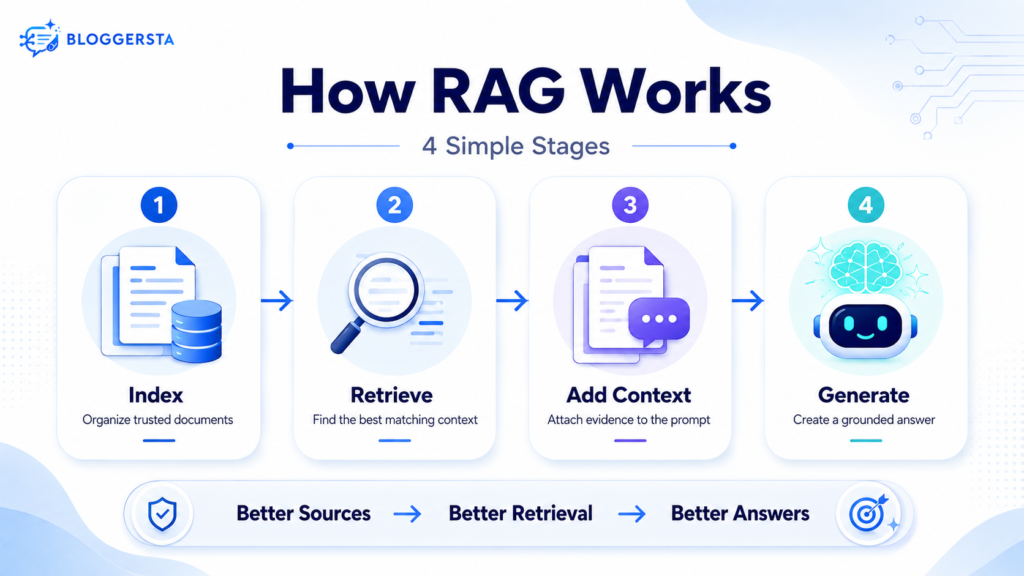
A RAG workflow includes preparation and real-time retrieval. Document indexing usually happens beforehand. Retrieval, augmentation, and generation happen whenever someone asks a question.
Stage 1: Index the Knowledge
The system collects approved documents and cleans their content. It then divides them into smaller passages called chunks.
An embedding model converts each chunk into a numerical representation. These numbers capture the passage’s general meaning rather than its exact wording.
The embeddings, original text, and document details are stored inside a searchable index. This storage system is often called a vector database or vector store.
Stage 2: Retrieve Relevant Information
When a person asks a question, the system creates an embedding for that query too.
It compares the query’s meaning with the stored document embeddings. Similarity search then identifies passages that appear closely related.
For example, a question about parental leave should retrieve policy sections about leave, contractors, and eligibility. It should not return unrelated salary information.
Stage 3: Augment the Prompt
The system combines the original question with the retrieved passages. It may also include source names, dates, permissions, and instructions.
This expanded input becomes the augmented prompt.
Stage 4: Generate the Answer
The LLM reads the question and the retrieved evidence. It then creates a natural response based on that context.
AWS outlines a similar four-step process involving document embeddings, a user query, similarity search, and an LLM response using retrieved context.
Documents → Chunks → Embeddings → Vector Store
Question → Search → Retrieved Context → LLM Answer
Advanced systems may also rerank passages, filter them by permissions, or include source citations.
Also Read: Galaxy.ai Vs ChatGPT: Real Difference and Which One Should You Use?
What Are the Four Stages of RAG?
The four beginner-friendly stages of RAG are indexing, retrieval, augmentation, and generation.
| Stage | What Happens | Main Output |
| Indexing | Documents become searchable chunks and embeddings | Knowledge index |
| Retrieval | The system finds passages related to the question | Relevant context |
| Augmentation | Retrieved information joins the user’s prompt | Grounded prompt |
| Generation | The LLM writes an answer from the supplied context | Final response |
Some guides describe only three stages. They leave out indexing because it normally happens before a user sends a query.
The shorter runtime flow is:
Retrieve → Augment → Generate
Both versions describe the same general system.
Also Read: Best AI Tools for Project Management Teams
What is RAG in an LLM?
RAG is not normally a replacement for an LLM. It is a supporting system built around one.
Each part has a different role:
| Component | Main Job |
| LLM | Understands instructions and writes responses |
| Retriever | Searches for useful passages |
| Embedding model | Converts meaning into numerical vectors |
| Vector store | Holds searchable document representations |
| Reranker | Reorders passages by likely relevance |
| Prompt layer | Combines the question and retrieved evidence |
The LLM is the writer, while the retriever acts like a researcher. The vector store works like a library catalog built around meaning.
People sometimes search “what is a RAG,” but RAG is usually not one standalone model. It is an architecture connecting search, external data, prompting, and generation.
For a broader explanation of systems using tools and knowledge sources, read What is an AI Agent?.
RAG AI Example: an Employee Policy Assistant
A clear retrieval-augmented generation example is an internal employee-support assistant.
Suppose someone asks:
How many paid parental-leave weeks do contractors receive?
Without RAG, a public LLM may provide a general answer. It could also make an unsupported assumption because it cannot see the company’s current policy.
With RAG, the process changes:
- The retriever searches the latest employee and contractor documents.
- It locates the section covering parental leave.
- The relevant passage enters the augmented prompt.
- The LLM writes an answer using that passage.
- The system provides a source link or citation.
A possible answer might say:
Contractors are not covered by the employee parental-leave program. See section 8.3 of the current contractor policy.
The important fact comes from the company document, not the LLM alone. AWS lists question-answering, legal research, retail, healthcare, and manufacturing among common RAG use cases.
How is RAG Different from a Standard LLM?
A standard LLM mainly relies on training data and information supplied inside the current prompt. A RAG system can search external information while handling a request.
| Feature | Standard LLM | RAG System |
| Knowledge source | Training data and prompt | Training data, prompt, and retrieved sources |
| Private documents | Unavailable unless manually supplied | Can be indexed and searched |
| Updates | May need new context or model updates | Update the knowledge source |
| Citations | May lack supporting evidence | Can return retrieved sources |
| Setup | Simpler | Requires retrieval infrastructure |
| Main weakness | Knowledge gaps and hallucinations | Weak retrieval or poor source data |
RAG does not automatically make an answer correct. The retriever may select the wrong passage. The language model may also misunderstand or ignore useful evidence.
The difference is access, not guaranteed truth.
RAG vs Fine-Tuning
RAG and fine-tuning solve different problems.
| Need | RAG | Fine-Tuning |
| Add changing facts | Strong choice | Poor fit |
| Use private documents | Strong choice | Harder to update |
| Change writing style | Limited | Strong choice |
| Teach a repeated format | Possible through prompting | Strong choice |
| Provide citations | Easier | Not built in |
| Update information quickly | Replace or reindex documents | New training may be required |
A simple rule helps:
Use RAG to control what information the model consults. Use fine-tuning to influence how the model behaves.
For example, a support assistant may use RAG for current product documentation. Fine-tuning might help it consistently follow a specific response format.
AWS presents RAG as a practical option for answering questions from custom documents without repeatedly retraining the underlying model.
How to Build a RAG Pipeline
This short Retrieval Augmented Generation tutorial explains the main pipeline without diving into complicated code.
Step 1: Choose a Narrow Use Case
Begin with one clear problem. A product-support assistant is easier to test than a system expected to answer every company question.
Step 2: Collect Trusted Documents
Use current manuals, policies, approved pages, and reliable database records. Poor source material produces poor retrieval.
Step 3: Clean and Chunk the Content
Remove duplicate headers, broken text, repeated footers, and outdated pages. Split each document into passages that preserve complete ideas.
Step 4: Create Embeddings
Use an embedding model to represent each passage numerically. Similar meanings should appear closer together during search.
Step 5: Store the Vectors
Place the embeddings and original text inside a vector store or managed retrieval service.
Step 6: Build the Retrieval Prompt
Send the most relevant passages, user question, and response instructions to the LLM.
Clear prompting still matters. Read What is Prompt Engineering? for practical guidance.
Step 7: Evaluate the System
Test whether it:
- Retrieves the correct evidence
- Refuses when evidence is missing
- Cites the right source
- Respects document permissions
- Handles conflicting information
- Avoids inventing unsupported details
Trusted Data + Useful Chunks + Accurate Retrieval + Clear Prompt + Evaluation = Better RAG
Pinecone’s official RAG chatbot tutorial follows a similar process involving chunks, embeddings, retrieval, and context-based generation.
Why Document Chunking Matters
Chunking can determine whether a RAG system finds the exact answer or returns a confusing fragment.
Chunks that are too large may contain several unrelated subjects. Smaller chunks may lose definitions, headings, or important conditions.
Other common problems include:
- Broken tables
- Repeated page footers
- Missing image content
- Unclear abbreviations
- Duplicate passages
- Sections separated from their headings
A policy paragraph saying “this benefit excludes contractors” is useless if the preceding benefit name appears in another chunk.
Split documents around headings, topics, or complete ideas. AWS recommends clear structures and self-contained sections because well-written source content improves retrieval quality.
Is ChatGPT a RAG LLM?
ChatGPT is not one permanent RAG LLM, but several ChatGPT features can use retrieval before producing an answer.
A normal response may rely on model training and the current conversation. Other features retrieve additional information:
- ChatGPT Search can find current web information and provide source links.
- Company knowledge can search connected organizational sources.
- Connected apps can supply relevant internal context.
- Uploaded files can provide information for document-based questions.
OpenAI states that ChatGPT Search retrieves relevant web results and generates answers with links to those sources.
OpenAI’s company knowledge feature can also search connected organizational tools and return citations to original material. Access depends on the plan, enabled apps, and workspace permissions.
Therefore, ChatGPT can perform retrieval-augmented workflows. However, not every ChatGPT response uses RAG. (Feature details checked: July 2026.)
Benefits of Retrieval-Augmented Generation
RAG is useful when a model needs current, private, or specialized information without memorizing every document.
Its main advantages include:
- Access to updated information
- Answers based on private documents
- Faster knowledge changes
- Better domain relevance
- Possible source citations
- Less need for model retraining
- Greater control over approved information
- Improved auditability
RAG can reduce hallucinations by grounding responses in selected evidence. Still, it cannot remove them completely.
The result depends on source quality, retrieval accuracy, and the model’s ability to follow the supplied context.
Limitations and Risks of RAG
A RAG system is only as reliable as its weakest stage.
Common problems include:
- Retrieving the wrong passage
- Missing the best document
- Indexing outdated information
- Using poor chunk boundaries
- Receiving conflicting sources
- Increasing response time
- Adding database and model costs
- Exposing unauthorized information
- Following malicious instructions inside documents
- Presenting weak evidence with too much confidence
RAG cannot retrieve a fact that was never added, indexed, or permitted.
Production systems need access controls, logging, evaluation, source checks, and clear refusal behavior. AWS emphasizes identity management, permissions, guardrails, orchestration, and retrieval controls as important parts of production RAG systems.
What is RAG as a Service?
RAG as a service describes managed platforms that handle document ingestion, embeddings, indexing, retrieval, scaling, or response generation.
| Managed Option | Main Purpose |
| Amazon Bedrock Knowledge Bases | Managed retrieval and generation using business data |
| Vertex AI RAG Engine | Tools for creating and running RAG workflows |
| Pinecone | Vector search and retrieval infrastructure |
| OpenAI-connected knowledge features | Retrieval from web or connected organizational sources |
Amazon Bedrock Knowledge Bases can retrieve relevant source chunks, generate natural-language answers, rerank results, and include citations.
Google provides a managed RAG Engine inside Vertex AI, including tools for creating corpora, importing files, retrieving context, and generating responses.
Managed services save development time. Custom systems provide greater control over retrievers, databases, security, and evaluation.
Useful RAG Documentation
Beginners should understand the workflow first, then choose one platform-specific guide.
- Original Retrieval-Augmented Generation paper
- AWS guide to understanding RAG
- Amazon Bedrock Knowledge Bases
- Google Vertex AI RAG quickstart
- Pinecone RAG chatbot tutorial
- OpenAI ChatGPT Search documentation
FAQs
Is ChatGPT a RAG LLM?
ChatGPT does not use RAG for every answer. However, Search, company knowledge, connected apps, and document-based workflows can retrieve external information before ChatGPT produces a response.
What Are the Four Stages of RAG?
The four stages are indexing, retrieval, augmentation, and generation. Documents are prepared first. The system then finds relevant passages, adds them to the prompt, and generates an answer.
What is RAG with an Example?
A support assistant may search a current product manual before answering a customer. It retrieves the relevant section and gives it to the LLM, which writes an evidence-based response.
How is RAG Different from an LLM?
An LLM generates language from training and supplied context. RAG is a wider system that retrieves additional information from external sources before asking the LLM to answer.
Does RAG Eliminate Hallucinations?
No. RAG can reduce unsupported answers, but weak retrieval, outdated documents, conflicting sources, or unclear prompts can still produce mistakes.
Do You Need a Vector Database for RAG?
Not always. Vector databases are common because they support semantic search. Smaller systems may use keyword search, full-text search, structured databases, or hybrid methods.
Final Thoughts
Retrieval-Augmented Generation gives an LLM useful information before it answers. The process indexes trusted documents, retrieves relevant passages, adds them to the prompt, and creates a grounded response.
This open-book approach can improve accuracy, freshness, and source visibility without retraining the model after every information change. Still, good results depend on clean documents, sensible chunking, accurate retrieval, clear instructions, and careful testing.
Begin with one narrow use case and a small knowledge base. Test every stage before adding more data. A simple RAG pipeline that finds the right evidence beats a complicated system that searches badly.