
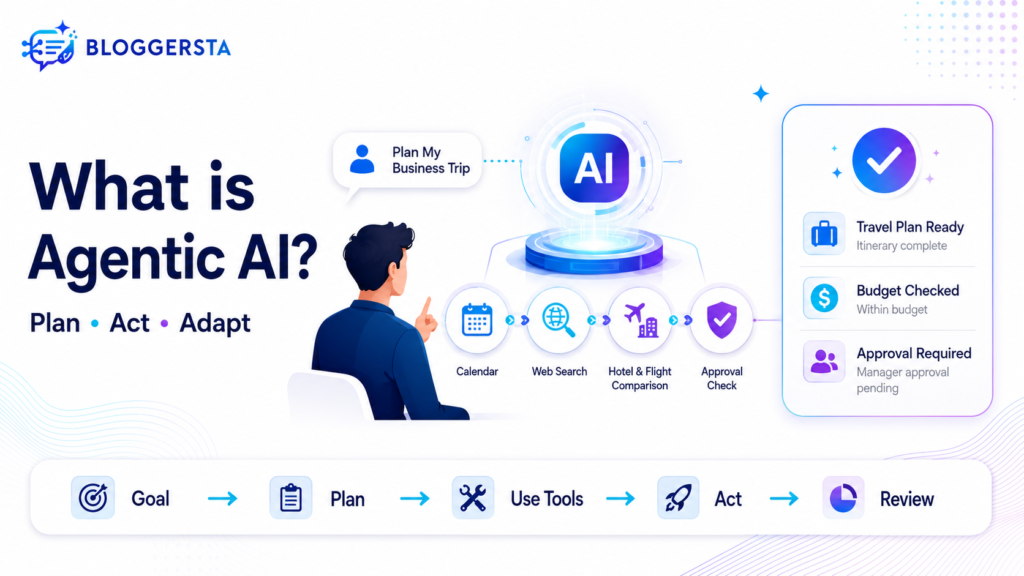
AI is moving beyond answering questions. Microsoft reported that active agents across Microsoft 365 grew fifteenfold within one year. These systems can research, plan, use software, and complete connected tasks. So, what is agentic AI, exactly? (Microsoft Work Trend Index)
Traditional generative AI usually waits for your prompt and produces content. Agentic AI receives a broader goal, decides which steps matter, uses available tools, and reviews what happened. Imagine asking AI to plan a four-day trip under $1,500. A chatbot suggests an itinerary. An agentic system checks dates, compares prices, updates the budget, and pauses before booking.
Quick Answer
Agentic AI is an artificial intelligence system that works toward a goal with some autonomy. It can understand the objective, plan several steps, use connected tools, take actions, review results, and change its approach when necessary. Unlike a basic chatbot, it does more than produce an answer. It actively moves the task toward completion.
What is Agentic AI?
Agentic AI is an approach that allows artificial intelligence to make coordinated decisions and take actions toward a defined goal.
A typical agentic system combines:
- A language or reasoning model
- A goal and operating instructions
- Short-term or long-term memory
- Access to tools and applications
- Planning and decision-making
- An action and feedback loop
- Permissions and stopping rules
- Human approval for sensitive steps
The basic formula looks like this:
Goal + Reasoning + Tools + Action + Feedback = Agentic AI
Google Cloud describes agentic AI as systems focused on autonomous decision-making and action. They gather information, reason about it, build a plan, act, and reflect on the outcome. (Google Cloud’s agentic AI guide)
Autonomous does not mean uncontrolled. Most useful systems operate inside boundaries set by developers, administrators, or users.
For a closer look at the software component behind these workflows, read our guide explaining what an AI agent is.
What is Agentic AI and How Does It Work?
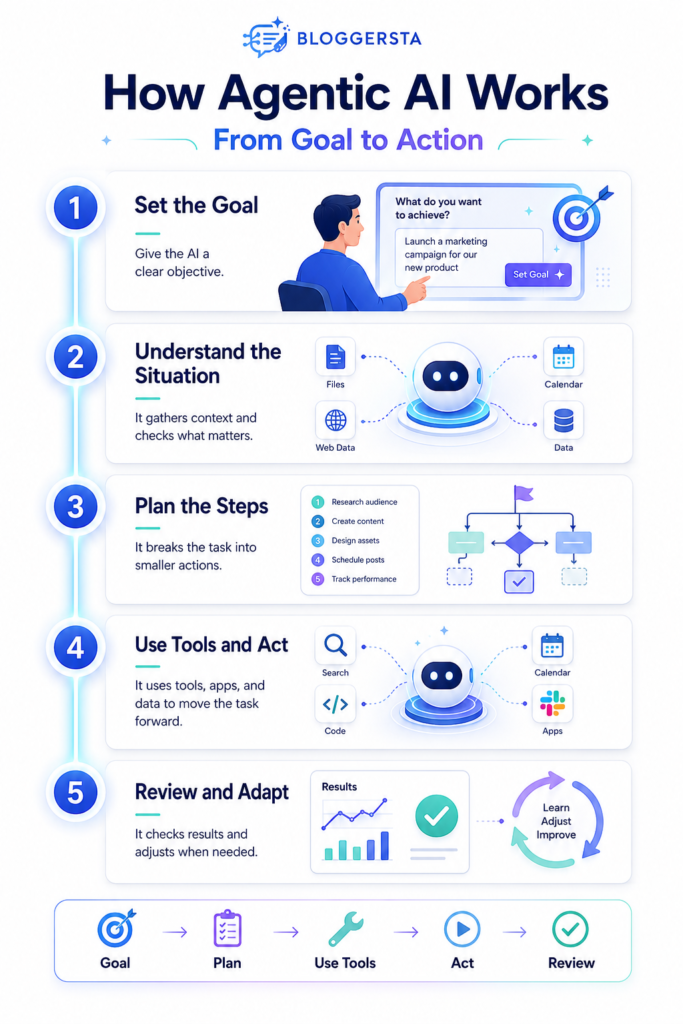
Agentic AI works through a repeating perception-action loop. It does not simply answer once and wait for another instruction.
Stage 1: Perceive
The system reads the objective and gathers relevant information. That information may come from files, databases, websites, emails, sensors, or connected applications.
For the travel request, it may check the traveler’s calendar, destination, budget, and preferred departure airport.
Stage 2: Reason
The model studies the available information and decides what matters. It may notice that the preferred travel dates conflict with an existing meeting.
Stage 3: Plan
The system divides the main goal into smaller tasks. It might search flights first, compare hotels next, calculate costs, and then build an itinerary.
Stage 4: Act
The agent uses tools, APIs, websites, code, or business software. Depending on its permissions, it might search booking platforms or create a draft calendar event.
Stage 5: Observe and Reflect
After every action, the system checks the result. If the selected hotel pushes the trip above budget, it reviews cheaper alternatives.
Stage 6: Repeat or Stop
The process continues until the task finishes, a limit is reached, or human approval becomes necessary.
Perceive → Reason → Plan → Act → Review → Repeat
Anthropic explains that effective agents work across several turns, call tools, observe feedback, and adapt after intermediate results. It also recommends simpler workflows when full autonomy is unnecessary. (Anthropic’s agent-building guide)
Also Read: What is an AI Agent? Simple Explanation with Examples
What is Agentic AI vs Generative AI?
Generative AI creates content, while agentic AI coordinates actions toward a broader result.
| Feature | Generative AI | Agentic AI |
| Main purpose | Produces text, images, code, or audio | Completes a goal |
| Interaction | Usually prompt and response | Multi-step workflow |
| Planning | Mostly user-directed | System can plan steps |
| Tool use | Optional | Often central |
| Actions | Usually returns content | Can act across connected systems |
| Feedback | Waits for another prompt | Reviews results and adapts |
| Human role | Gives instructions | Sets goals and supervises |
Suppose you request a vacation plan. Generative AI writes a suggested itinerary. Agentic AI may search flights, compare hotels, check your calendar, recalculate the budget, and request approval.
The two approaches are not opposites. Agentic systems often use generative models for reasoning, summaries, instructions, and communication. Google similarly distinguishes content creation from systems that organize tools and actions around higher-level goals.
Understanding Retrieval-Augmented Generation also helps because agents often retrieve current or private information before acting.
Agentic AI vs AI Agents
An AI agent is usually one software component with a specific role. Agentic AI describes the wider approach that supports goal-driven planning and action.
Think of an agent as one specialist on a team. The agentic system is the manager coordinating everyone.
A multi-agent system might assign separate agents to:
- Search competitor websites
- Analyze product prices
- Review customer feedback
- Draft a market report
- Check the report for missing evidence
The agents handle individual subtasks. The wider system manages orchestration, memory, handoffs, and final delivery.
Also Read: What is Prompt Engineering in AI? A Beginner’s Guide to Better AI Prompts
Agentic AI Examples
Agentic AI examples become clearer when a task involves several connected actions.
Travel Planning
A travel agent checks the calendar, compares flights, reviews hotels, calculates costs, and asks for approval before booking.
Software Development
A coding agent can inspect project files, plan changes, write code, run tests, read errors, and revise its approach. These tasks require action and feedback rather than one code response.
Customer Support
A support agent reads a request, checks account information, searches current policies, suggests a resolution, and sends unusual cases to a person.
Market Research
An agentic research system searches multiple sources, compares competitors, identifies patterns, and produces a report with evidence.
Workplace Administration
An administrative agent may review meeting notes, organize files, draft follow-up messages, and schedule approved tasks.
The strongest example usually contains three things:
A goal, several actions, and feedback between those actions.
is ChatGPT Agentic AI?
ChatGPT is not agentic in every conversation, but several current ChatGPT features display agentic behavior.
A basic conversation remains reactive. You ask something, ChatGPT responds, and you choose what happens next.
OpenAI’s ChatGPT Work is designed for longer tasks involving research, connected apps, files, documents, spreadsheets, presentations, and scheduled work. Users can follow its progress, answer questions, redirect it, and approve important actions. (ChatGPT Business release notes)
OpenAI also provides workspace agents for eligible Business and Enterprise users. Teams can connect them with tools, schedule recurring runs, share them internally, or trigger them through an API. (OpenAI’s workspace agent guide)
ChatGPT agent mode can also browse websites, use enabled applications, and perform actions under workspace controls. (OpenAI’s ChatGPT agent documentation)
Therefore, ChatGPT can be agentic when it plans and acts through agents, tools, and applications. A normal text reply is not automatically agentic.
Feature information checked: July 2026.
New users can first learn how to use ChatGPT step by step.
Is Copilot Agentic AI?
Microsoft Copilot becomes agentic when its agents retrieve information, make decisions, and act across connected business systems.
Microsoft says Copilot agents can query HR, CRM, and financial systems. They can also submit expense reports, update records, create support tickets, compile research, and automate processes. (Microsoft Copilot Agents)
People can create simpler agents inside Microsoft 365 Copilot. Advanced business workflows can be developed through Copilot Studio.
However, not every Copilot response is agentic. Basic drafting, summarizing, and question answering may remain standard generative AI interactions.
Is Claude Agentic AI?
Claude can behave agentically through research, coding, computer use, and connected-tool workflows.
Claude Research performs several searches, decides what to investigate next, and builds on earlier findings. Anthropic directly describes Research as an agentic feature. (Claude Research documentation)
Claude Code can operate across multiple agentic turns and use permission-controlled tools. Its command-line options also let developers set maximum turns and permission modes. (Claude Code documentation)
Still, a normal Claude conversation may simply return an answer. The product becomes agentic when it pursues an outcome through repeated actions and feedback.
Who Are the Big 4 AI Agents?
There is no official technical group called the “Big 4 AI agents.” The phrase usually refers to four major commercial ecosystems offering visible agentic features.
| Ecosystem | Current Agentic Offerings | Common Use |
| OpenAI | ChatGPT Work and workspace agents | Research and task completion |
| Anthropic | Claude Research and Claude Code | Research and software development |
| Gemini Spark and Agent Platform | Personal and enterprise workflows | |
| Microsoft | Microsoft 365 Copilot Agents | Workplace automation |
Google describes Gemini Spark as a personal agent that organizes files and handles multi-step workflows across Google Workspace. Current access depends on plan, location, device, and rollout status. (Gemini release updates)
Google’s Gemini Enterprise Agent Platform supports building, scaling, governing, and monitoring business agents. (Gemini Enterprise Agent Platform)
This “Big 4” label reflects market visibility, not a scientific classification.
What is Agentic AI in Cyber Security?
Agentic AI in cyber security uses goal-driven agents to investigate threats, prioritize risks, and perform approved defensive actions.
Common tasks include:
- Alert triage
- Threat hunting
- Incident investigation
- Identity-risk analysis
- Vulnerability prioritization
- Detection-rule creation
- Device-policy review
- Remediation recommendations
Microsoft Security Copilot agents operate through configured identities, permissions, triggers, and administrator controls. Microsoft recommends using accounts with the lowest permissions needed. (Microsoft Security Copilot agent setup)
The danger is easy to see. A security agent with broad access could misread an event and take a harmful action. Strong access controls, logs, approval steps, and limited permissions are necessary.
Agentic AI Tools Worth Knowing
The right agentic AI tools depend on your goal, existing software, and technical experience.
| Tool or Platform | Best Fit | Main Agentic Capability |
| ChatGPT Work | Longer knowledge tasks | Researches and creates finished deliverables |
| ChatGPT Workspace Agents | Repeatable business work | Uses tools, schedules, and connected apps |
| Claude Research | Detailed research | Conducts linked searches |
| Claude Code | Software projects | Edits files and runs commands |
| Microsoft Copilot Agents | Workplace processes | Acts across Microsoft and business systems |
| Gemini Spark | Personal workflows | Organizes files and completes tasks |
| Gemini Agent Platform | Enterprise development | Builds, governs, and monitors agents |
Tool access and product names checked: July 2026. Availability can depend on the region, plan, workspace settings, and administrator approval.
Benefits of Agentic AI
Agentic systems can:
- Complete longer, multi-step tasks
- Work across several applications
- Reduce repetitive handoffs
- Change direction when one step fails
- Run scheduled or triggered workflows
- Coordinate specialized agents
- Speed up research and analysis
- Keep people focused on decisions
Yet autonomy does not always save time. A poorly designed system can create more checking, corrections, and confusion.
Microsoft’s 2026 research found fifteenfold growth in active Microsoft 365 agents. It also stressed that human judgment and organizational readiness shape their actual impact.
Risks and Limitations of Agentic AI
The same abilities making agents useful also introduce serious risks.
- One mistake can affect several later steps.
- An agent may choose the wrong tool.
- Broad permissions can expose private information.
- Malicious instructions may manipulate connected agents.
- Longer workflows can increase costs and waiting time.
- Decisions may be difficult to explain.
- Several agents may take conflicting actions.
- An agent may continue when it should stop.
Anthropic notes that agents bring higher costs and possible compounding errors. It recommends extensive testing and appropriate guardrails.
OpenAI also limits agent access through workspace controls, enabled applications, website restrictions, and role-based permissions.
Greater autonomy requires tighter permissions and better supervision.
How to Evaluate an Agentic AI Tool
Before adopting a tool, ask practical questions:
- Can it complete the intended task reliably?
- Which systems and files can it access?
- Does it request approval before important actions?
- Can you review its activity and sources?
- What information does it remember?
- Can administrators restrict permissions?
- How does it recover after failure?
- Can the workflow be paused immediately?
- What does each completed task cost?
Use this safety formula:
Useful Goal + Limited Tools + Clear Permissions + Testing + Human Review = Safer Agentic AI
Start with one narrow workflow. Expand access only after consistent testing.
Frequently Asked Questions About Agentic AI
is ChatGPT an Agentic AI?
ChatGPT is not agentic in every conversation. ChatGPT Work, agent mode, connected tools, scheduled workflows, and workspace agents can plan and complete multi-step tasks, making those experiences agentic.
What is the Difference Between Generative AI and Agentic AI?
Generative AI mainly creates content from prompts. Agentic AI pursues a goal by planning steps, using tools, taking actions, reviewing results, and adapting when needed.
What is an Example of Agentic AI?
An agentic travel assistant can check a calendar, compare flights, review hotels, calculate costs, adjust the plan, and request approval before booking.
Who Are the Big 4 AI Agents?
There is no official Big Four. The phrase commonly refers to agentic products from OpenAI, Anthropic, Google, and Microsoft because these companies operate major commercial AI ecosystems.
is Copilot Agentic AI?
Copilot is agentic when its agents access business information, make decisions, and perform actions across connected systems. A standard chat response may remain generative assistance.
is Claude Agentic AI?
Claude acts agentically through features such as Research and Claude Code. Basic Claude conversations are not automatically agentic because they may only return an answer.
Final Thoughts
Agentic AI moves artificial intelligence from answering prompts toward completing goals. It perceives a situation, plans steps, uses tools, takes action, reviews results, and adapts when necessary. Generative AI may create an itinerary, while an agentic system can research options and move the booking process forward.
ChatGPT, Claude, Gemini, and Copilot now include agentic features, although access and autonomy vary. These systems can save time, but they also introduce risks involving errors, permissions, privacy, and accountability.
Start with one narrow workflow, limit tool access, request approvals, and review every important result before allowing greater independence.