
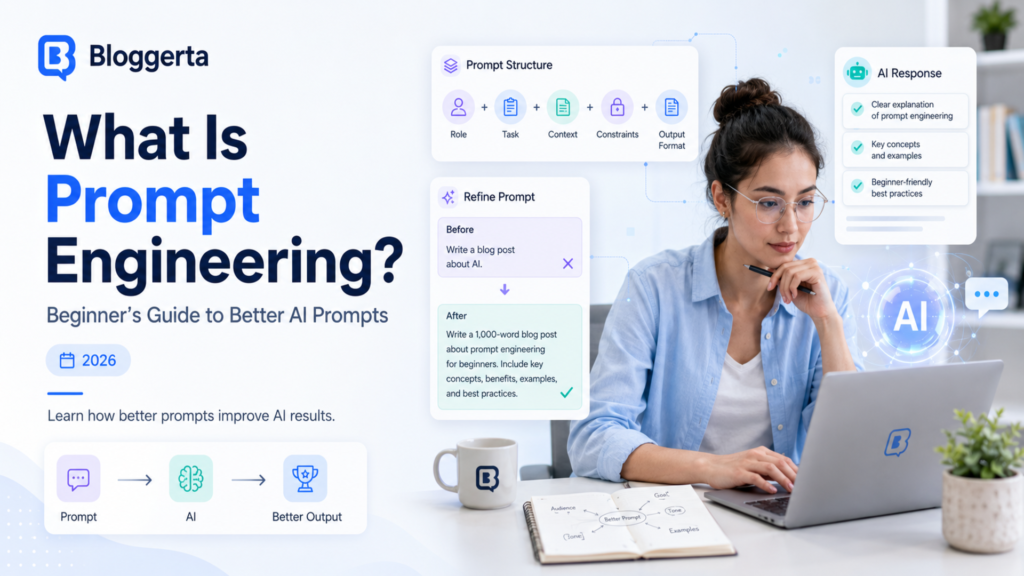
A vague AI prompt can turn a five-minute task into an hour of revisions. Microsoft and LinkedIn reported that 75% of knowledge workers use AI at work, making clear instructions a practical skill. So, what is prompt engineering in AI and how does it improve AI results?
AI cannot see the complete idea hiding inside your head. It only receives the words, files, images, and context you provide. Giving AI a vague request resembles asking a designer to “make something nice” without naming the audience, purpose, style, or format. A strong prompt closes those gaps. This guide explains prompt engineering types, ChatGPT methods, real examples, common mistakes, and useful career skills.
Quick Answer
Prompt engineering is the process of writing, testing, and refining instructions so an AI model produces a useful result. It reduces vague answers, missing context, unwanted formats, and repeated revisions. Everyday prompt design doesn’t require coding, though technical roles may involve APIs or automated testing. Next, let’s examine what is prompt engineering in AI, how prompting works and how you can improve your results.
What is Prompt Engineering in AI?
Prompt engineering in AI means creating clear instructions that guide an AI model toward a specific result. A prompt can contain a question, command, background details, examples, rules, limits, and a requested output format.
OpenAI recommends giving models clear instructions and enough context for the task. It also suggests improving prompts after reviewing earlier responses.
Consider this basic example:
Weak prompt:
Write about email marketing.
Improved prompt:
Write a 150-word introduction explaining three email marketing mistakes for new online store owners. Use simple language and include one practical example.
The second prompt reduces guesswork. It names the topic, audience, length, angle, writing level, and required detail.
- Writers can apply the same method when using tools from our AI Writing Tools for Bloggers and Content Writers guide.
What is Prompt Engineering in Generative AI?

Source: Image by DC Studio on Magnific
Prompt engineering in generative AI guides tools that create new text, images, code, audio, or video. Your instructions shape what the model produces, how it presents the answer, and which details receive attention.
People commonly use generative AI for:
- Writing articles, emails, and product descriptions
- Creating images from written descriptions
- Summarizing reports and uploaded documents
- Producing or explaining computer code
- Planning marketing campaigns
- Reviewing information provided by the user
Prompt engineering doesn’t retrain the complete large language model. Instead, it improves the instructions, context, constraints, examples, and output format used for one task.
For another beginner-friendly explanation, read What is Jasper AI? A Simple Guide for Beginners and Marketers.
[Internal Link: What is Jasper AI? A Simple Guide for Beginners and Marketers]
Prompt Engineering Types Beginners Should Know
Different prompt engineering types provide different levels of guidance. Some give one direct instruction, while others include examples, roles, formatting rules, or follow-up corrections.
Zero-Shot Prompting
Zero-shot prompting asks an AI model to complete a task without receiving an example. You provide the instruction, then let the model respond using its existing knowledge.
For example:
Classify this customer review as positive, negative, or neutral.
This method works well for familiar tasks with simple categories. However, the answer may wander when your rules are unusual, subjective, or highly technical.
Few-Shot Prompting
Few-shot prompting gives the AI one or more examples before requesting a new response. Those examples show the desired tone, structure, labels, or writing pattern.
For example:
Product: Reusable bottle
Tone: Friendly
Caption: Stay refreshed without wasting plastic.
You can then ask for a similar caption about a lunch box. The example works like a road sign. It points the model toward your preferred style without explaining every small choice.
Role and Context Prompting
Role prompting asks the model to answer from a chosen professional viewpoint. That role can shape vocabulary, priorities, and the depth of the answer.
For example:
Act as an experienced career coach. Review this résumé for an entry-level marketing position.
A role alone won’t rescue a weak request. Add the reader, goal, background material, and limits. “Act as an expert” sounds useful, though the model still needs to know what the expert should produce.
Structured and Iterative Prompting
Structured prompting requests a specific format, such as a table, bullet list, numbered guide, headings, or JSON. Iterative prompting happens after you review the first answer and request a focused revision.
For example:
Rewrite the answer using shorter sentences and add one real-world example.
Multimodal prompts combine written instructions with images, screenshots, audio, videos, or uploaded files. Google also recommends clear instructions, contextual information, examples, structured prompts, and repeated testing.
Prompt Engineering ChatGPT: How to Write Better Prompts

Source: Image by DC Studio on Magnific
Good ChatGPT prompts don’t need impressive vocabulary. They need relevant details placed in a sensible order, much like a clear brief handed to a coworker.
Use a Simple Prompt Formula
Try this formula:
Role + Task + Context + Constraints + Output Format + Example
Each part answers a practical question:
- Role: Who should the AI act like?
- Task: What should the AI create or solve?
- Context: What background does the model need?
- Constraints: What should the answer include or avoid?
- Output format: Should it use paragraphs, bullets, or a table?
- Example: What does a suitable result resemble?
You won’t need every element each time. A simple definition may require one sentence. A business plan needs far more context.
Compare a Weak Prompt with a Better Prompt
| Prompt Element | Weak Prompt | Better Prompt |
| Request | Write a product description | Write a 100-word product description |
| Audience | Not stated | First-time apartment renters |
| Product | Lamp | Small adjustable desk lamp |
| Tone | Not stated | Friendly and practical |
| Format | Not stated | Two paragraphs and three bullets |
A complete version might look like this:
Act as an ecommerce copywriter. Write a 100-word description for a small adjustable desk lamp aimed at first-time apartment renters. Use a friendly, practical tone. Write two short paragraphs followed by three feature bullets.
The stronger prompt gives ChatGPT fewer gaps to fill. It also makes editing easier because every requirement remains visible.
Test and Refine the Result
Prompt testing usually takes several rounds. Read the answer carefully, then check:
- Is the information accurate?
- Are any key details missing?
- Does the tone suit the reader?
- Is the length correct?
- Does the structure match your request?
- Are any claims unsupported?
Change one prompt element at a time. Otherwise, you may improve the response without knowing which revision made the difference.
Google describes prompt engineering as an iterative process involving prompt creation, response evaluation, and further refinement.
Why is Prompt Engineering Important?
Prompt engineering matters because AI cannot automatically understand your hidden goals or preferences. Better instructions reduce unnecessary back-and-forth while producing answers that fit the audience, purpose, and requested format more closely.
Clear prompts can:
- Reduce repeated revisions
- Produce more relevant answers
- Improve formatting consistency
- Clarify the intended reader
- Support repeatable team workflows
- Reveal missing information earlier
Still, better wording doesn’t guarantee factual accuracy. AI hallucinations can include invented quotations, statistics, studies, or sources. Always review legal, medical, financial, and other sensitive material before using it.
A strong prompt improves direction, while human review protects quality.
Business owners interested in repeatable AI tasks may also find our small-business guide useful.
What Does a Prompt Engineer Do?
A prompt engineer studies how different instructions affect AI responses. The role combines writing, testing, research, quality review, and some technical knowledge.
Daily Work of a Prompt Engineer
A prompt engineer may write prompts, compare model responses, create reusable templates, and define output standards. The work can also involve recording failed tests, consulting subject experts, and checking answers for bias, safety, or reliability.
Some professionals create system prompts, which set broader behavior before the end user submits a request. Prompt-related work also appears inside AI product, data, automation, and content operations roles.
Skills Needed for Prompt Engineering
Useful skills include clear writing, logical thinking, research, testing, communication, data interpretation, and subject knowledge. Familiarity with large language models helps you predict where instructions may fail.
Coding can support API projects, automated evaluations, and large prompt libraries. However, beginners can learn everyday prompt design without programming.
A 2025 study examined 20,662 LinkedIn postings and found only 72 dedicated prompt engineer positions. Those roles frequently requested AI knowledge, communication, prompt design, and creative problem-solving. The skill has real value, though the standalone job title remains relatively rare.
Common Prompt Engineering Mistakes
Longer prompts aren’t automatically better. Added detail only helps when it supports the task. Too many unrelated rules can bury your main request or create conflicting directions.
Common mistakes include:
- Giving no clear audience or purpose
- Combining several unrelated tasks
- Using vague words such as “better”
- Forgetting the requested output format
- Adding instructions that conflict
- Trusting the first answer without review
- Requesting facts without asking for sources
- Reusing one prompt across every AI model
During prompt refinement, change one element and compare the results. Small tests usually teach more than giant prompt templates copied from social media.
Prompt wording also matters across languages. Our guide to Multilingual AI Support explains how language and cultural context can affect AI communication.
FAQs
What Will a Prompt Engineer Do?
A prompt engineer writes, tests, compares, and documents instructions for AI systems. The role can include building reusable templates, reviewing model responses, setting quality standards, and working with specialists. Some prompt engineers also test accuracy, bias, safety, and behavior across different models.
What are the 4 C’s of Prompting?
A practical version of the 4 C’s is Clarity, Context, Constraints, and Criteria.
- Clarity: State the task plainly.
- Context: Add useful background.
- Constraints: Set limits and rules.
- Criteria: Explain what a successful answer must contain.
These four elements help turn a loose idea into a focused AI prompt.
What is a Prompt Engineer’s Salary?
A prompt engineer’s salary varies by employer, experience, location, industry, and technical responsibility. Prompt design may also appear inside broader AI, software, content, product, or automation roles.
Treat dramatic six-figure claims carefully. A rare job advertisement doesn’t represent every position or the wider employment market.
What Skills Do You Need to be a Prompt Engineer?
You need clear writing, critical thinking, research, testing, communication, domain knowledge, and a basic understanding of generative AI. Patience also matters because strong results often need several attempts.
Coding helps with APIs and automated testing. Still, everyday prompt engineering ChatGPT work can begin without programming knowledge.
Final Thoughts
Prompt engineering turns a rough request into clear instructions an AI model can follow. When asking what is prompt engineering in AI, focus on the task, context, constraints, format, and examples. Better prompts reduce guesswork, though they never remove fact-checking or human judgment. AI tools will change, and prompting methods will shift too.
Clear communication and careful testing will still matter. Open ChatGPT and rewrite one vague request using the method above. Compare both answers side by side, note what improved, and adjust one detail. That small experiment teaches more than memorizing dozens of complicated prompt formulas.
2 Responses