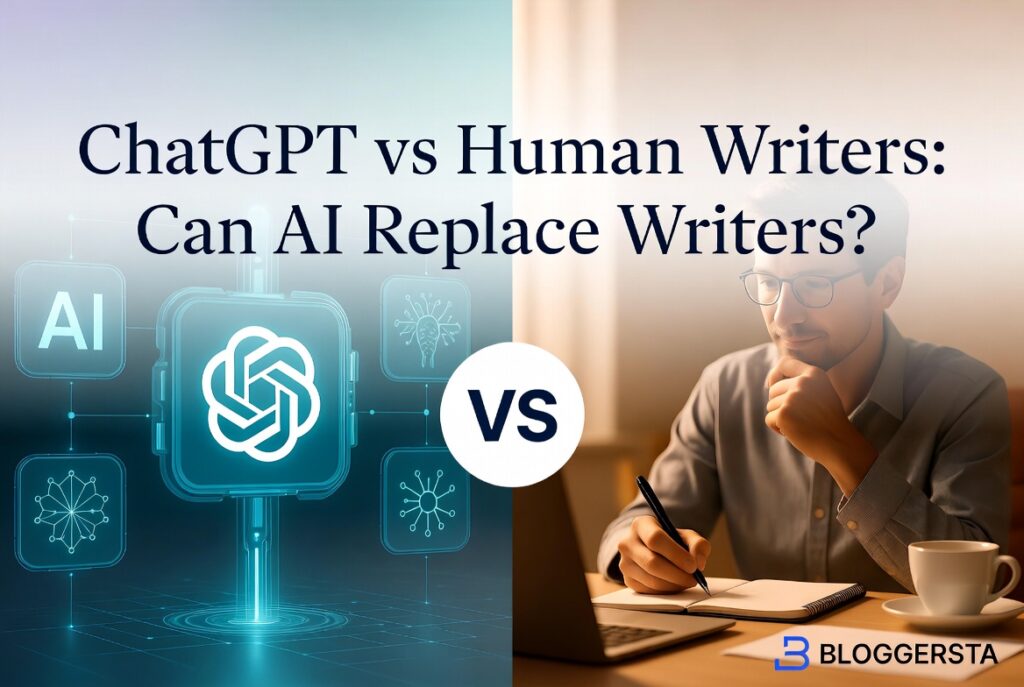
ChatGPT can draft an article before a human writer finishes their coffee. Yet speed doesn’t automatically create trust or connection. A 2025 study of 380 readers found that AI stories felt less transporting than human stories. So, in the race of ChatGPT vs Human Writers, can ChatGPT truly replace content writers?
Writing involves more than placing correct words in order. Strong content reflects audience knowledge, research, judgment, lived experience, and clear purpose. ChatGPT is like a fast kitchen appliance. It prepares ingredients quickly, but it cannot taste the meal or know the guest. This guide compares speed, creativity, accuracy, SEO, brand voice, cost, and practical workflow.
Quick Answer
ChatGPT cannot fully replace skilled content writers, but it can replace or speed up several routine tasks. AI works well for brainstorming, outlines, summaries, formatting, and rough drafts. Human writers remain stronger at original reporting, emotional connection, factual verification, cultural judgment, and brand strategy. The best results usually come from AI-assisted writing guided by a responsible human editor.
What is the Difference Between ChatGPT Vs Human Writers?
ChatGPT predicts likely words from patterns learned during training. A human content writer draws from observation, interviews, memory, judgment, and first-hand experience. AI can imitate a friendly tone, yet a person understands why that tone suits one audience and irritates another.
ChatGPT generates likely language. Human writers make intentional communication choices.
Still, humans aren’t automatically accurate or original. Quality depends on research, skill, available time, and editorial standards.
Clear instructions can improve AI drafts. Read our beginner’s guide to prompt engineering for practical examples.
ChatGPT Writing vs Human Writing: Quick Comparison
The right choice depends on the assignment. A basic product summary requires different skills from an expert opinion piece.
| Feature | ChatGPT | Human Writers |
| Speed | Produces drafts within seconds | Needs research and revision time |
| Volume | Handles standard content at scale | Produces less within the same period |
| Original insight | Reworks learned patterns | Adds interviews and personal conclusions |
| Accuracy | May create plausible false claims | Can investigate and verify sources |
| Emotion | Imitates emotional wording | Draws from real feelings |
| Brand voice | Follows supplied style rules | Understands deeper brand history |
| Cultural context | May miss local meaning | Recognizes lived social details |
| SEO | Helps with structure and keywords | Connects search intent with strategy |
| Accountability | Cannot own decisions | Can defend editorial choices |
ChatGPT wins on speed, volume, and predictable formatting. Human writers usually win when content requires originality, responsibility, emotional weight, or editorial judgment.
Where ChatGPT Performs Better Than Human Writers
ChatGPT performs best when a task is repetitive, clearly defined, and based on information you already provide. It can quickly support:
- Topic clusters and headline options
- Article outlines and FAQ drafts
- Summaries of supplied documents
- Basic emails and product descriptions
- Grammar checks and sentence cleanup
- Meta titles and descriptions
- Early ideas during writer’s block
Imagine a writer staring at an empty page. They ask ChatGPT for five openings, reject four, combine two, and write a better sixth version. That’s useful assistance.
However, fast output still needs review. OpenAI describes hallucinations as plausible but false statements and confirms that they remain a challenge for language models. Read OpenAI’s explanation of model hallucinations for more detail.
Writers comparing tools can also explore our guide to AI writing tools for bloggers.
Where Human Writers Still Perform Better
Human writers become more valuable when a project needs meaning, evidence, persuasion, or responsibility.
Emotional Connection and Lived Experience
A person can describe grief, ambition, embarrassment, or failure through remembered details. ChatGPT can copy emotional patterns, but it has no childhood, difficult client, private regret, or personal conviction.
That gap matters in founder stories, campaigns, creative writing, and thought leadership. Readers often remember one honest detail more than ten polished paragraphs.
Research and Factual Verification
A skilled writer can interview specialists, test a product, compare primary sources, and question weak claims. ChatGPT may summarize material quickly, yet it cannot guarantee every quotation, citation, or statistic is true.
Deep content research also involves curiosity. A writer may notice that an expert avoided one issue and ask a sharper follow-up question.
Strategy and Brand Voice
Human writers connect an article with audience fears, customer objections, positioning, and business goals. They know when a technically correct paragraph still feels wrong for the brand.
The human advantage isn’t slower typing. It’s judgment, responsibility, and knowing what should remain unsaid.
Can ChatGPT Replace Content Writers in SEO?
ChatGPT can support SEO writing, but it cannot replace the research, experience, and strategic judgment behind competitive content.
AI can group keywords, suggest headings, summarize search intent, draft FAQs, and format metadata. Human input remains stronger for:
- Product testing
- Expert quotations
- Competitor gaps
- Original opinions
- Internal linking decisions
- Conversion strategy
- Final editorial review
Google doesn’t state that AI-assisted content is automatically penalized. Its guidance on generative AI content says AI can help with research and structure. However, publishing many pages without adding reader value may violate scaled-content rules. Google recommends accuracy, quality, relevance, and useful context.
Google’s guidance for AI search follows the same direction. Pages still need clear structure, useful information, and technical accessibility.
The real question isn’t, “Was AI involved?” It is, “Does this page deserve the reader’s time?”
AI-Generated vs Human-Authored Texts

Differences between AI-generated vs human-authored texts may appear in specificity, rhythm, personal perspective, and cultural detail. Weak AI-generated content often shows familiar warning signs:
- Repeated sentence patterns
- Safe but empty conclusions
- Generic examples
- Unsupported factual claims
- Similar paragraph lengths
- Little first-hand detail
- An inconsistent voice
These signs aren’t proof. A rushed human writer may show them, while careful human editing can reshape an AI draft.
The 2025 study found similar ratings for novelty and entertainment, yet readers felt less immersed in ChatGPT stories. That research concerns fiction, not every business article. Still, it shows that surface quality and reader experience aren’t always identical.
Also Read: Perplexity AI vs ChatGPT: Which Is Better for Research?
How to Tell AI vs Human Writing
You usually cannot prove authorship from finished text alone. AI detection tools examine statistical patterns and return probability scores, not guaranteed writing histories.
NIST’s GenAI pilot found that detector results varied across generators and detection systems. Some generators fooled most detectors, while some detectors caught output from nearly all tested generators. A detector score should act as a clue, not a verdict. Read the NIST text-detection study for the full findings.
For a fair review, examine:
- Draft and revision history
- Research notes and source quality
- Personal examples
- Author explanations
- Factual accuracy
- Evidence of interviews or testing
One detector score should never stand alone as proof.
Can Writers Be Replaced by AI?
Some routine assignments may shrink or change, but writers as a whole are unlikely to disappear. AI already produces basic descriptions, formulaic list posts, summaries, announcements, and early drafts.
Human writers remain valuable for:
- Investigative work
- Expert interviews
- Persuasive sales writing
- Thought leadership
- Original storytelling
- Sensitive subjects
- Brand positioning
- Editorial responsibility
AI may eventually produce convincing novels and story collections. Still, language production differs from creating with purpose. A machine doesn’t want to comfort a reader, challenge a belief, record a community, or make sense of loss.
Writing roles will change. Writers may spend more time researching, editing, verifying, directing AI, and protecting brand credibility.
What is AI’s Biggest Weakness in Writing?
AI’s biggest weakness is that fluent language can sound trustworthy when the claim is false, shallow, or disconnected from lived reality.
OpenAI says hallucinations remain a fundamental problem because models can produce plausible statements that aren’t true.
For content work, the main weaknesses include:
- Hallucinated facts
- No lived experience
- Weak source judgment
- Limited accountability
- Cultural mistakes
- Generic interpretation
Broader AI systems also face transparency problems. Users may not understand why a model selected certain evidence or wording.
Smooth writing should never be confused with verified knowledge.
Best Human-and-AI Writing Workflow
A hybrid writing workflow works best when each side handles tasks matching its strengths. The human should lead from planning through publication.
- Set the goal: Define the audience, purpose, opinion, and business outcome.
- Use AI for planning: Generate angles, questions, and outline options.
- Conduct human research: Find primary sources and original details.
- Draft selected sections: Work from approved notes instead of invented claims.
- Rewrite deeply: Add voice, judgment, examples, and emotional detail.
- Verify every claim: Check statistics, quotations, names, and links.
- Approve publication: A person accepts responsibility for quality.
Human Direction + AI Speed + Human Judgment = Stronger Content
Learn the basics in our step-by-step ChatGPT guide. You can also read What is an AI Agent? to see how writing tools may take more active roles.
FAQs
Can Writers Be Replaced by AI?
AI can replace some routine tasks, but it cannot fully replace writers who provide research, experience, judgment, original reporting, and emotional meaning. Roles will change, with greater focus on strategy, verification, editing, and responsible AI use.
How to Tell AI vs Human Writing?
Review sources, drafts, notes, revision history, and first-hand details. AI detectors can provide probability scores, but false positives mean those scores should never serve as final proof.
What is AI’s Biggest Weakness?
AI can produce convincing language without guaranteed truth, experience, or accountability. Other concerns include limited transparency, bias, cultural mistakes, and weak source judgment.
Is ChatGPT Better Than a Human Writer?
ChatGPT is better at speed, volume, formatting, and rapid idea generation. A skilled writer is better at reporting, cultural judgment, emotional connection, source verification, and strategy. The right choice depends on the task.
Does Google Prefer Human-Written Content?
Google focuses on helpfulness, accuracy, originality, relevance, and reader value rather than a human-versus-AI label. AI-assisted content can perform well when it adds value. Scaled, low-effort pages may violate Google’s spam policies.
Also Read: Gemini vs ChatGPT vs Claude: Which AI Is Actually Best?
Final Thoughts
The ChatGPT vs Human Writers debate does not need a single winner. ChatGPT brings speed, structure, formatting, and quick idea support. Human writers bring purpose, judgment, originality, evidence, and accountability. The strongest process keeps a person in charge from planning through publication.
AI can prepare a rough route, but human insight decides where the article should go. Take one recent draft and ask ChatGPT for another outline. Compare both versions carefully. Keep useful ideas, reject generic ones, verify every claim, and let real experience shape the final story. Reader trust is always worth more than faster publishing alone.