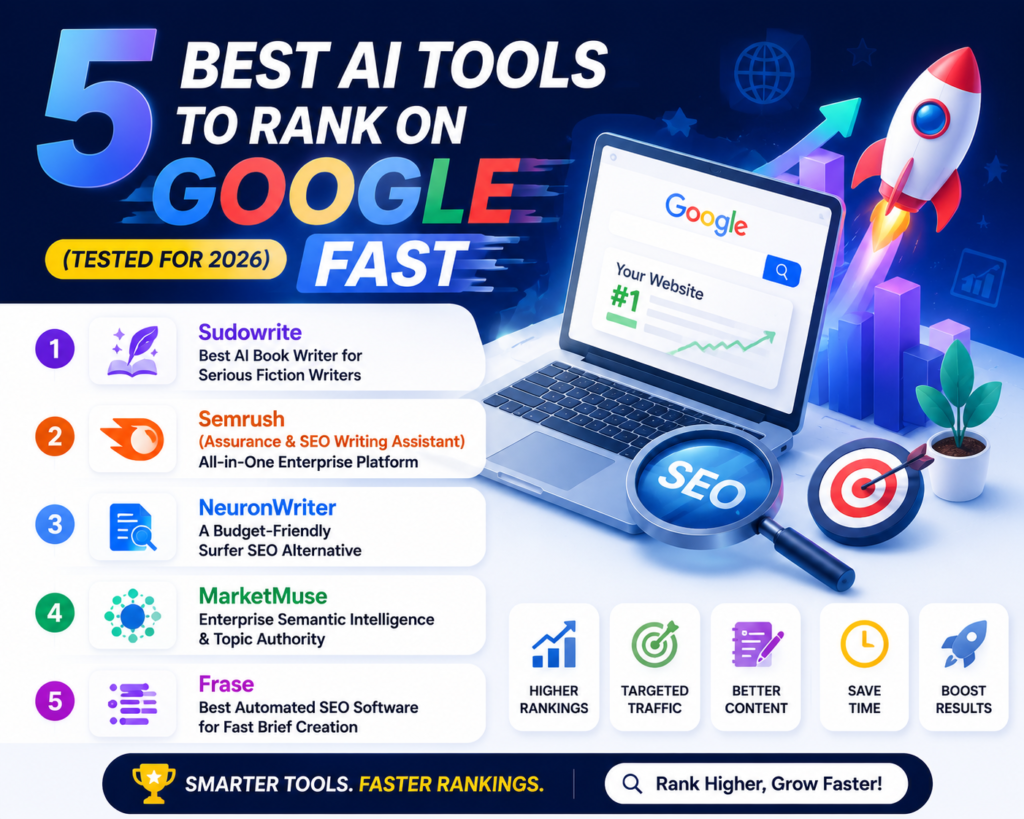
The way websites rank on Google is changing quickly, and many USA businesses are struggling to keep up. With Google SGE, AI-generated search answers, and platforms like Perplexity reshaping search behaviour, traditional SEO methods are no longer enough on their own. That’s why more marketers, bloggers, and agencies are now turning to the 5 Best AI SEO Tools to improve content optimization, entity analysis, semantic relevance, and real-time SERP tracking without wasting hours on manual work.
Modern AI SEO tools are designed to speed up workflows while helping websites stay competitive in search results. In this guide, we tested the 5 Best AI SEO Tools based on ranking accuracy, workflow speed, ease of use, adaptability to Google updates, and overall value for money.
- Tested for ranking performance and optimization accuracy
- Compared for usability, speed, and automation features
- Reviewed based on pricing, AI capabilities, and SEO workflow efficiency
Can AI Do SEO? Shifting from Manual Optimization to Automated Workflows
Yes, AI can absolutely do much of SEO for you today. Automated AI tools can complete in minutes what used to take hours of manual keyword research, site audits, and content review. AI is not going to replace SEO experts; rather, it will fill out the most repetitive portions of SEO practices like keyword analysis, technical checks, content optimization, and data processing, allowing marketers to spend more time on strategy and content quality.
The biggest shift is that SEO workflows are now faster and far more data-driven. Tasks that once required hours of manual effort — like trend detection, technical issue identification, and content optimization — are now handled in real time by AI-powered platforms.
| SEO Task | Traditional SEO | AI-Powered SEO |
| Keyword Research | Manual research and intent guessing | Fast semantic clustering and intent analysis |
| Technical Audits | Checking pages one by one | Automated issue detection and prioritization |
| Content Optimization | Manual keyword placement and editing | Real-time readability and entity analysis |
| Schema Markup | Writing code manually | Automatic schema generation and validation |
Read the full guide on how to build your first AI chatbot
Quick Comparison of the Best AI SEO Tools in 2026
AI top-tier SEO tools 2026 do much more than just track keywords. Modern platforms then facilitate content optimization, provide AI search visibility, automate site improvement recommendations, and even track how often they get mentioned in tools such as ChatGPT and Google AI Overviews.
Use this table to quickly identify which platform best fits your budget, team size, and primary SEO goal before diving into the full reviews below
| Platform | Best For | Standout AI Feature | Starting Price |
| Semrush | Complete SEO management for teams | AI-powered traffic and error tracking | Around $130/month |
| Surfer SEO | Real-time content optimization | NLP scoring in real-time & keyword recommendations | Around $89/month |
| Search Atlas | Automated technical SEO fixes | OTTO SEO automation engine | Around $59/month |
| Frase | Content briefs and topic research | AI-driven question and SERP analysis | Around $15/month |
| Wellows | Tracking AI search visibility | AI citation and sentiment monitoring | Around $29/month |
| Alli AI | Large-scale SEO automation | Bulk optimization and split testing | Around $299/month |
Review of the 5 Best AI SEO Tools for Content Optimization & Higher Rankings
Finding the right AI SEO tool is no longer just about doing keyword tracking. Today’s SEO professionals use these platforms for content planning, semantic optimization, technical auditing, and search intent analysis — all to improve rankings faster and with less manual effort.
We analysed 5 of the top AI SEO tools, based on real-world performance, automation features, optimization precision, and overall value for bloggers, agencies, and SEO teams.
1. Surfer SEO – The Gold Standard for On-Page Content Optimization
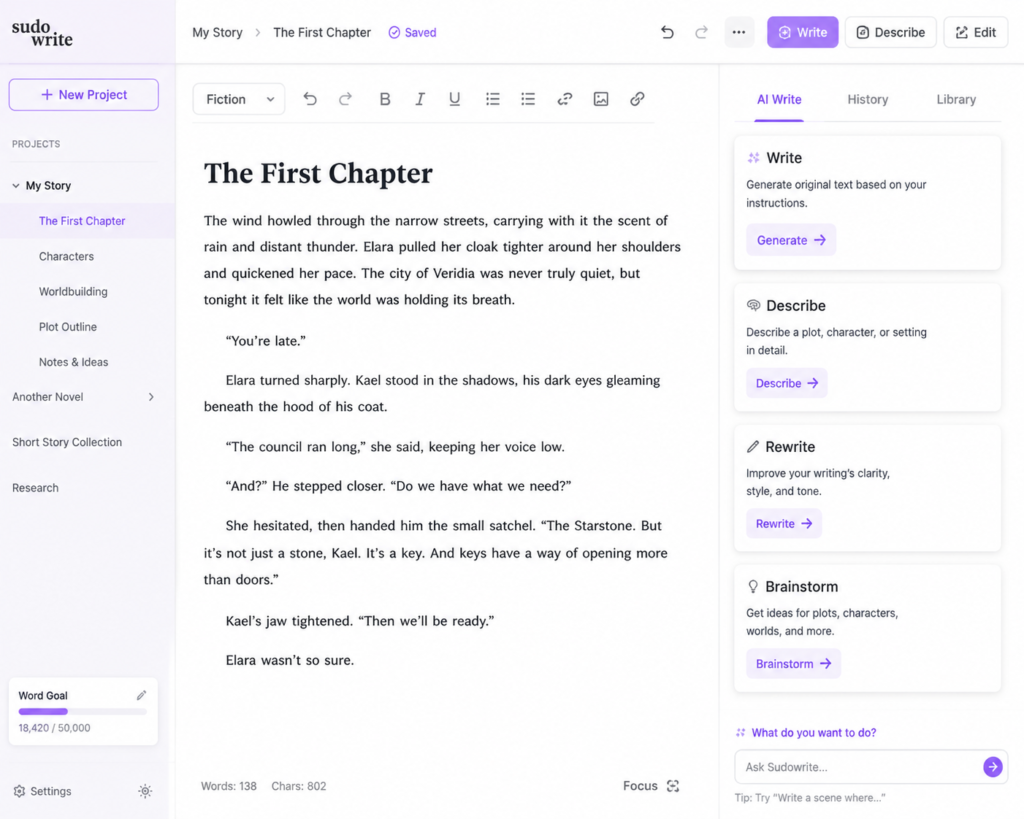
Surfer SEO has established itself as one of the most reliable AI SEO tools for content optimization, largely due to its strong focus on real-time SERP analysis. Rather than offering generic keyword recommendations, it analyzes live search results and generates semantic content suggestions based on what is currently ranking. Writers can naturally include NLP terms, entities, and topical signals directly within the editor as they write.
It comes with a workflow tailor-made for content teams who would love some SEO guidance as they write. Optimizing content for long-form articles is exponentially faster as the editor updates recommendations in real-time.
- Standout Feature: Content Score in real-time that updates as you write
- Best Used For: Long-form informational blog posts and SEO articles
- Pricing: Plans start from approximately $89/month
Technical Checklist
- NLP keyword integration
- Real-time SERP analysis
- Content scoring system
- Heading and structure optimization
- Google Docs and WordPress integrations
2. Semrush (Assurance & SEO Writing Assistant) – All-in-One Enterprise Platform
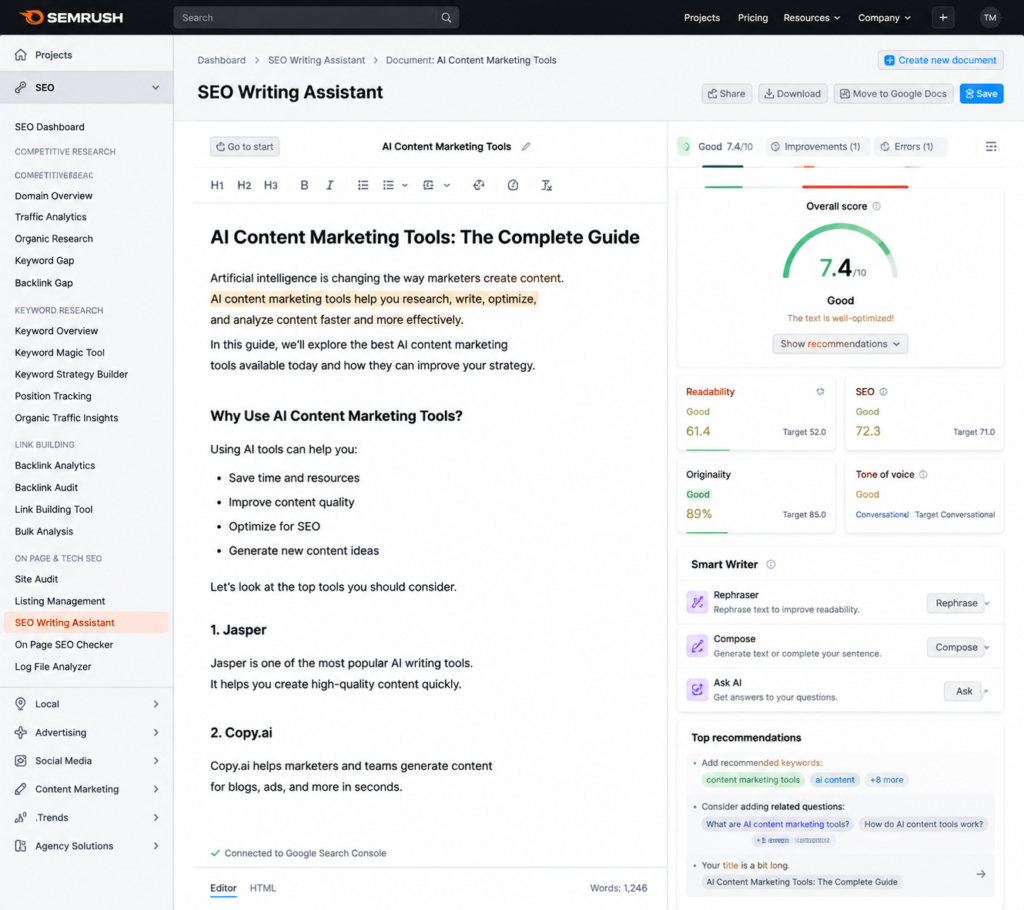
Semrush is not only a keyword research tool. An all-in-one platform that combines Technical SEO, Competitor Analysis, Backlink Tracking, Content Optimization, and Site Recommendations, automated. Due to its large keyword database and ability to analyze competitive intent, many agencies use it as their primary SEO operating system.
With it, you get AI-powered recommendations to help identify traffic losses, technical errors, backlink gaps, and content opportunities without needing 10 different tools.
- Standout Feature: AI-powered backlink gap analysis with automated outreach recommendations.
- Best Used For: Agency-level SEO management and multi-site workflows
- Pricing: Plans start from approximately $130/month
3. NeuronWriter – A Budget-Friendly Surfer SEO Alternative
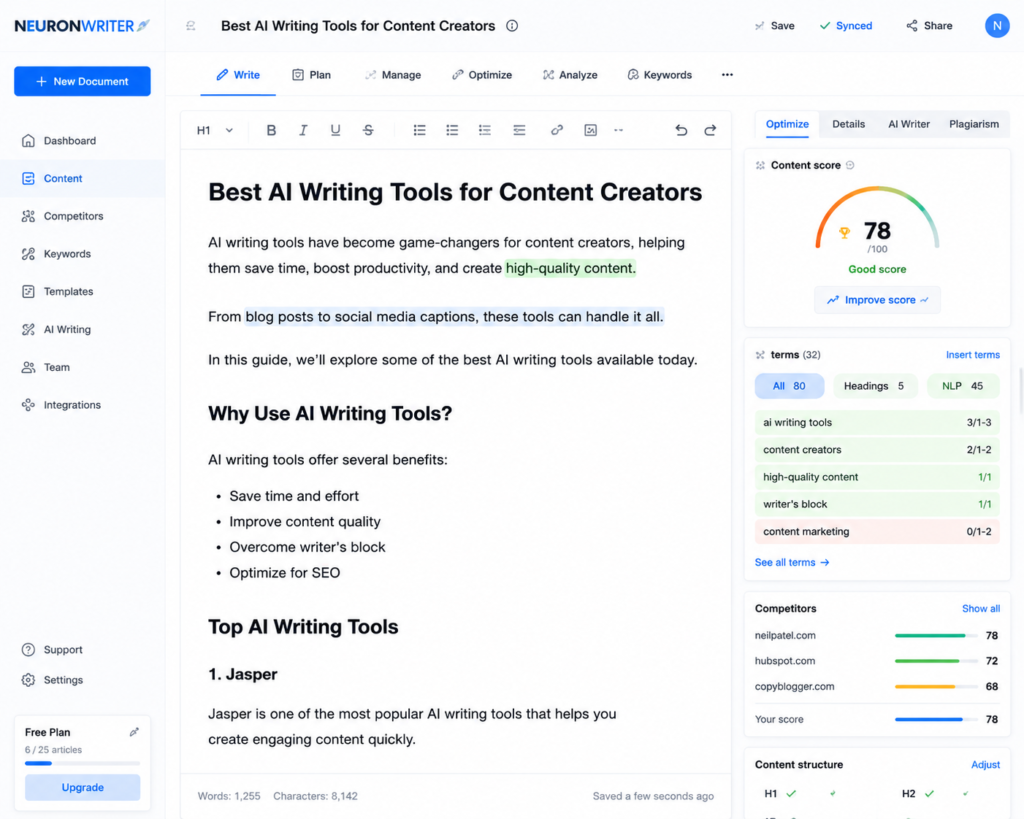
NeuronWriter has gained strong popularity as a budget-friendly alternative to Surfer SEO, particularly among bloggers and small businesses that need effective content optimization without the enterprise price tag. Provides content scoring, keyword recommendations using NLP, and AI writing assistance without the enterprise SEO platform price tag.
Additionally, the standout feature is the recommendation of internal links and content structure improvements, based on Google Search Console data, to enhance topical relevance across a site.
| Pros | Cons |
| Lower pricing compared to Surfer SEO | Smaller keyword database |
| Useful NLP optimization features | UI feels less polished |
| Internal linking recommendations | Fewer enterprise integrations |
| Good for bloggers and niche sites | Limited advanced automation |
4. MarketMuse – Enterprise Semantic Intelligence & Topic Authority
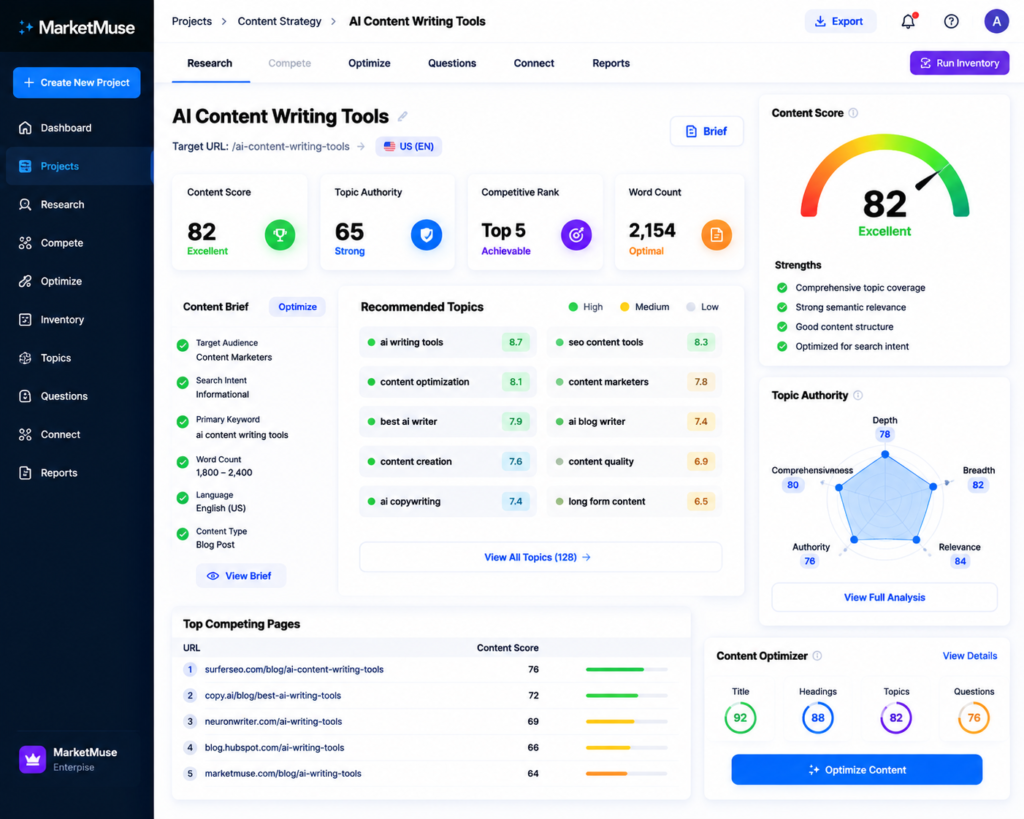
MarketMuse focuses on topical authority and semantic depth rather than chasing keyword density alone. Rather than chasing a certain number of words, it analyzes whole sites for topic coverage and finds weak content gaps that need to be filled in.
This makes it ideal for larger publishers and content-heavy websites trying to build authority in competitive niches.
How to Find Low-Competition Content Gaps with MarketMuse
- Scan your current website content inventory
- Identify weak topical coverage areas
- Compare authority scores against competitors
- Create themed clusters of content around gaps
- Focus on the lowest competition niches to get a ranking quickly
5. Frase – Best Automated SEO Software for Fast Brief Creation
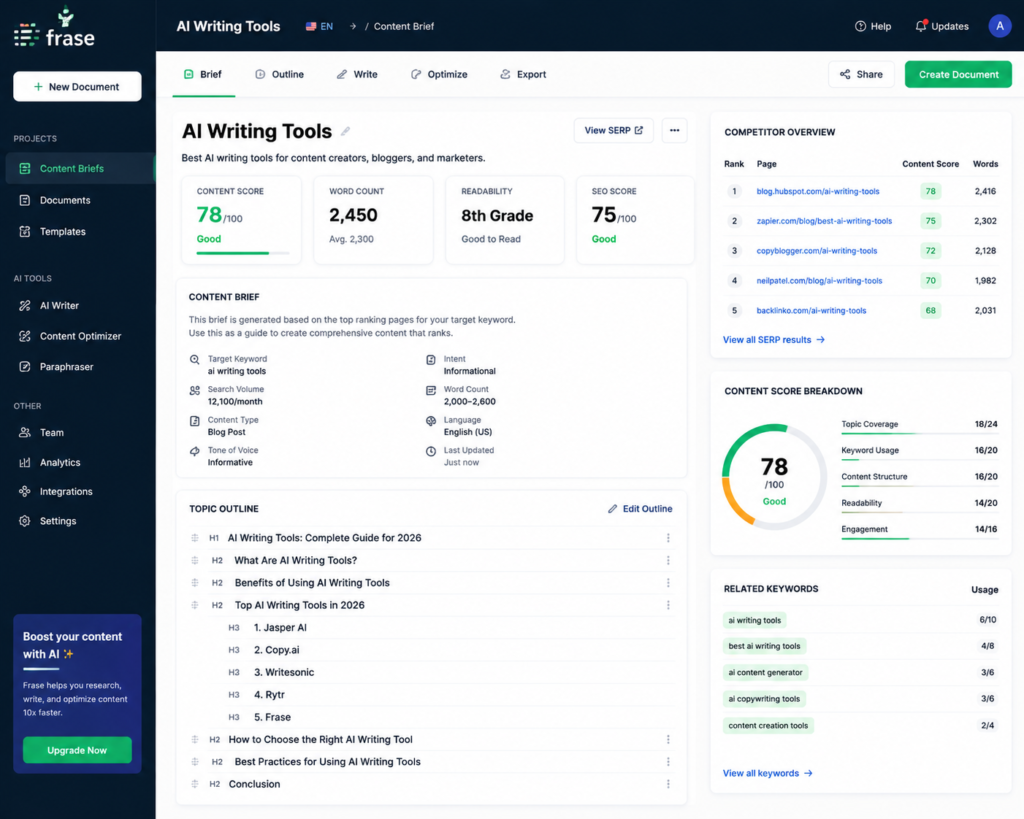
Frase is built for speed. Pulling live Serp data directly into the workflow significantly helps content managers quickly produce outlines, SEO briefs, and topic research documents. There is a tool that pulls People Also Ask questions, Reddit threads, and Quora discussions to connect writers with search intent driven by actual humans.
This is especially helpful for teams that manage many freelance writers or have massive publishing schedules.
- Standout Feature: Pulls live SERP data, People Also Ask questions, and forum discussions directly into content briefs.
- Best Used For: Content teams and agencies managing high-volume publishing schedules.
Strategic Buying Guide: Uncovering the Best AI for Keyword Research
Choosing the best AI SEO tool for keyword research is not just about popularity, but about how well the platform meets your workflow and data needs. Advanced applications emphasize real-time insights, no-code tools for integration, and inexpensive operation through large content pipelines.
- Prioritize Real-Time Data Access: Look for tools that use live web crawling and real-time SERP signals rather than relying solely on historical keyword databases. This ensures that your strategy is aligned with current ranking behavior, as opposed to outdated trends.
- Check Platform Integration: Make sure the tool integrates smoothly with your content management system — whether that is WordPress, Webflow, or Google Docs. Smooth integration to save you time and decrease workflow friction when publishing content at scale.
- Compare Credit and Usage Costs: Many AI platforms offer monitoring but the keyword research, content generation, and optimizing feature charges different prices. Understand how credits are consumed before committing, so you do not end up paying significantly more during periods of heavy SEO updates or large-scale content production.
Read full guide: 7 Best AI Writing Tools for Bloggers (Tried & Tested)
FAQs
1. Can AI do SEO?
Yes, AI can handle most SEO tasks like keyword research, content optimization, and competitor analysis. It speeds up the process but still works best when guided by human strategy.
2. What is “Topical Authority”?
Topical authority means covering a topic deeply and consistently on your website. When you publish related, high-quality content around one subject, search engines start seeing your site as a trusted source, which can improve rankings.
3. Are there free AI SEO tools available?
Yes, you can use Google Keyword Planner and free versions of SEO and AI writing tools to gather some keyword ideas, and do some basic optimization.
4. What is Generative Engine Optimization (GEO)?
GEO means optimizing your content to show up in AI-driven responses as the answers for Google SGE or ChatGPT summaries, rather than just competing in SERPs。
5. What is the best AI tool for SEO content?
It depends on your needs. Surfer SEO is great for on-page optimization, Semrush is helpful with full SEO research, and Writesonic is more suited to quick content creation.
Conclusion: Embracing the Future of Search with AI SEO Tools
Search is evolving quickly as Google moves toward more advanced, AI-driven systems that rely less on traditional keyword-based ranking and more on live data and machine learning. Because of this shift, manual SEO alone is no longer enough to stay ahead of competitors.
Using the right AI SEO tools helps improve content optimization and visibility, making it easier for your website to appear in Google search results as well as AI-generated answers. It also saves time while aligning your content with modern ranking systems.
Start with a single tool today — even a budget-friendly option like NeuronWriter or Frase — and apply it to one existing blog post. Optimize the content, update headings, and improve the semantic structure. Track your rankings over the next 4 to 6 weeks to see the impact. This simple test can teach you more than any comparison guide.
The future of SEO belongs to those who combine smart tools with valuable content. Choose your tool, take action, and start improving your rankings faster.