
AI agents are moving from tech demos into everyday work. Microsoft’s 2025 Work Trend Index found that 46% of leaders use agents to fully automate workstreams or business processes. But what is an AI agent and how does it complete tasks without constant instructions?
Traditional AI usually waits for your next message. An agent receives a goal, chooses steps, uses available tools and checks whether the task worked. Think about travel planning. A chatbot can list flights. An agent can compare routes, check your calendar, prepare an itinerary and pause before booking. This guide explains how agents work, their main types, useful examples, leading platforms and common risks.
Quick Answer
An AI agent is a software system that receives a goal, plans the required steps, uses tools or data and takes actions with limited supervision. Unlike a basic chatbot, it can continue working, check results and adjust its next move. Common examples include scheduling agents, research agents, coding agents and customer-support agents.
What is an AI Agent?
An AI agent is a program that uses artificial intelligence to pursue a goal and complete tasks for a user. It may reason, plan, remember context, use external tools, take actions and review results before deciding what to do next.
Most agents include:
- A clear goal
- An AI model or decision system
- Context and stored state
- Tools, files or connected services
- Rules and permissions
- A feedback loop
A useful formula is:
Goal + Reasoning + Tools + Action + Feedback = AI Agent
The system does not need human-like intelligence. A thermostat can act as a simple rule-based agent. A modern GPT-powered system may plan research, search sources, update a spreadsheet and produce a report. Google Cloud describes agents as AI systems that pursue goals and complete tasks with reasoning, planning, memory and some autonomy.
[Also Read: What is Prompt Engineering? A Beginner’s Guide to Better AI Prompts]
How Does an AI Agent Work?
Most modern agents use a repeating cycle rather than producing one isolated answer. The exact design varies, though the basic movement stays familiar:
- Receive a goal: You describe the outcome you need.
- Gather context: The agent checks instructions, files, memory or live information.
- Plan the work: It divides the goal into smaller steps.
- Use tools: It may browse, run code, update software or call an API.
- Review and repeat: It checks progress and changes its next move.
The cycle looks like this:
Goal → Observe → Plan → Act → Check → Repeat
Suppose you ask an agent to arrange a client meeting. It may review calendars, compare time zones, draft an invitation and wait for approval before sending it. That last pause matters. Purchases, messages, account changes and other high-impact actions should remain under human control.
AI Agent vs Chatbot vs Automation
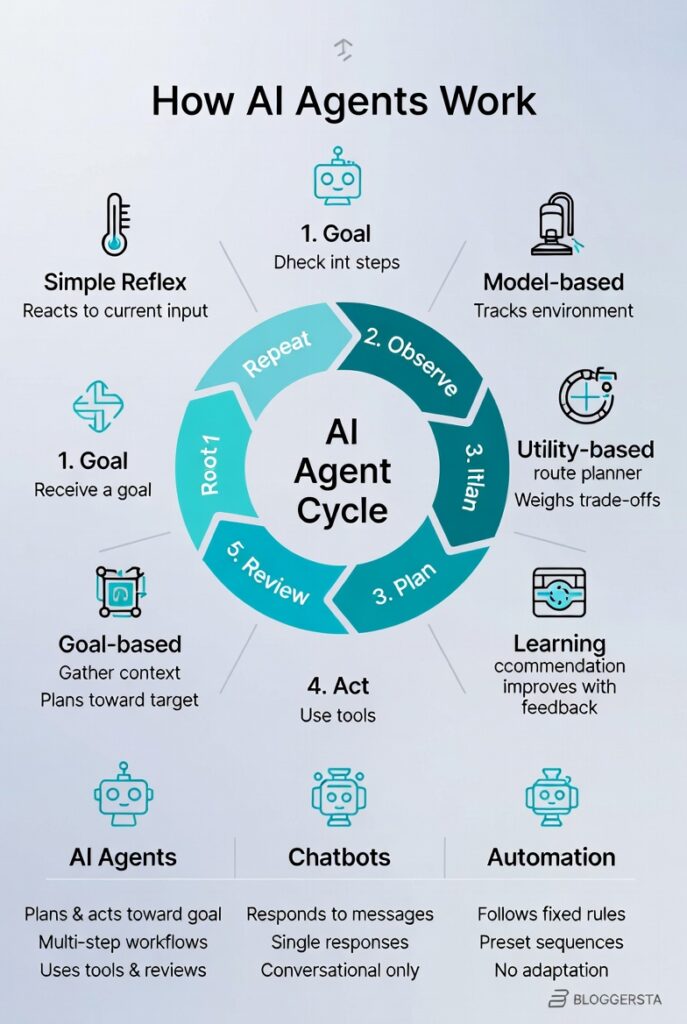
Chatbots, assistants, automations and agents can share features. The clearest difference is how far each system moves after receiving your request.
| System | Main Behavior | Simple Example |
| Chatbot | Responds to each message | Explains a return policy |
| Fixed automation | Follows preset rules | Sends a receipt after purchase |
| AI agent | Plans and acts toward a goal | Reviews a refund request and routes it |
| AI assistant | Helps a user complete work | Drafts an email or meeting summary |
An agent may include a chat window, but conversation is only the front door. The agent earns its name when it continues pursuing an outcome through several connected actions.
Autonomy also exists on a spectrum. Some agents suggest the next step, while others perform approved actions across several tools.
What are the Five Types of AI Agents?
The five traditional agent types differ in memory, planning, decision-making and learning. IBM groups them as simple reflex, model-based reflex, goal-based, utility-based and learning agents.
| Agent Type | Simple Meaning | Beginner-Friendly Example |
| Simple reflex agent | Reacts to current input through fixed rules | A thermostat starts cooling above a set temperature |
| Model-based reflex agent | Tracks parts of its environment | A robot vacuum remembers obstacles |
| Goal-based agent | Plans steps toward a chosen result | A travel system creates an itinerary |
| Utility-based agent | Compares options and trade-offs | A route planner weighs speed, cost and traffic |
| Learning agent | Improves through feedback and experience | A recommendation system learns preferences |
Simple reflex agents follow current conditions. Model-based agents remember parts of their environment. Goal-based agents plan toward a target, while utility-based agents compare acceptable outcomes and trade-offs.
Learning agents adjust through data or feedback. Still, not every machine-learning system is an agent. It must also observe, decide or act toward a defined result.
Today’s LLM agents often mix these patterns. A research agent may pursue a goal, compare sources, remember findings and revise its plan after receiving new information.
Good AI Agent Examples
Good AI agent examples complete connected tasks rather than answering one question and stopping.
- Email and calendar agent: Finds open times, drafts messages and schedules approved meetings.
- Research agent: Searches sources, compares claims and prepares a cited report.
- Customer-support agent: Reads a ticket, checks account details and selects the next action.
- Coding agent: Reviews an issue, edits files, runs tests and reports what changed.
- Data agent: Turns a plain-language question into a database query and formats the results.
- Physical agent: A robot or autonomous vehicle observes its environment and makes decisions.
For example, imagine a shop receiving a damaged-product complaint. A chatbot may explain the return policy. An agent could read the message, check the order, confirm eligibility, prepare a return label and ask a person to approve the refund.
OpenAI says ChatGPT agent can conduct research, work with spreadsheets, prepare presentations, manage planning tasks and interact with connected services under user guidance.
[Internal Link: 5 Best No-Code AI App Builders for Entrepreneurs (2026)]
Is ChatGPT an AI Agent?
Standard ChatGPT mainly works as a conversational AI assistant, but some ChatGPT features operate as AI agents.
An ordinary chat usually follows a request-and-response pattern. You ask a question, receive an answer and decide what happens next.
ChatGPT agent mode behaves differently. It can plan, browse, use a terminal, work through several tools and carry out multi-step tasks through its own virtual computer. Users can interrupt, redirect, pause or take control during the process.
A normal reply does not make every ChatGPT conversation agentic. Tool access alone is not the whole test either. The system becomes agent-like when it keeps pursuing a goal through observation, planning, action and review.
ChatGPT Work also gathers context and acts across connected tools, files and desktop apps to create documents, spreadsheets and slides.
Feature availability checked: July 2026.
[Also Read: How to Use ChatGPT for Beginners: A Step-by-Step Guide (2026)]
AI Agent Platforms, Apps and Free Options
An AI agent platform helps teams build, test, monitor and manage agents. An AI agent app gives everyday users a ready-made experience. The model supplies reasoning, while the surrounding system provides instructions, permissions, memory and tools.
AI Agent OpenAI Options
People searching for AI agent OpenAI often want either ChatGPT agent features or developer tools.
OpenAI’s Agents SDK manages repeated tool calls, specialist handoffs, sessions, traces, guardrails and approval pauses. It can also stop a workflow when the task finishes or requires human permission.
People searching for AI agents GPT usually mean agents powered by GPT models. A GPT model can support planning and tool selection, but the full agent also needs a working loop, permissions, tools and clear stopping rules.
AI Agent Google Options
Google Cloud presents its Gemini Enterprise Agent Platform for business agents. Google also describes agents as systems that can reason, plan, remember, act and coordinate with other agents.
Can You Use an AI Agent Free?
The phrase AI agent free can mean open-source software, trial credits, a limited plan or a small number of included tasks.
Costs may still appear through model calls, hosting, APIs, storage or connected services. Check the current pricing and data terms before linking company files or customer records.
Benefits and Risks of AI Agents
Agents can remove repetitive handoffs and handle longer workflows, but extra independence creates extra risk.
Possible benefits include:
- Completing repeatable multi-step work
- Moving between several connected tools
- Producing faster research or first drafts
- Running scheduled tasks
- Helping teams manage larger workloads
Common risks include:
- Taking the wrong action
- Inventing facts or misreading context
- Receiving wider permissions than needed
- Exposing private information
- Following malicious instructions hidden online
- Continuing with a poorly defined goal
Prompt injection is a serious concern because a harmful webpage can contain instructions designed to mislead an agent. OpenAI uses confirmations and user oversight for consequential actions, but users should still limit access and review important steps.
More independence requires stronger supervision, not less.
FAQs
Is ChatGPT an AI Agent?
ChatGPT is mainly a conversational assistant during ordinary chats. It acts as an AI agent when agentic features let it plan, use tools and complete multi-step work. The answer depends on the mode, permissions and tools available.
What are the Five Types of AI Agents?
The five traditional types are simple reflex, model-based reflex, goal-based, utility-based and learning agents. They differ in memory, planning, decision-making and adaptation. Modern GPT agents may combine traits from several types.
What are Good Examples of AI Agents?
Useful examples include meeting schedulers, research assistants, customer-support systems, coding agents, route planners, autonomous robots and data-retrieval tools. Each receives a goal, considers available information, takes actions and checks progress.
Are AI Agents Free?
Some agent apps and developer tools may provide limited access, trials or credits. However, model calls, hosting, connected services, storage and higher usage limits can cost money. Review the current pricing page before starting a large workflow.
Do AI Agents Need Coding?
Not always. A ready-made AI agent app may work through plain instructions. Building a custom agent with private databases, APIs, internal software or detailed business rules usually requires coding skills or developer support.
[Also Read: Best Jasper AI vs Copy.ai Comparison 2026: Features, Pricing & Which Tool Is Better?]
Final Thoughts
An AI agent works toward a goal by planning steps, using tools, taking actions and reviewing results. That is the clearest answer to what is an AI agent. A chatbot mainly responds, while an agent can continue through a multi-step workflow. Agents may save time, reduce handoffs and support harder tasks. Still, human review matters because models can make mistakes or misuse permissions.
Pick one repeated task from your week and map it as Goal → Plan → Tool → Action → Review.
That simple exercise will reveal whether you need an agent, a chatbot or basic automation before you buy another AI tool.