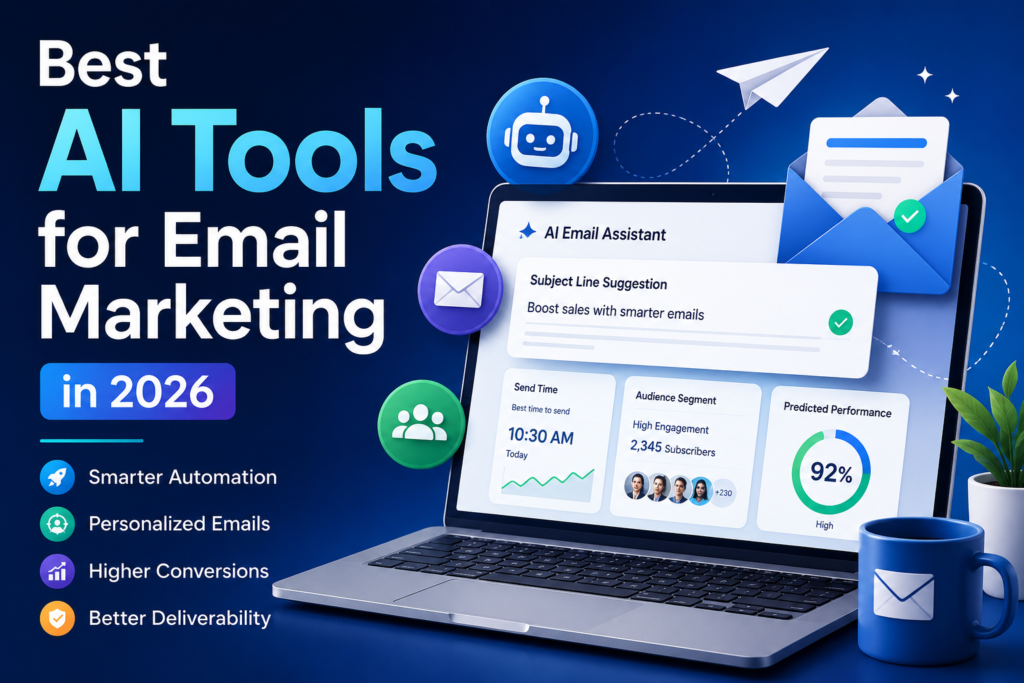
Email marketing still works. It drives sales, brings readers back, and keeps customers warm. Still, doing everything by hand is slow. Writing copy, testing subject lines, building segments, and sending follow-ups can feel like spinning plates. That is where ai tools for email marketing come in. They help teams move faster, send smarter emails, and stop guessing so much.
| Quick Answer: The best ai tools for email marketing include Klaviyo for ecommerce automation, HubSpot for CRM-based email campaigns, Brevo for affordable automation, Mailchimp for beginner-friendly email marketing, ActiveCampaign for advanced customer journeys, and Omnisend for ecommerce email and SMS workflows. The best choice depends on your list size, budget, business model, and automation needs. |
What Are AI Tools for Email Marketing?
AI tools for email marketing are platforms or features that help businesses write emails, build segments, automate campaigns, improve timing, and make messages more relevant. Some are full email platforms. Others focus on content, testing, or optimization. In short, they help you work smarter, not just faster.
Think of them like a sharp kitchen knife. The tool helps a lot, but the cook still matters. Good AI can suggest a subject line, group subscribers by behavior, and spot weak campaigns. Yet human review still matters because brand voice, trust, and timing are not things you should leave on autopilot.
- Writing support: Generates subject lines, body copy, CTAs, and newsletters.
- Personalization: Adapts emails based on customer behavior.
- Segmentation: Groups subscribers by activity, purchase history, or interest.
- Automation: Sends triggered emails based on user actions.
- Deliverability: Helps improve list health and reduce spam risk.
Best AI Tools for Email Marketing at a Glance
If you are short on time, start here. This table covers the best ai marketing tools for email campaigns in one quick view. It shows who each tool fits best, where free access may help, and where the catch usually hides. Because, let’s be honest, there is always a catch.
Some tools are stronger for stores. Others work better for B2B teams or creators. That is why the “best” choice depends on your workflow, not a flashy homepage. A small newsletter does not need the same setup as a fast-growing ecommerce brand.
| Tool | Best For | Free Plan | Best Email Use | Main Caution |
| Klaviyo | Ecommerce email automation | Free plan may be available with limits | Product recommendations, abandoned carts, customer segmentation | Can become expensive as list grows |
| HubSpot | CRM-based email campaigns | Free tools available with limits | B2B nurturing, lead scoring, sales workflows | Advanced features can be costly |
| Brevo | Budget-friendly automation | Free plan available with daily limits | Newsletters, transactional emails, basic automation | Some advanced features need paid plans |
| Mailchimp | Beginner email marketing | Free plan may be available with limits | Simple newsletters, templates, audience management | Automation depth may be limited for advanced users |
| ActiveCampaign | Advanced automation | Trial or paid access may vary | Customer journeys, behavior-based email flows | May feel complex for beginners |
| Omnisend | Ecommerce email and SMS | Free plan may be available with limits | Email plus SMS campaigns for online stores | Best value mainly for ecommerce users |
| Jasper or ChatGPT | Email copywriting | Free or trial access may vary | Subject lines, campaign drafts, CTAs | Needs human editing for brand voice |
n Also Read: How to build your first AI chatbot?
1. Klaviyo — Best AI Tool for Ecommerce Email Marketing
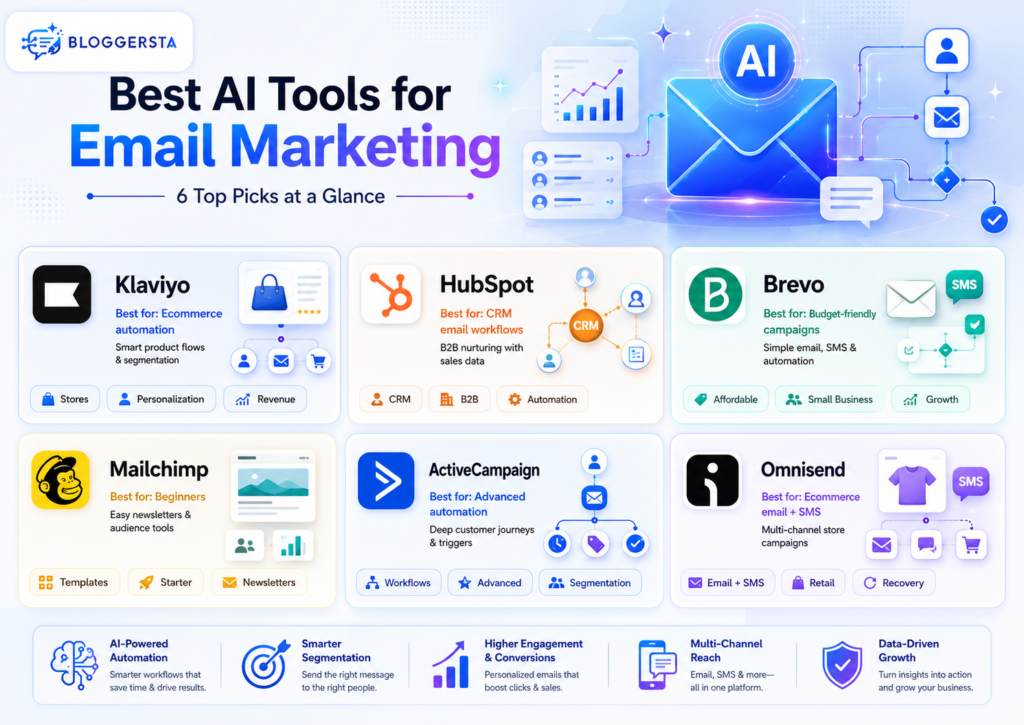
Klaviyo is one of the strongest AI tools for ecommerce email marketing because it connects product data, purchase history, customer actions, and automation in one place. It is built for stores that want smarter flows, not just prettier newsletters. If you sell products online, Klaviyo usually ends up on the shortlist.
It shines in the moments that actually move revenue. Think abandoned carts, browse abandonment, post-purchase emails, and win-back campaigns. Instead of sending the same email to everyone, it helps you send different messages based on what shoppers actually do. That is where AI email personalization starts paying off.
- Best for: Ecommerce tracking and customer segmentation.
- Best user: Shopify, WooCommerce, and online store owners.
- Free option: Free access may be available with limits.
- AI use: Predictive analytics, personalized recommendations, and smarter segments.
- Caution: Pricing can rise as your contact list grows.
2. HubSpot — Best AI Email Marketing Tool for B2B and CRM Workflows
HubSpot is best for businesses that want email tied closely to CRM data, lead scoring, and sales activity. It is not just an email sender. It is more like a central office desk where marketing and sales keep passing notes to each other.
That makes it especially useful for B2B teams. A lead downloads a guide, visits a pricing page, and opens a follow-up email. HubSpot can help connect those dots. If your email strategy depends on relationship-building, not quick product pushes, this setup makes sense.
- Best for: CRM-based email automation.
- Best user: B2B companies, SaaS teams, agencies, and sales teams.
- Free option: Free tools are available, but advanced automation may require paid plans.
- AI use: Email writing, lead insights, automation, and CRM support.
- Caution: Full CRM and automation features can become expensive.
3. Brevo — Best Budget-Friendly AI Tool for Email Marketing
Brevo is a strong pick for small businesses that want useful automation without a painful starting cost. It covers email campaigns, transactional messages, SMS, and core automation. That makes it a practical choice when your list is growing but your budget still has training wheels on.
It is not the fanciest tool in the room, and that is okay. Sometimes simple is exactly what you need. Brevo helps smaller teams run newsletters, welcome flows, and basic customer journeys without drowning in settings. For many brands, that is more than enough early on.
- Best for: Affordable email automation.
- Best user: Small businesses, startups, creators, and local brands.
- Free option: Free plan may be available with sending limits.
- AI use: Campaign writing, automation, segmentation, and send optimization.
- Caution: Advanced users may need higher plans.
4. Mailchimp — Best AI Email Marketing Tool for Beginners
Mailchimp remains a friendly entry point for people who want templates, simple workflows, and audience tools in one familiar dashboard. It is often the first platform people try, and there is a reason for that. It feels approachable, not overwhelming.
For beginners, that matters more than people admit. If a tool is too clunky, it gathers dust. Mailchimp helps bloggers, creators, and small businesses get campaigns out the door without needing a map and compass. It also supports AI tools for newsletters through content suggestions and campaign help.
- Best for: Simple newsletters and beginner campaigns.
- Best user: Bloggers, creators, small businesses, and beginners.
- Free option: Free plan may be available with limits.
- AI use: Email content suggestions, subject lines, segmentation, and campaign help.
- Caution: More advanced automation may require other tools or paid plans.
5. ActiveCampaign — Best for Advanced Email Automation
ActiveCampaign is built for businesses that want detailed customer journeys, behavior-based triggers, and deeper workflow control. If basic autoresponders feel too small for your plans, this is where things get more serious. It is one of the stronger email marketing automation tools for advanced teams.
The upside is power. The downside is complexity. You can build smart sequences based on tags, page visits, actions, and timing. Still, smaller teams may feel like they brought a bulldozer to plant flowers. Great tool, just not always the right size.
- Best for: Advanced customer journeys.
- Best user: Agencies, SaaS businesses, consultants, and growing companies.
- Free option: Trial or plan details may vary.
- AI use: Automation suggestions, segmentation, predictive sending, and campaign optimization.
- Caution: It may be too complex for very small lists.
6. Omnisend — Best AI Email Tool for Ecommerce Email and SMS
Omnisend is built for online stores that want email and SMS working together. That mix matters because shoppers rarely buy in a straight line. They click around, leave, come back, and sometimes need a little nudge. Omnisend is designed for that messy real-life path.
It is especially useful for promotions, cart recovery, reactivation, and product-focused campaigns. If your store needs channel coordination, not just standalone email blasts, it can be a smart fit. In that sense, it is one of the more practical AI email campaign tools for ecommerce brands.
- Best for: Ecommerce email and SMS automation.
- Best user: Online stores and product-based brands.
- Free option: Free plan may be available with limits.
- AI use: Product-focused automation, segmentation, and campaign optimization.
- Caution: It is most useful for ecommerce, not every business type.
Also Read: How To Use An AI Agent To Sort Emails?
Free AI Tools for Email Marketing Worth Trying First
Free ai tools for email marketing are useful when you want to test ideas before paying for more power. They help with campaign writing, simple workflows, and basic list building. That said, free plans usually come with limits on contacts, sends, branding, or advanced automation.
A good free plan is like a sample spoon at an ice cream shop. It tells you what the flavor is, but not whether you want the whole tub. So test first, then upgrade only when the tool clearly saves time or improves results.
- Brevo: Good for testing email campaigns with daily sending limits.
- Mailchimp: Good for beginner newsletters and templates.
- HubSpot: Good for CRM-connected email and lead tracking.
- Omnisend: Good for ecommerce email and SMS testing.
- ChatGPT or Jasper-style tools: Good for AI email subject line generator tasks, CTAs, and draft copy.
- Klaviyo: Good for ecommerce testing if your store needs behavior-based emails.
Caution: Pricing, free limits, and AI features change often, so always check the current plan pages before you commit.
How AI Improves Email Marketing Campaigns
AI improves email marketing by cutting down guesswork. It can analyze behavior, suggest timing, improve copy, and support better targeting. That means fewer spray-and-pray campaigns and more emails that actually fit the person receiving them.
It also helps marketers move faster when the list gets big. Instead of sorting people by hand, AI email segmentation can group readers based on clicks, purchases, inactivity, or interest. Add AI email marketing automation, and you get emails that respond to behavior instead of random calendar dates.
- Better timing: Predicts when subscribers are more likely to open.
- Better targeting: Segments audiences based on behavior.
- Better copy: Suggests subject lines, CTAs, and email body text.
- Better personalization: Recommends content or products by user interest.
- Better list health: Finds inactive or risky contacts.
- Better testing: Helps compare subject lines, offers, and email versions.
How to Choose the Best AI Marketing Tool for Email Campaigns
The best ai marketing tools for email campaigns depend on your business model, list size, budget, and sales process. A local service business does not need the same system as a fast-moving online store. The wrong fit can waste time even if the tool itself is solid.
So start with the problem, not the platform. Need smarter product emails? Look at ecommerce tools. Need simpler newsletters? Keep it light. Need heavy automation? Pick a tool that can grow with you. That is usually the better route than chasing shiny features.
- For ecommerce: Choose Klaviyo or Omnisend.
- For B2B and CRM: Choose HubSpot.
- For budget-friendly growth: Choose Brevo.
- For beginners: Choose Mailchimp.
- For advanced automation: Choose ActiveCampaign.
- For email copywriting: Use ChatGPT, Jasper, or similar writing tools.
- For small lists: Start free before upgrading.
AI Email Marketing Safety and Deliverability Tips
AI should improve email quality, not flood inboxes with bland junk. The trouble starts when people lean too hard on automation and stop reviewing what goes out. That is how weird subject lines, broken fields, and lifeless copy sneak into campaigns.
Good results still need human eyes. That is especially true for AI email deliverability tools, because deliverability is not just software magic. It also depends on list quality, consent, timing, frequency, and message trust.
- Check accuracy: Review claims, offers, prices, and dates.
- Protect deliverability: Remove inactive or invalid contacts.
- Keep brand voice: Edit AI copy before sending.
- Avoid spam triggers: Do not overuse hype, fake urgency, or misleading subject lines.
- Respect consent: Send only to people who opted in.
- Test before sending: Check mobile layout, links, and personalization fields.
Final Recommendation
There is no one-size-fits-all winner in ai tools for email marketing. Klaviyo is best for ecommerce tracking and smart product flows. HubSpot is best for CRM-based growth. Brevo is best for affordable scaling. Mailchimp is best for beginners. ActiveCampaign is best for deep automation. Omnisend is best for ecommerce email plus SMS.
If you also need copy help, tools like ChatGPT or Jasper can support drafts, CTAs, and subject lines. That said, the best AI email marketing software is the one that fixes your biggest bottleneck first. Start with the tool that solves your biggest email problem, whether that is writing, automation, segmentation, deliverability, or ecommerce revenue.
FAQs
What Is the Best AI Tool for Email Marketing Automation?
There is no single winner for every business. Klaviyo is strong for ecommerce tracking, HubSpot fits CRM-led B2B growth, and Brevo is a smart budget-friendly option for growing lists.
How Does AI Actually Improve Email Marketing?
AI helps by analyzing subscriber behavior, improving send timing, suggesting copy, supporting AI email personalization, and grouping users by activity. That means more relevant emails with less manual work.
Can AI Write Entire Email Marketing Campaigns?
Yes, it can write subject lines, body copy, CTAs, and campaign drafts. Still, human editing is needed for accuracy, voice, trust, and emotional tone.
Will Using AI Tools Harm My Email Deliverability?
No, not by default. In fact, AI email deliverability tools can support list cleaning and better send practices. Poor strategy, weak lists, and spammy copy are the real problem.
Are AI Email Marketing Tools Expensive?
Pricing varies by list size, sending volume, and features. Many platforms offer starter or free options, while advanced tools with predictive analytics and deeper automation can cost much more.