
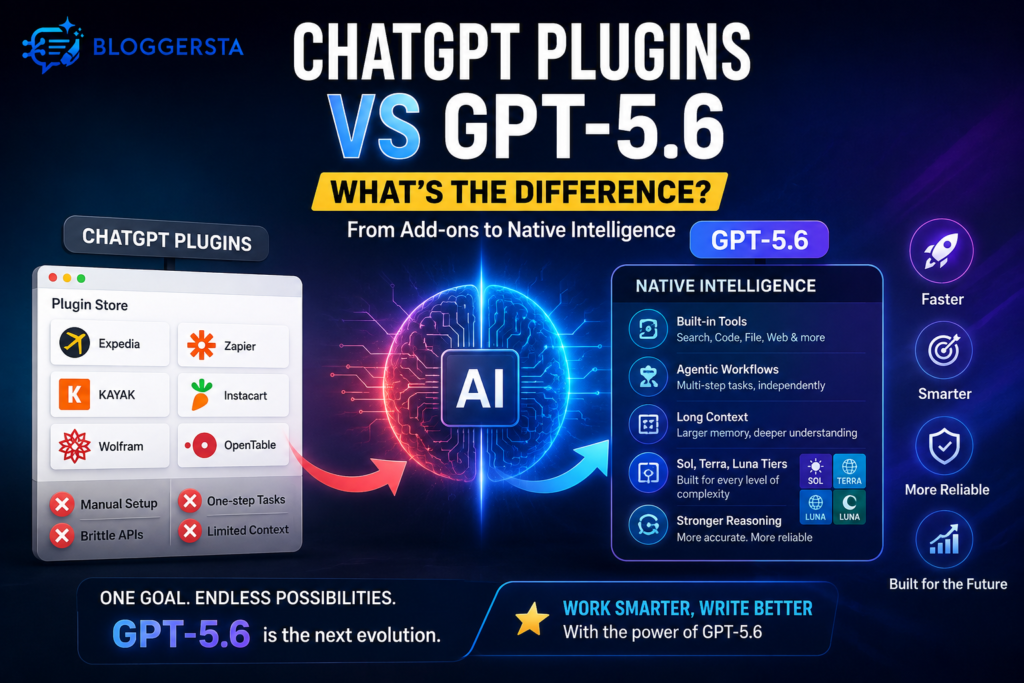
When GPT-5.6 launched, some early testers reported agent workflows running for hours across multiple apps, instead of the old one-click plugin tricks. That is a huge shift from the plugin era. No wonder people keep asking, “ChatGPT plugins vs GPT-5.6 what’s the difference now?”
Quick Answer
ChatGPT plugins were manual add-ons that hooked ChatGPT into external APIs one task at a time. GPT-5.6 is a native, multi-tier model family—Sol, Terra, and Luna—with built-in tools, agent workflows, computer use, and long-context reasoning that make many plugins unnecessary. The old friction was brittle APIs and shallow reasoning, while GPT-5.6 focuses on deeper, longer, more flexible tasks.
Chatgpt Plugins Vs GPT 5.6: What’s The Difference Free?
If you used ChatGPT during the plugin era, you probably remember the dance. You opened the plugin store, installed a few tools, connected your accounts, and prayed the API did not break mid-task. Now the ChatGPT plugins vs GPT 5.6 what’s the difference free debate feels more like old web vs modern apps.
ChatGPT plugins:
- Store-based add-ons from third parties
- Each plugin mapped to a specific API or website
- Good for narrow jobs like booking or single-site lookups
GPT-5.6 models:
- Native Sol, Terra, and Luna tiers
- Built-in tools and advanced function calling
- Designed for long, multi-step workflows instead of one-off calls
So the “free vs paid” angle matters less than the architecture. Even if you access GPT-5.6 through a subscription, the core shift is how the model uses tools by default, not just how many you can install.
From Plugins To GPT-5.6 – Architectural And Functional Shifts
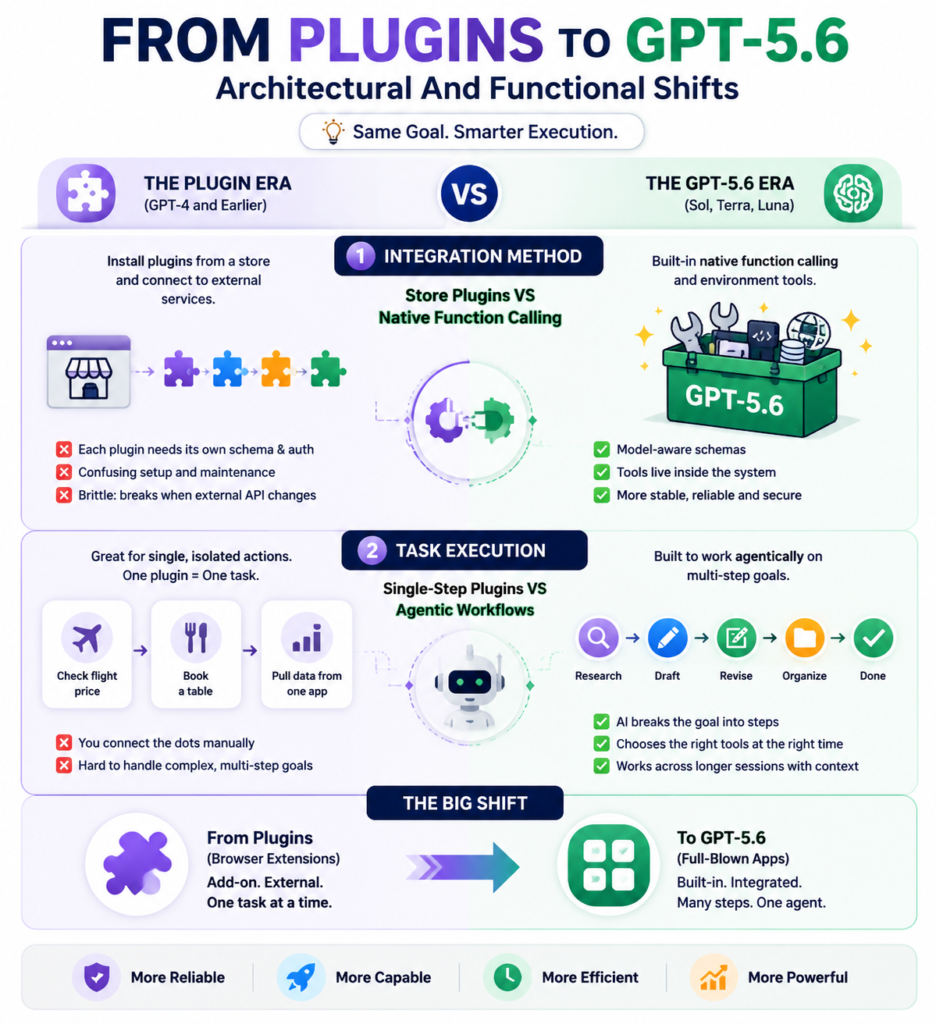
The jump from plugins to GPT-5.6 feels a bit like moving from browser extensions to full-blown apps. Same general idea, totally different execution.
Integration Method – Store Plugins Vs Native Function Calling
In the plugin era, you went to a store, picked a plugin, and wired it to an external service. Every plugin needed its own schema, auth, and often a confusing setup. A single change in that external API could break the whole flow.
GPT-5.6 takes a different route. Instead of relying on loose plugins, it uses native function calling and environment tools described in model-aware schemas. Think of it as giving the model a toolbox that lives inside the system, rather than bolting on external gadgets every time.
Task Execution – Single-Step Plugins Vs Agentic Workflows
Old plugins were really good at simple, isolated actions. For example, “check this flight price,” “book a table,” or “pull data from a single app.” After that, you usually stitched steps together manually in your own head.
GPT-5.6 is built to work agentically. That means it can break a bigger goal into multiple steps, decide which tool to call when, and keep going over longer sessions. OpenAI’s own “what’s new” style updates talk about multi-step flows that research, draft, revise, and organize tasks in one run. Instead of asking five different plugins, you hand one agent a goal and supervise its path.
Also Read: How to Use ChatGPT for Beginners: A Step-by-Step Guide (2026)
Model Intelligence – GPT-4 Era Vs Sol, Terra, And Luna
Plug-ins mostly rode on GPT‑4 era models. They were powerful, but reasoning depth and context length still felt constrained. It was easy to lose track of long projects or detailed instruction chains.
GPT‑5.6 introduces three tiers:
- Sol: Deep reasoning and complex workflows
- Terra: Balanced day-to-day work
- Luna: High-throughput, cost-aware volume
Explainers describe Sol as the “thinking engine,” Terra as the everyday generalist, and Luna as the fast, high-volume worker. Compared with GPT‑5.5, GPT‑5.6 Sol adds better orchestration, larger context, and sturdier tool use instead of just incremental language gains.
GPT-5.6 Sol, Terra, Luna – Which Tier For What?
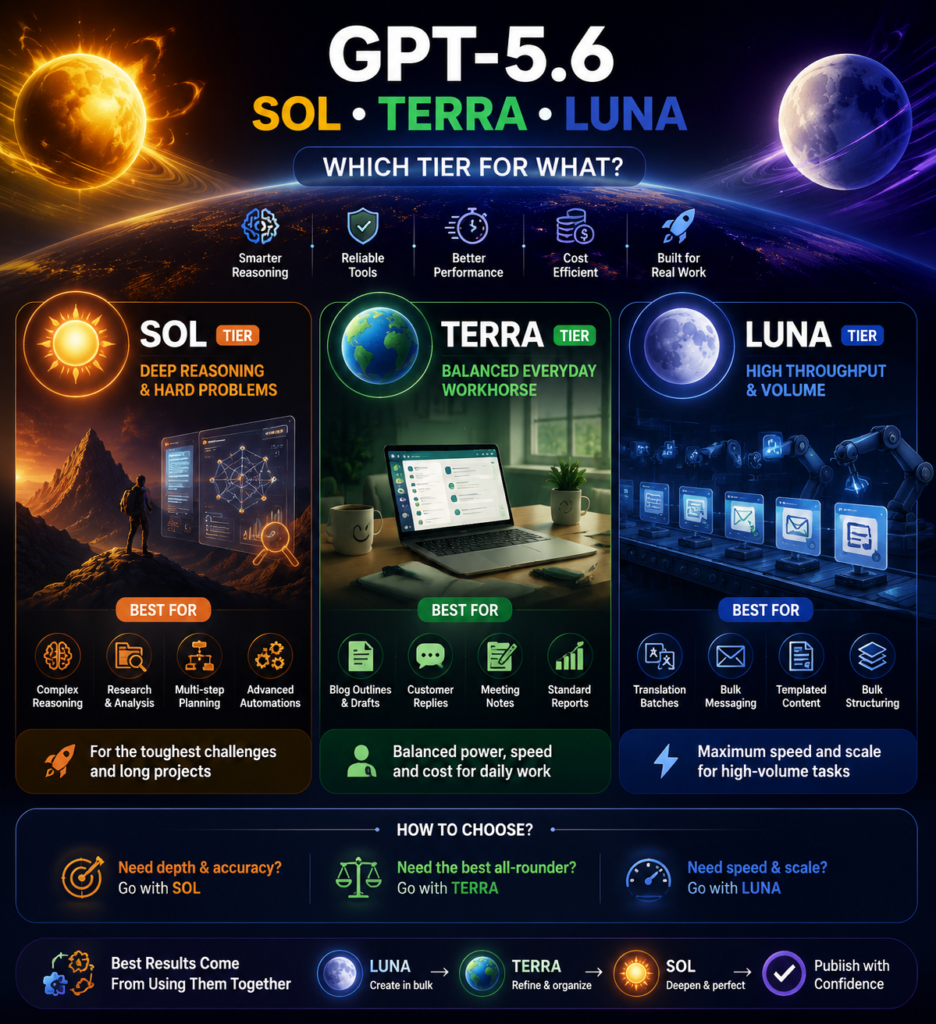
Once you know GPT‑5.6 is a family instead of a single brain, the next question is simple: which member suits your job?
GPT-5.6 Sol – Deep Reasoning And Hard Problems
Sol is the heavy hitter. It is designed for multi-step planning, research-heavy analysis, and complex automations that run through several tools at once. Early GPT‑5.6 comparison write-ups and tests, including GPT‑5.6 Sol vs Fable 5 breakdowns, often use Sol for the toughest reasoning benchmarks and long projects.
If you are exploring advanced AI workflows, the AI learning category on a site like Bloggersta’s AI learning resources can give you more context on how deep-reasoning models change planning, research, and automation.
GPT-5.6 Terra – Balanced Everyday Workhorse
Terra sits in the middle. It balances speed, cost, and intelligence. Many day-to-day tasks—blog outlines, customer replies, meeting notes, standard reports—fit comfortably here. It works like a reliable colleague who might not break records but rarely drops the ball.
Small teams and solo creators may find Terra more sustainable. When you compare tools in best AI tools for small business owners 2026 on Bloggersta, you will probably see a pattern: balanced models win when budgets and workloads pull in opposite directions.
GPT-5.6 Luna – High Throughput And Volume
Luna is tuned for volume. It is built for translation batches, templated messaging, bulk structuring, and other “many similar tasks” scenarios. The tradeoff is obvious. You give up some depth to gain speed and lower cost.
For large content libraries, you might pair Luna for initial structuring and a more capable tier like Sol or Terra for final review. That mix is especially useful if you are already using stacks of AI writing tools for bloggers and need to keep costs predictable.
Also Read: ChatGPT vs Human Writers: Can AI Replace Content Writers?
GPT 5.6 Vs Claude And Fable 5
It is tempting to ask one simple question: “Is GPT‑5.6 better than Claude?” Reality is messier but more interesting.
Independent testers at places like Emerging AI compare GPT 5.6 vs Claude and GPT‑5.6 vs Fable 5 across reasoning tasks, long-form writing, and agent workflows. Some report:
- GPT‑5.6 Sol often wins at step-by-step reasoning and tool orchestration
- Claude sometimes feels more natural in long narrative or reflective writing
- Fable 5 focuses heavily on story and simulation style tasks
In other words, there is no single champion. The best stack might pair GPT‑5.6 for structured agents, Claude for rich long-form content, and a specialized storyteller like Fable 5 when you want pure narrative. That mix matches how bloggers already combine core AI models with best undetectable AI writing tools and humanizer layers for final polish.
Also Read: Gemini vs ChatGPT vs Claude: Which AI Is Actually Best?
Practical Use Cases – When Plugins Still Matter, When GPT-5.6 Wins
Do plugins still matter at all? In some niche cases, yes.
Plugins or plugin-like connectors still help when:
- A very specific SaaS offers an official plugin with features not yet covered by general tools
- You rely on a proprietary API that fits old plugin logic better than new native tools
- Your team already built workflows around certain plugin behaviors
However, GPT‑5.6 tends to win when:
- You want GPT‑5.6 comparison across multiple apps in one workflow
- You need long context windows for research, editing, and multi-step checking
- You value agent autonomy, even if you still supervise every important decision
For bloggers, GPT‑5.6 Terra or Sol can become the central writing engine, supported by external AI writing assistants and on-page optimizers. You still might use specific SEO or analytics tools, but the core writing pipeline shifts toward native agents rather than old plugins.
A quick note on ChatGPT plugins vs GPT 5.6 what’s the difference apk debates: the APK or mobile package you install is less important than the backend model and tools it exposes. One app might still rely on legacy plugin patterns, while another surfaces Sol or Terra with full agent features. Same phone, very different brains.
Also Read: Perplexity AI vs ChatGPT: Which Is Better for Research?
FAQs – GPT-5.6, Versions, And Future Models
Which GPT 5.6 Is Best?
The best GPT‑5.6 tier depends on your task. Sol handles deep reasoning and complex workflows, Terra fits everyday content and support tasks, while Luna is ideal for high-volume, lower-cost jobs where speed matters more than nuance.
Is GPT-5 Different Than ChatGPT?
Yes. GPT‑5.6 refers to the underlying model family, while ChatGPT is the product that wraps those models with tools, memory, and an interface. ChatGPT can use GPT‑5.6 Sol, Terra, or Luna depending on your plan and settings.
Is GPT 5.6 Out?
GPT‑5.6 is available through selected ChatGPT plans and partner integrations at the time of writing, though rollout details and access tiers may shift over time. Always check the latest product notes before planning long-term workflows.
Which Version Of GPT Is Better?
“Better” depends on context. GPT‑5.6 offers stronger reasoning, bigger context, and tighter tool integration than GPT‑4 or GPT‑5.5, but it may cost more. For light, occasional use, earlier versions might still be enough.
Is GPT-5 The Best GPT?
GPT‑5.6 is the most advanced public GPT generation so far in terms of architecture and agents, yet “best” still depends on your budget, latency needs, and risk tolerance. You pick the version that fits your real workload, not just the newest label.
Is There A GPT 6?
Future models are widely expected, but official details about any GPT‑6 are limited or still under wraps. Until there is a confirmed release, it is safer to treat GPT‑5.6 as the flagship and design workflows that can evolve over time.
Final Thoughts
ChatGPT plugins were a clever first draft of integration. GPT‑5.6 is more like a full rewrite of how the model sees tools, time, and tasks. Instead of juggling plugin buttons, you can work with Sol, Terra, or Luna as long-term collaborators.
Pair those models with thoughtful workflows, solid editing, and a stack of trusted tools—like the ones covered in Bloggersta’s guides to AI writing and small business tools—and you get something more powerful than any single plugin ever was.