
Flash used to mean faster but weaker. Google’s July 2026 results challenge that rule: Gemini 3.6 Flash scored 49% on DeepSWE, while Gemini 3.1 Pro reached 12%. With such a wide coding gap, which Gemini model is actually better for your workflow?
The wrong choice can raise token costs, slow user-facing applications, and create extra debugging loops. This Gemini 3.6 Flash vs Gemini 3.1 Pro comparison covers coding, reasoning, context, API pricing, model access, migration, and practical use cases.
Quick Answer
Gemini 3.6 Flash is the better starting point for most developers. It is stable, cheaper, and stronger across Google’s current coding, tool-use, computer-use, and long-context comparisons. Gemini 3.1 Pro Preview still deserves testing for difficult reasoning and custom-tool workflows already proven on Pro. The sections below explain where each model wins.
Gemini 3.6 Flash vs Gemini 3.1 Pro at a Glance
Both models accept multimodal inputs and provide a one-million-token context window. However, their status, pricing, and strongest workloads differ sharply.
| Feature | Gemini 3.6 Flash | Gemini 3.1 Pro |
| Model ID | gemini-3.6-flash | gemini-3.1-pro-preview |
| Release period | July 2026 | February 2026 |
| Status | Stable and generally available | Preview |
| Input context | 1,048,576 tokens | 1,048,576 tokens |
| Maximum output | 65,536 tokens | 65,536 tokens |
| Inputs | Text, image, video, audio, PDF | Text, image, video, audio, PDF |
| Best starting use | Coding, agents, tools, multimodal work | Deep reasoning and validated custom tools |
| Free API tier | Available | Not available |
| Standard input price | $1.50 per million | $2 or $4 per million |
| Standard output price | $7.50 per million | $12 or $18 per million |
Gemini 3.6 Flash became generally available on July 21, 2026. Gemini 3.1 Pro remains a Preview endpoint, which may carry tighter limits and greater change risk than a stable production model.
What is Gemini 3.6 Flash?
Gemini 3.6 Flash is Google’s stable multimodal model for coding, knowledge work, spatial reasoning, and multi-step agent tasks.
Its official model name is gemini-3.6-flash. It supports function calling, code execution, structured outputs, file search, Search grounding, URL context, and computer use in Preview. Developers can access it through Google AI Studio and the Gemini API.
Google designed this Gemini Flash model for rapid loops. Imagine a coding agent inspecting a file, running tests, reading errors, and revising a patch. Flash aims to complete that cycle with fewer unwanted edits and fewer repeated turns.
What is Gemini 3.1 Pro Preview?
Gemini 3.1 Pro Preview is Google’s advanced reasoning model for software engineering, multimodal analysis, and precise multi-step tool use.
The official Gemini 3.1 Pro model name is gemini-3.1-pro-preview. Google also provides gemini-3.1-pro-preview-customtools, an endpoint designed to prioritize bash commands and custom developer tools.
Gemini 3.1 Pro High is not a separate downloadable model. “High” describes its default thinking level. Pro also supports low and medium settings, which can reduce reasoning time and cost for simpler work.
Google has not published an official Gemini 3.1 Pro parameters count. Any website claiming an exact number is estimating or repeating unsupported information.
Gemini 3.6 Flash vs Gemini 3.1 Pro Benchmarks
Google’s direct comparison gives Flash a clear lead across coding, terminal work, machine-learning engineering, computer use, chart reasoning, and long-context retrieval.
| Benchmark | Gemini 3.6 Flash | Gemini 3.1 Pro | What It Measures |
| SWE-Bench Pro | 58.7% | 54.2% | Software engineering |
| DeepSWE v1.1 | 49% | 12% | Long-horizon coding |
| Terminal-Bench 2.1 | 78.0% | 73.8% | Terminal and tool use |
| MLE-Bench | 63.9% | 42.6% | Machine-learning engineering |
| OSWorld-Verified | 83.0% | 76.2% | Computer-use execution |
| CharXiv, no tools | 85.2% | 83.3% | Chart reasoning |
| MRCR at 128K | 91.8% | 84.9% | Long-context retrieval |
| MRCR at 1M | 54.0% | 26.3% | Full-context retrieval |
These figures make Gemini 3.6 Flash the stronger first choice for repository editing, debugging, terminal agents, computer-use systems, and large-document retrieval.
However, benchmark names matter. SWE-Bench Pro and SWE-Bench Verified use different tasks, harnesses, and scoring methods. A result from one version should not be compared directly with another version.
Does Gemini 3.1 Pro Still Win at Reasoning?
Gemini 3.1 Pro can still be valuable when the task requires difficult scientific reasoning, architectural planning, or a custom-tool setup already tested with Pro.
The key word is tested. The Pro label alone does not prove better results. Google’s current direct comparison shows Flash winning many practical execution tasks, while Pro remains positioned as an advanced reasoning model.
A useful division might look like this:
- Flash edits files, calls tools, and completes repeated actions.
- Pro reviews a risky plan or investigates a difficult logic problem.
- A human approves important changes before deployment.
This approach can work, though routing every request between two models adds cost and complexity. The wider idea connects with how a multi-agent system assigns specialist roles.
Context Window and Multimodal Support
Both models accept text, code, images, audio, video, and PDFs. Each supports 1,048,576 input tokens and up to 65,536 output tokens.
Yet context size only tells you how much information fits. It does not show how reliably the model finds a small detail buried inside that information.
Gemini 3.6 Flash scored 91.8% on Google’s 128K MRCR test and 54% at the one-million-token point. Gemini 3.1 Pro reached 84.9% and 26.3%, respectively. Flash therefore looks stronger for large repositories, RAG pipelines, document search, and long conversation histories.
This difference becomes clearer after learning how retrieval-augmented generation finds relevant information before generating an answer.
Wants to know more about RAG? Read our blog What is Retrieval-Augmented Generation (RAG)?
Gemini 3.1 Pro Price vs Gemini 3.6 Flash Price

Gemini 3.6 Flash costs less under standard, batch, and cache-storage pricing.
| Pricing Area | Gemini 3.6 Flash | Gemini 3.1 Pro |
| Standard input, up to 200K | $1.50 per million | $2 per million |
| Standard output, up to 200K | $7.50 per million | $12 per million |
| Standard input, above 200K | $1.50 per million | $4 per million |
| Standard output, above 200K | $7.50 per million | $18 per million |
| Batch input | $0.75 per million | $1 or $2 per million |
| Batch output | $3.75 per million | $6 or $9 per million |
| Cache storage | $1 per million tokens/hour | $4.50 per million tokens/hour |
| Standard free tier | Available | Not available |
Gemini 3.6 Flash keeps flat standard pricing across prompt sizes. Gemini 3.1 Pro API pricing rises once a prompt crosses 200,000 tokens.
Still, token price is only the sticker price.
Real cost = API spend + retries + review time + repair work
A model can look cheap yet waste money through failed tools, unnecessary edits, or repeated prompts. Measure cost per accepted result, not cost per generated token.
Gemini 3.5 Flash vs Gemini 3.1 Pro
The Gemini 3.5 Flash vs Gemini 3.1 Pro comparison already weakened the old belief that Pro always means stronger.
Gemini 3.5 Flash scored 55.1% on SWE-Bench Pro, slightly above Pro’s 54.2%. It also led on Terminal-Bench and several tool-use evaluations. Gemini 3.6 Flash has since pushed those Flash results further.
The Gemini 3.5 Flash context window is one million tokens. Its standard price is $1.50 per million input tokens and $9 per million output tokens. Gemini 3.6 Flash keeps the same input cost while lowering output pricing to $7.50.
Therefore, searches for Gemini 3.5 Flash vs Pro or Gemini 3.1 Pro vs 3.5 Flash coding now point toward a newer conclusion: 3.6 Flash is the more relevant comparison for new development.
Gemini 3.1 Flash-Lite vs Gemini 3.5 Flash
Gemini 3.1 Flash-Lite targets high-volume, low-cost tasks. Gemini 3.5 Flash handles more demanding coding, reasoning, and multimodal work.
Flash-Lite costs $0.25 per million text, image, or video input tokens and $1.50 per million output tokens. Gemini 3.5 Flash costs $1.50 and $9, respectively.
Choose Flash-Lite for classification, translation, extraction, routing, and simple subagent work. Choose 3.5 Flash—or preferably 3.6 Flash—for complex coding and tool-heavy processes.
Free Access, Downloads and Vertex AI
Gemini 3.6 Flash offers limited free input and output access through the Gemini API. Gemini 3.1 Pro free API access is not listed under the standard pricing tier.
There is no normal Gemini 3.1 Pro download or standalone Gemini Flash download. These proprietary models run through Google’s services, including Google AI Studio, the Gemini API, supported Gemini applications, and Vertex AI.
Gemini 3.1 Pro became available in Preview through Vertex AI Model Garden on February 19, 2026.
Pages advertising a Gemini 3.1 Pro app download or Gemini 2.0 Flash download may be misleading. Google shut down Gemini 2.0 Flash API endpoints on June 1, 2026.
Which Gemini Model Should You Choose?
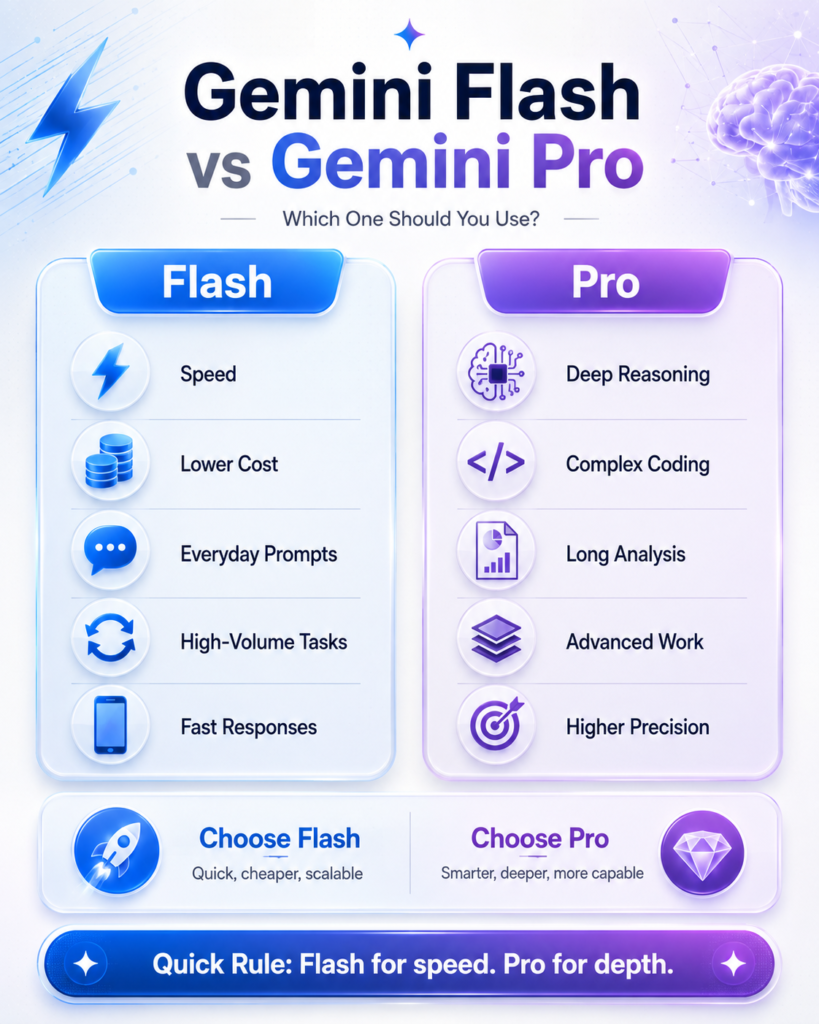
Choose Gemini 3.6 Flash for:
- Coding agents and repository edits
- Debugging and terminal work
- Computer-use workflows
- RAG and large-document retrieval
- Multimodal analysis
- High-volume tool calls
- Stable production applications
- Cost-sensitive API workloads
Its combination of stable status, coding results, tool support, context performance, and lower pricing makes it the safer default.
Choose Gemini 3.1 Pro for:
- Difficult scientific reasoning
- Complex software planning
- High-risk final review
- Proven custom-tool workflows
- Existing systems validated on Pro
- Cases where internal tests show better output
For agent-style development, it also helps to understand how agentic AI works and how an AI agent differs from a chatbot.
Also Read: Gemini vs ChatGPT vs Claude: Which AI Is Actually Best?
How to Test and Migrate Safely
Run both models on one task that can clearly pass or fail. Use identical prompts, files, tools, permissions, and thinking levels. Start each run in a fresh session.
Record:
- Successful completion
- Tool errors
- Total tokens
- Response time
- Unwanted changes
- Manual correction time
- Final API cost
The better model is the one that finishes the real job with less cost, delay, and cleanup.
When migrating, change the model ID to gemini-3.6-flash. Remove deprecated temperature, top_p, and top_k settings. Replace older thinking_budget configurations with thinking_level, remove prefilled model turns, and retest structured outputs and function calls.
Move one workflow at a time. Keep Pro available temporarily until Flash matches your accepted-result rate.
Also Read our latest blog: Jasper AI Review 2026: Is It Still Worth It?
Frequently Asked Questions
Is Gemini 3.5 Flash Better Than 3.1 Pro?
Gemini 3.5 Flash leads 3.1 Pro on several coding and tool-use benchmarks while costing less. Pro may still suit difficult reasoning or established custom-tool workflows. Gemini 3.6 Flash is now the stronger Flash choice for most new projects.
Which One is Better, Gemini Flash or Gemini Pro?
Gemini Flash is usually better for speed, coding loops, agent workflows, and lower costs. Gemini Pro can suit deep reasoning tasks. The correct choice depends on the exact model versions and your measured success criteria.
Is Gemini 3.1 Pro Better Than Gemini 3 Pro?
Yes. Gemini 3.1 Pro replaced the older Gemini 3 Pro Preview. Google shut down the original gemini-3-pro-preview endpoint on March 9, 2026, and directed developers toward 3.1 Pro Preview.
Which is Better, Gemini 2.5 Flash or 3.1 Flash-Lite?
Gemini 3.1 Flash-Lite is designed for newer high-volume tasks such as translation, extraction, and routing. Gemini 2.5 Flash may still suit existing systems, though its retirement is scheduled for October 16, 2026 on Vertex AI.
What is the Price Difference Between Gemini 3.5 Flash and Gemini 3.1 Flash?
The accurate comparison is Gemini 3.5 Flash vs Gemini 3.1 Flash-Lite. The former costs $1.50 for input and $9 for output. Flash-Lite costs $0.25 for text, image, or video input and $1.50 for output.
Is Gemini 3 Flash Better Than Gemini 2.5 Pro?
Gemini 3 Flash performs strongly on coding and agent tasks. Gemini 2.5 Pro may remain suitable for tested legacy workloads. Compare matching benchmarks and real outputs rather than assuming every newer model wins automatically.
Final Verdict
Gemini 3.6 Flash changes the old belief that Flash models trade quality for speed. It is stable, cheaper than Gemini 3.1 Pro, and stronger across Google’s current coding, tool-use, computer-use, and long-context comparisons.
Gemini 3.1 Pro remains useful when difficult reasoning or a proven custom-tool setup justifies its higher cost. Still, do not choose through branding alone. Run both against the same prompts, tools, and success rules.
For most new coding, agent, RAG, and multimodal projects, Gemini 3.6 Flash is the better starting point.