
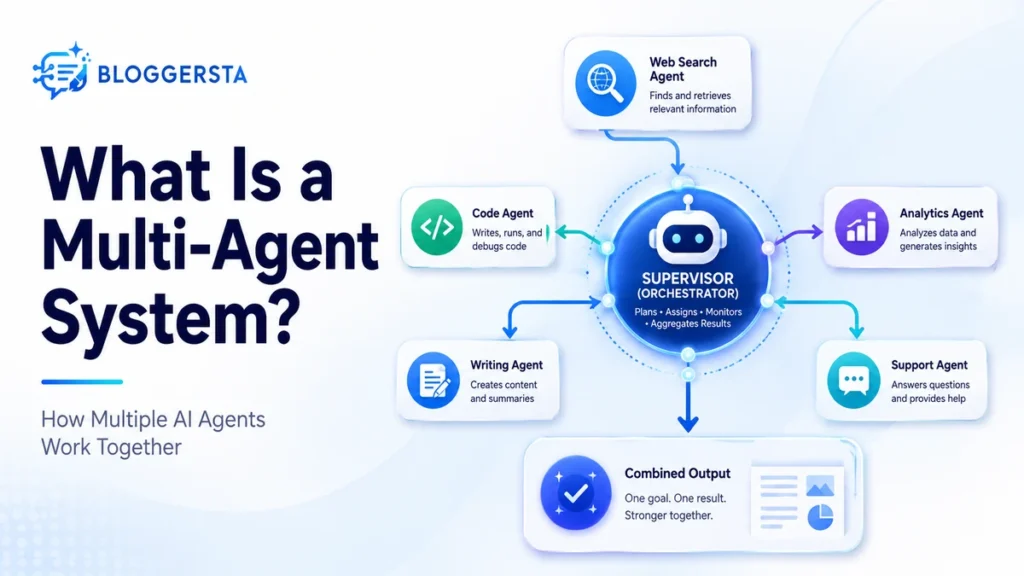
Ask one AI assistant to research a software feature, write the code, test it, review security and prepare documentation. It might manage everything, but its attention can become stretched. What happens when several specialized AI agents divide that work?
A multi-agent system uses two or more independent agents inside one coordinated setup. Each agent can receive a role, instructions, tools and relevant context. They then exchange information and combine their work. Some systems use a central supervisor, while others let agents collaborate more freely. The idea resembles a skilled project team: each specialist handles one responsibility, but everyone contributes toward the same outcome.
| What Does a Multi-Agent System Mean in AI? A multi-agent system is an AI setup where two or more autonomous agents interact to solve a shared problem. Each agent may have its own role, tools, information and instructions. The agents divide tasks, communicate results and coordinate their actions through a shared environment or orchestration layer. Shared Goal + Specialized Agents + Communication + Coordination = Multi-Agent System Google Cloud defines a multi-agent system as a group of autonomous computational agents that interact inside a shared environment. Those agents may collaborate, coordinate, negotiate or compete while pursuing shared or individual goals. |
What is a Multi-Agent System?
A multi-agent system, often shortened to MAS, is a computerized environment containing several agents that can make decisions and interact.
An agent might be:
- An LLM-powered software agent
- A rules-based program
- A robot or drone
- A connected sensor
- A simulation participant
- A digital assistant linked with human users
Modern AI systems often give each agent a narrow responsibility. One may search documentation, another may write code, while a third checks the final output.
Not every system requires a central manager. Some use distributed decision-making, voting, negotiation or peer-to-peer communication. Google identifies agents, a shared environment and interaction mechanisms as the core parts of an MAS.
Before exploring AI teams, it helps to understand what an AI agent is.
How Does a Multi-Agent System Work?
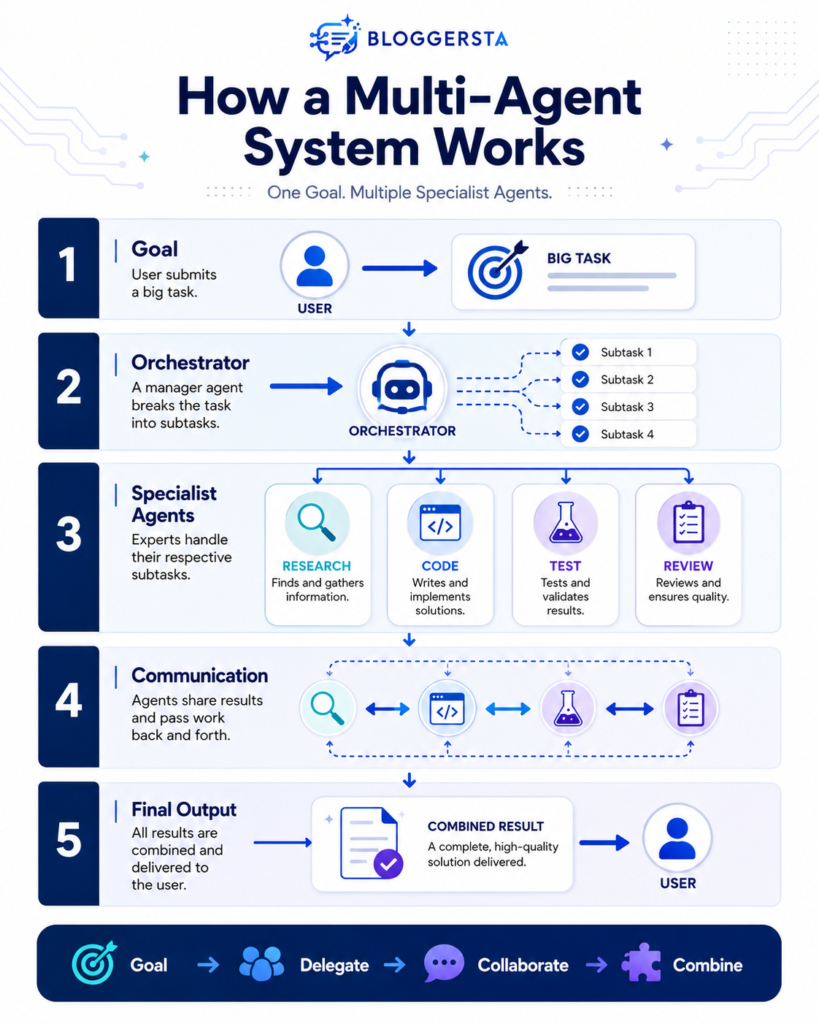
A multi-agent system breaks a large objective into smaller responsibilities, assigns those tasks to suitable agents and coordinates their results.
1. Receive the Goal
The system receives a broad request: Research, build, test and document a new website feature.
2. Divide the Work
A supervisor, router or planning component identifies the required subtasks.
3. Assign Specialized Agents
Each specialist receives a clear job:
- Research agent checks documentation.
- Coding agent writes the feature.
- Testing agent runs tests.
- Reviewer agent checks security and quality.
4. Share Information
Agents communicate through messages, shared memory, files, workflow state or an orchestrator.
5. Work in Sequence or Parallel
Some tasks follow a pipeline. Others run at the same time. For example, research and interface planning may happen in parallel.
6. Combine and Review Results
A supervisor or aggregator reviews the outputs, resolves conflicts and prepares the final result.
Goal → Delegate → Collaborate → Review → Combine
Microsoft’s AutoGen supports teams where several agents work toward one goal. Its documentation also stresses that team behavior must be observable because debugging several interacting agents is harder than debugging one.
Multi-Agent System Architecture
A multi agent system architecture contains more than a collection of chatbots. It needs communication, memory, tool access and controls.
| Component | Main Role |
| Agents | Handle specialized tasks |
| Orchestrator | Routes work and manages progress |
| Communication layer | Passes messages between agents |
| Shared state | Stores context, results and task status |
| Tools | Connect agents with APIs and software |
| Environment | Provides the shared workspace |
| Guardrails | Limit permissions and actions |
| Evaluator | Checks quality and completion |
In a centralized architecture, one supervisor controls task delegation. This setup is easier to monitor.
In a decentralized architecture, agents communicate directly or react to shared events. It can be flexible, although failures become harder to trace.
Google’s reference architecture shows how a coordinator can invoke specialized subagents and use communication protocols to connect agents across different runtimes.
Agents may also use retrieval-augmented generation to access approved knowledge before completing their tasks.
Also Read: AI Agent vs Chatbot: Key Differences with Examples
Types of Multi-Agent Systems
Different types of multi agent systems suit different problems.
Cooperative Systems
Agents share one goal and divide responsibilities. A research, writing and editing team creating one report is a good example.
Competitive Systems
Agents pursue competing goals or resources. These systems appear in auctions, simulations, trading experiments and games.
Supervisor Systems
One manager agent assigns work to subagents and combines their results.
Router-Based Systems
A router examines the request and directs it toward the best specialist.
Sequential Pipelines
Each agent finishes one stage before passing the output forward:
Research → Draft → Review → Publish
Handoff Systems
One agent transfers control to another when the task changes.
Concurrent Systems
Several agents complete independent tasks simultaneously.
LangGraph documents subagents, routers, handoffs and custom workflows as common multi-agent patterns. It also warns that a well-equipped single agent can often handle tasks without extra coordination.
Single-Agent vs Multi-Agent Systems
| Feature | Single Agent | Multi-Agent System |
| Number of agents | One | Two or more |
| Responsibilities | Broad | Divided by role |
| Parallel work | Limited | Often possible |
| Context | One shared context | Separate or shared contexts |
| Cost | Usually lower | Usually higher |
| Development | Simpler | More involved |
| Debugging | Easier | Harder |
| Best fit | Focused tasks | Complex workflows |
A simple rule works well:
Start with one agent. Add more only when specialization or parallel work solves a real problem.
AutoGen recommends beginning with a single agent for straightforward work and moving to a team only when one agent proves insufficient.
Multi Agent Systems Examples
Multi agent systems examples usually involve complex work that benefits from specialist roles.
- Software engineering: planning, coding, testing and security-review agents collaborate.
- Fraud detection: separate agents examine transactions, devices, identities and risk rules.
- Customer support: a router directs requests to billing, returns or technical agents.
- Research: several agents collect evidence while another compares and summarizes it.
- Logistics: warehouse, vehicle and route agents coordinate schedules.
- Cybersecurity: specialist agents inspect alerts and recommend approved responses.
The main applications of multi agent systems include software development, customer service, finance, supply chains, robotics, research and business automation.
Popular Multi-Agent Platforms
| Multi Agent Platform | Main Use |
| LangGraph | Routers, subagents, state and handoffs |
| Microsoft AutoGen | Conversational agent teams |
| Google Agent Development Kit | Agent hierarchies and tools |
| Amazon Bedrock | Supervisor-and-specialist collaboration |
LangGraph models workflows using state, nodes and edges, while AutoGen offers team patterns such as round-robin groups, selector groups, handoffs and swarm-style coordination.
Agentic AI vs Multi-Agent Systems
Agentic AI is the broader idea of AI systems that plan and act toward goals. A multi-agent system is one architecture that uses several interacting agents.
| Agentic AI | Multi-Agent System |
| Can use one agent | Requires two or more agents |
| Focuses on goal-directed action | Focuses on agent interaction |
| May use several tools | Uses several agent roles |
| Communication is optional | Agent communication is central |
A single travel agent that plans a trip is agentic AI. A system with separate flight, hotel, budget and calendar agents is multi-agent.
The broader idea is explained in the guide covering what agentic AI is.
Benefits and Limitations
The main benefits include:
- Narrow, well-defined responsibilities
- Parallel task execution
- Better context separation
- Independent review stages
- Flexible models and tools
- Easier replacement of one specialist
However, more agents also bring greater cost, latency, communication failures, duplicate work and security risks.
More agents create more capability, but also more places where a workflow can fail.
Tracing, tool limits, approval gates, stopping conditions and human review reduce these risks. Google notes that interacting agents may create unpredictable behavior and can be harder to evaluate at scale.
Frequently Asked Questions About Multi-Agent Systems
Is ChatGPT a Multi-Agent System?
ChatGPT is not publicly described as one fixed multi-agent system. OpenAI offers agentic experiences and configurable Workspace Agents, but this does not mean every ChatGPT conversation uses several independent agents.
What is the Definition of a Multi-Agent System?
A multi-agent system is an environment where two or more autonomous agents communicate, coordinate, collaborate or compete while pursuing shared or individual goals.
Is ChatGPT an Agent or LLM?
ChatGPT is a product powered by AI models. Its Chat experience provides conversational assistance, while ChatGPT Work is designed for longer, multi-step work and finished deliverables.
What is Agentic AI vs Multi-Agent?
Agentic AI describes systems that plan and act toward goals. A multi-agent system is a specific architecture where several agents interact. Agentic AI can use one agent, but an MAS requires multiple agents.
Final Thoughts
A multi-agent system divides complex work among several interacting agents. Each agent may handle a specialized role, use different tools and share results through an orchestrator or communication layer. This team-based approach can improve focus, parallel execution and scalability.
Still, more agents increase costs, latency, security concerns and debugging difficulty. Begin with one agent and add specialists only when they solve a clear problem. Define responsibilities carefully, limit access, trace every handoff and require human approval for sensitive actions.
Strong multi-agent design depends on clear coordination, not simply placing more AI agents inside one workflow.