
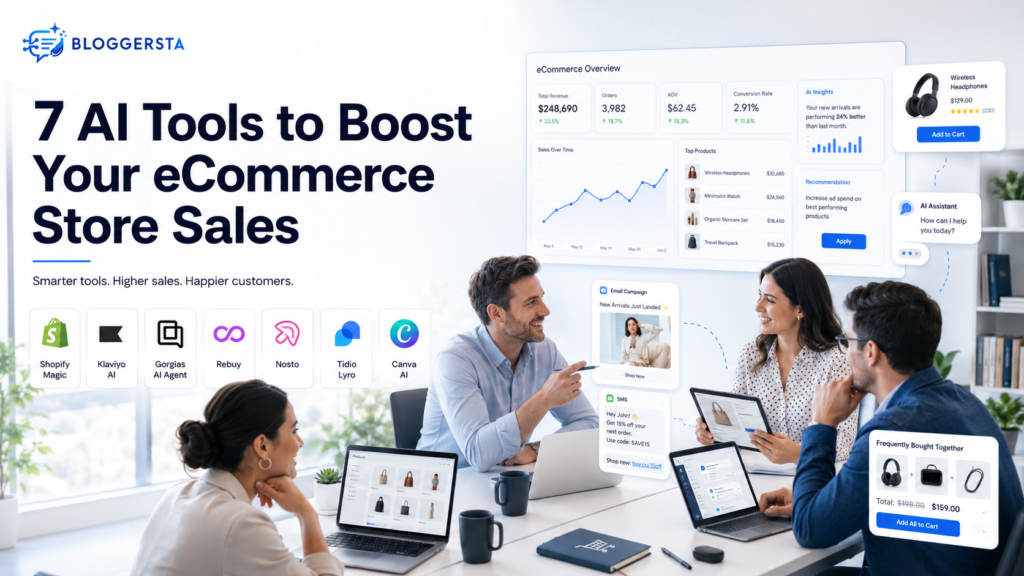
Online shoppers now expect faster help, smarter product suggestions, and fewer dead ends. Salesforce reported that AI and agents influenced $229 billion in global online holiday sales in 2024. So, which AI Tools to boost your eCommerce store sales without adding extra chaos?
Quick Answer
The best AI tools to boost your eCommerce store sales are Shopify Magic, Klaviyo AI, Gorgias AI Agent, Rebuy, Nosto, Tidio Lyro, and Canva AI. These eCommerce AI tools help with product descriptions, email and SMS marketing, chatbot support, product recommendations, site search, ads, abandoned cart recovery, and repeat purchases. Let’s match each tool with the right sales gap.
Why eCommerce Stores Need AI Tools to Boost Your eCommerce Store Sales
Online stores lose money in sneaky places. A weak product page can kill trust. Slow replies can lose ready buyers. Poor site search can make shoppers leave even when the right product sits in your catalog. Then come abandoned carts, random emails, and missed upselling chances.
That’s where AI tools for eCommerce can help. They don’t fix bad products, weak pricing, or unclear offers. However, they can speed up daily work, improve customer experience, and help shoppers find what they want before they bounce.
- Speed: AI can reduce time spent on copy, support, and campaign setup
- Personalization: AI can support personalized shopping across key pages
- Recovery: AI can bring back carts, cold leads, and inactive buyers
7 AI Tools to Boost Your eCommerce Store Sales
The best tool depends on your biggest leak. Maybe your product pages feel flat. Maybe shoppers leave because support replies arrive too late. Or maybe your store gets traffic but loses money through weak checkout conversion.
You don’t need every tool in this list today. Start with the problem closest to revenue. Then pick the tool that removes that friction with the least fuss.
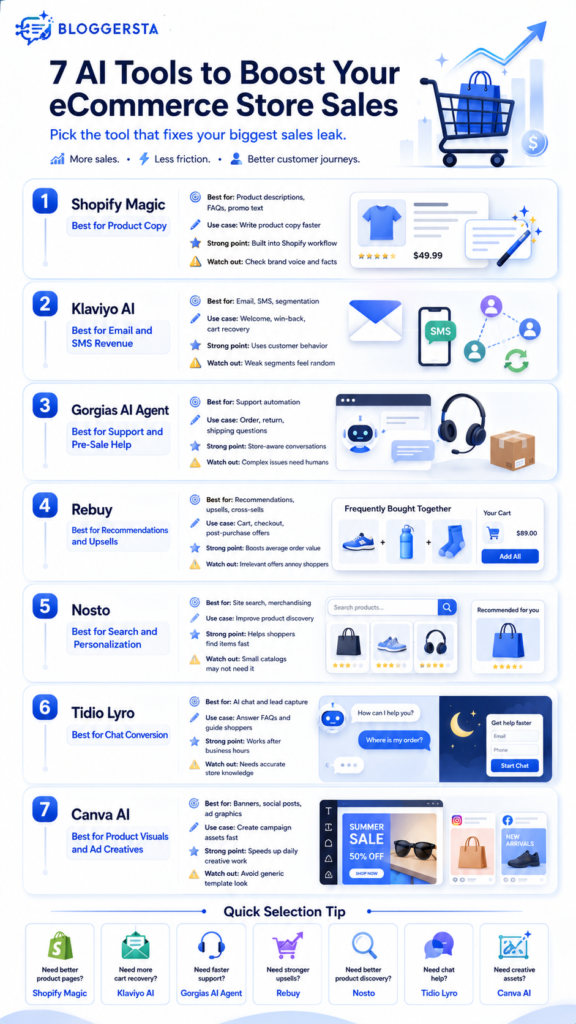
1. Shopify Magic — Best for Product Copy and Store Tasks
Shopify Magic is a strong AI tool to increase your eCommerce store sales for sellers who spend too much time writing product pages, FAQs, emails, and promo text. It helps create cleaner product copy from basic details, which can save time when you manage many SKUs.
For example, a fashion store can turn “black cotton hoodie, oversized fit” into clearer copy with size notes, fabric details, and buying cues. That helps shoppers understand the product faster. For many AI tools for Shopify stores, Shopify Magic is the simplest starting point because it sits inside the selling workflow.
- Best for: Product descriptions, store content, and Shopify tasks
- Use case: Write product copy, FAQs, emails, and promo text faster
- Strong point: Works inside the Shopify store workflow
- Watch out for: AI copy still needs brand voice and fact checks
2. Klaviyo AI — Best for Email and SMS Revenue
Klaviyo AI helps online stores use customer data for email, SMS, audience groups, and lifecycle campaigns. It’s useful for AI email marketing tools because it connects messages with shopper behavior, purchase history, and product interest.
Think of a skincare store. A first-time buyer may need usage tips. A repeat buyer may need refill reminders. Someone who abandoned a cart may need a product-focused nudge. Klaviyo can help manage these flows through customer segmentation, which often makes campaigns feel less random and more timely.
- Best for: Email and SMS marketing, customer segmentation, and repeat purchases
- Use case: Build welcome, win-back, and abandoned cart recovery flows
- Strong point: Uses customer behavior for better timing
- Watch out for: Poor segments can still make emails feel off
3. Gorgias AI Agent — Best for Customer Support and Sales Help
Gorgias AI Agent is built for eCommerce support. It can help answer common questions about orders, returns, shipping, discounts, and products. That matters because many shoppers ask one small question before buying.
Picture someone ready to order shoes. They ask about sizing, but nobody replies for hours. That sale may disappear. With customer support automation, Gorgias can answer many routine questions and keep shoppers moving toward checkout. For stores with rising support volume, this can protect both time and store revenue.
- Best for: Customer support automation and pre-sale help
- Use case: Answer order, return, shipping, and product questions
- Strong point: Connects support conversations with store context
- Watch out for: Complex complaints may still need a human agent
4. Rebuy — Best for Product Recommendations and Upsells
Rebuy helps stores show smarter recommendations, bundles, cart offers, checkout suggestions, and post-purchase deals. It’s one of the stronger AI product recommendation tools for stores that want better cross-selling without making the page feel crowded.
A coffee store gives a simple example. When someone buys beans, Rebuy can suggest filters, mugs, syrups, or subscription refills. Done well, that raises average order value without shouting at the shopper. The trick is relevance. A good offer feels helpful. A bad one feels like a pushy cashier.
- Best for: Product recommendations, upselling, and cross-selling
- Use case: Show cart, checkout, and post-purchase offers
- Strong point: Can increase average order value
- Watch out for: Irrelevant offers can annoy shoppers
Also Read: 5 AI Tools to Automate Your Sales Outreach
5. Nosto — Best for Site Search and Personalization
Nosto helps improve product discovery through search, personalization, testing, and merchandising. It works well for stores with larger catalogs, where shoppers need help finding the right item quickly.
For example, a home décor store may have hundreds of lamps, rugs, and wall pieces. If shoppers search by room, style, color, or product type, Nosto can help guide them toward better results. Better discovery can support conversion rate because fewer visitors hit a dead end and leave.
- Best for: Site search, merchandising, and personalized shopping
- Use case: Improve product discovery across larger catalogs
- Strong point: Helps shoppers find products faster
- Watch out for: Small catalogs may not need advanced search yet
6. Tidio Lyro — Best for Chat Conversion and Lead Capture
Tidio Lyro helps stores answer questions through AI chat. It can support shoppers when your team is offline, which matters because buyers don’t always shop during office hours. Some browse late at night with one thumb and zero patience.
Say a customer asks about sizing at 11 p.m. Lyro can answer from store content or guide them to the right page. For small teams, an AI chatbot for eCommerce can reduce repeat questions and collect leads. It can also support eCommerce automation without hiring a larger support team.
- Best for: AI chat, lead capture, and quick answers
- Use case: Answer FAQs, collect emails, and guide shoppers
- Strong point: Helps stores reply outside working hours
- Watch out for: The bot needs accurate store knowledge
7. Canva AI — Best for Product Visuals and Ad Creatives
Canva AI helps store owners create banners, sale graphics, product collages, email headers, short videos, and social posts. For lean teams, this can be a lifesaver during promo weeks.
Imagine a small jewelry store planning a Mother’s Day campaign. The owner needs a sale banner, Instagram story, email header, and product collage. Canva AI can speed up that work without hiring a designer for every small asset. Among AI marketing tools for eCommerce, it’s practical because visuals affect clicks before shoppers ever reach the product page.
- Best for: Ad creatives, social posts, and promotional graphics
- Use case: Create sale banners, product visuals, and campaign assets
- Strong point: Makes daily creative work faster
- Watch out for: Generic templates can weaken brand identity
Also Read: What are the best AI Tools for Small Business Owners?
Quick Comparison Table of AI Tools to Boost Your eCommerce Store Sales
A quick table of AI tools to boost your eCommerce store sales helps when the tools start blending together. Use it to match each platform with your biggest sales problem, not the loudest feature on the pricing page.
If your product pages are thin, start with Shopify Magic. If carts keep getting abandoned, try Klaviyo. If shoppers ask many questions, Gorgias or Tidio may help more.
| Tool | Best For | Main Sales Use Case | Best Fit |
|---|---|---|---|
| Shopify Magic | Product copy and store tasks | Write product pages and store content | Shopify sellers |
| Klaviyo AI | Email and SMS marketing | Abandoned cart and repeat purchase flows | Growing brands |
| Gorgias AI Agent | Customer support | Answer pre-sale and post-sale questions | Stores with support volume |
| Rebuy | Recommendations and upsells | Increase average order value | Shopify brands |
| Nosto | Search and personalization | Improve product discovery | Larger catalogs |
| Tidio Lyro | Chat and lead capture | Answer questions and collect leads | Small to mid-size stores |
| Canva AI | Creative assets | Make ads, banners, and social posts | Lean marketing teams |
How to Use AI Tools for eCommerce Without Hurting the Shopping Experience
AI can help, but too much automation can feel messy. Too many popups, wrong recommendations, generic emails, or bad chatbot replies can hurt trust. Shoppers want help. They don’t want a digital carnival blocking the checkout button.
Start with one clear problem. Test one tool for two weeks. Review the output, check the data, and watch what happens to sales. Keep humans involved in pricing, claims, complaints, and brand messaging.
- Start small: Fix one sales problem before adding more tools
- Check output: Review product copy, emails, and chatbot replies
- Use real data: Let customer behavior guide offers
- Avoid clutter: Don’t overload pages with popups
- Measure results: Track revenue, cart recovery, AOV, and repeat sales
Final Recommendation
Shopify Magic helps with product copy. Klaviyo AI helps with email and SMS marketing revenue. Gorgias AI Agent and Tidio Lyro help with customer questions. Rebuy and Nosto help with recommendations, checkout conversion, and product discovery. Canva AI helps with creative assets.
Pick one sales leak and test one tool for two weeks. Track store revenue, cart recovery, support response time, average order value, and repeat sales. The best AI tools for online stores help shoppers buy with less friction. That’s the whole game.
Frequently Asked Questions
What is the Best AI Tool for eCommerce Sales?
The best AI tools to increase online sales depends on your biggest sales problem. Shopify Magic helps with product copy. Klaviyo AI supports email revenue and abandoned carts. Gorgias AI Agent helps support teams answer shoppers faster. Rebuy supports upsells and product recommendations. Nosto helps product discovery. For many stores, the smartest choice is the tool that fixes the nearest revenue leak.
Can AI Tools Increase eCommerce Conversion Rates?
Yes, AI tools to increase online sales can improve conversions when they fix real store issues. They may help with weak product pages, poor search, slow support, missed follow-ups, and irrelevant recommendations. Still, AI is not a magic wand. You still need good products, clear offers, honest claims, and human review.
What AI Tool is Best for Abandoned Cart Recovery?
Klaviyo AI is a strong fit for abandoned cart recovery because it uses customer data for email and SMS flows. It can help send timely reminders, product-based messages, and win-back campaigns. The goal is not to annoy shoppers with endless reminders. Better timing, useful copy, and product context matter more than message volume.
Are eCommerce AI tools Useful for Small eCommerce Stores?
Yes, small stores can use AI to write product copy, answer FAQs, create graphics, send email campaigns, and recover carts. The best move is to start with one low-cost tool that solves the clearest problem. A small store doesn’t need a heavy tech stack. It needs fewer leaks and smoother buying steps.