AI has revolutionized the process of researching, writing, and publishing content for bloggers. But writing is no longer the most challenging aspect of SEO content marketing.
According to Google, there are over 2.5 billion monthly active users of AI Overviews. AI Mode has also reached 1 billion monthly active users. That change makes the AI blog writer vs. ChatGPT discussion more relevant. Search visibility now depends on valuable content, strong search intent, originality, and content quality.
ChatGPT is particularly good at brainstorming, outlining, rewriting, and content strategy. Many AI blog writers take it further by integrating research, SEO optimization, templates, publishing, and management into a single workflow.
So which option wins?
Quick Answer
If you need help creating ideas, outlines, introductions, or complete drafts, ChatGPT is often enough. It provides writers with a lot of flexibility in terms of prompts, tone, structure, and editing.
When you’re publishing regularly and need the help of AI with research, SEO optimization, formatting and publishing all in one workflow, a dedicated AI blog writer makes much more sense.
The best strategy for most serious SEO publishers is neither to choose one nor the other. Take advantage of ChatGPT to brainstorm ideas and strategies, and rely on specialized tools for repetitive tasks.
For those looking for other alternatives, check out our comparison of the best AI blog writers in 2026 to discover dedicated writing platforms for SEO, quality, and speed.
AI Blog Writer vs ChatGPT at a Glance
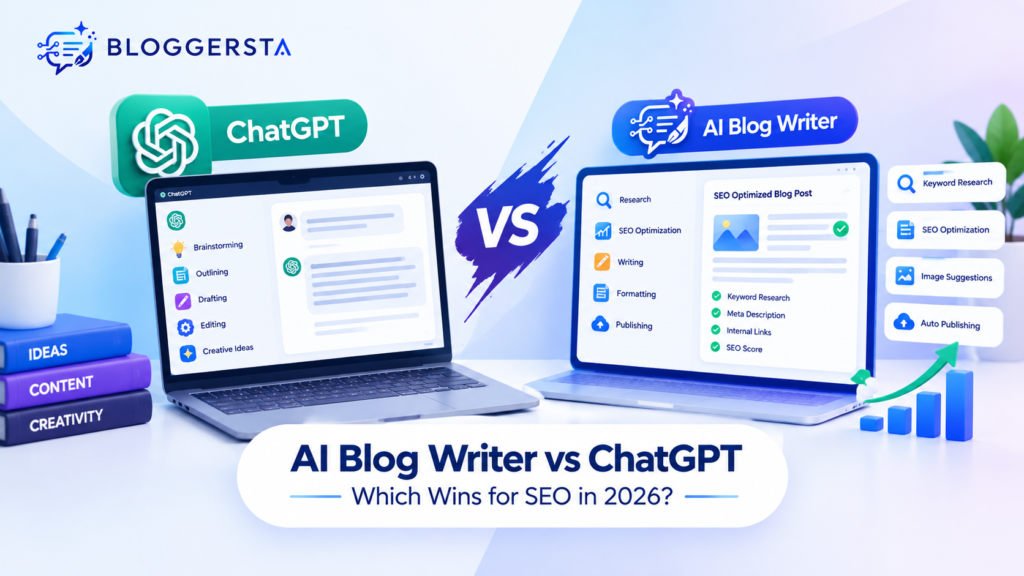
The primary distinction between ChatGPT and a dedicated AI blog writer lies in the amount of SEO work each performs for you. ChatGPT provides greater flexibility, and specialized platforms typically include writing, research, optimization, formatting, and publishing capabilities.
| Feature | ChatGPT | Dedicated AI Blog Writer |
| Content ideas | Excellent | Excellent |
| Outlining | Excellent | Excellent |
| Writing flexibility | Excellent | Good to excellent |
| SEO workflow | Requires setup | Usually built in |
| Keyword integration | Prompt-based | Often automated |
| Brand voice | Highly customizable | Template-based |
| Research workflow | Flexible | Often structured |
| WordPress publishing | Usually manual or integrated through other tools | Often built in |
| Content updates | Requires workflow | Often easier to automate |
| Best for | Writers and strategists | Frequent SEO publishers |
The important difference is not simply writing quality. It is workflow depth.
ChatGPT gives you a powerful writing assistant. A dedicated platform attempts to give you an entire publishing system.
If you want to explore dedicated tools in more detail, see our guide to AI blog writers tested for SEO, quality, and speed.
The Main Difference: Writer vs Content Workflow
The most significant difference between an AI blog writer and ChatGPT lies in the amount of work that is done outside of the writing box.
ChatGPT can brainstorm an idea, review an outline, create FAQs, rewrite paragraphs, and enhance an article, among other tasks. You can also create very specific prompts for search intent, brand voice, topical coverage, and on-page search engine optimization. The downside is that you need to create the workflow manually.
A dedicated AI blog writer usually packages several of those steps together. Depending on the platform, you can enter a keyword or topic and get research, an outline, a draft, SEO tips, images, formatting, or publishing options.
That makes dedicated tools particularly useful for repeatable production. If you’re publishing two well-researched articles each month, ChatGPT could be your go-to solution. Now, if you are publishing dozens of articles every month, automation can prove to be very useful.
Research, Search Intent, and Writing Quality
Research is a key difference between ChatGPT and dedicated AI blog writers.
ChatGPT can help identify search intent, audience questions, content gaps, related topics, entities, and article ideas. But its SEO research is only as good as your prompts, data, and review process.
AI blog writers typically focus on keyword research, analysis of competitors, keyword suggestions, and content structuring using search intent. This is why they can be helpful for repeatable SEO projects, yet neither tool can ensure that the content created will be accurate or original.
Google values content that is reliable, helpful, and useful to people. AI-generated pages that add little value may be considered scaled content abuse.
ChatGPT offers greater control over tone, structure, and editing, while dedicated tools usually create drafts faster. In both cases, fact-check claims and statistics and verify sources and keyword recommendations before publishing.
Best for research: ChatGPT for control; dedicated tools for SEO automation.
SEO Optimization, Brand Voice, and Content Updates
SEO is where dedicated AI blog writers can save the most time.
ChatGPT supports keyword research, search intent, headings, internal links, FAQs, semantic keywords, and content optimization through detailed prompts. However, you must repeat these instructions and review every output manually.
AI blog writers typically come equipped with SEO tools like keyword ideas, content ratings, optimized headings, internal linking, and search intent analysis. This makes them more effective at publishing content at scale.
When you provide examples, style guidelines, and preferred language, ChatGPT also provides good control over your brand voice. Dedicated tools may include brand voice settings, but customization varies.
ChatGPT can detect outdated information, topics missing from the content, and new FAQs when creating updates. Recurring updates can be easier to make on dedicated platforms with their content management tools.
Best for SEO control: ChatGPT.
Best for SEO automation: Dedicated AI blog writers.
Best for brand voice: Either option with clear guidelines and examples.
WordPress Publishing and the Hidden Cost of AI Workflows
AI writing costs more than the subscription price. You will also have to research, edit the draft, insert internal links, format headings, optimize images, add metadata, upload the article, and run an SEO check.
For large-scale publishing, ChatGPT might be less efficient when dealing with these manual tasks. AI blog writers for WordPress are typically able to optimize content for SEO, format articles, add internal links, add images, integrate with WordPress, and publish in a single workflow.
If you publish occasionally, ChatGPT might be cheaper. Automation can save a lot of time for large content operations or for publishing weekly.
The key question is not:
“Which tool costs less?”
It is:
“Which tool reduces the cost and time of each finished article?”
When Should You Use ChatGPT or a Dedicated AI Blog Writer?
If your workflow looks like this, ChatGPT is typically sufficient:
- You publish a few articles each month.
- You enjoy controlling the research and outline.
- You already use SEO tools separately.
- You want extensive customization.
- You prefer editing the article yourself.
- You frequently write different content formats.
A dedicated AI blog writer becomes more attractive when your workflow looks different:
- You publish content every week.
- You manage multiple websites.
- You produce large content batches.
- Research and formatting consume too much time.
- You want repeatable SEO processes.
- You need WordPress publishing support.
- Multiple people work inside the same content operation.
The distinction is simple. ChatGPT gives you flexibility. Dedicated tools give you structure.
For those looking for a more comprehensive suite of tools, you can check out our article on the best AI tools for bloggers to help you with blog research, content creation, optimization, and productivity.
Can ChatGPT and an AI Blog Writer Work Together?
They absolutely can. Indeed, a hybrid approach can be the best option for some SEO practitioners.
You can use ChatGPT for flexible thinking, brainstorming, developing ideas, and personalized editing. A dedicated platform can handle repeatable content operations.
The following workflow combines AI automation with human oversight:
1. Research the Topic
Identify search intent, competing content, terminology, questions, and information gaps.
2. Create the Brief
Define the primary keyword, supporting keywords, audience, angle, headings, and content requirements.
3. Generate the Draft
Use the AI system that best fits your workflow to accelerate the first draft.
4. Add Human Expertise
Use original examples, firsthand observations, expert commentary, and useful distinctions.
5. Optimize for SEO
Analyze on-page optimization, keywords, headings, metadata, topical coverage, and readability.
6. Add Internal Links
Connect the new article with relevant existing content. Avoid adding links simply to increase link quantity.
7. Perform Editorial Review
Check facts, claims, originality, grammar, formatting, and reader usefulness.
8. Publish and Update
Publish the finalized article and revisit it when information, products, statistics, or search intent changes.
This approach avoids treating either tool as a complete replacement for an editorial process.
Turn a product guide into a video with Pictory AI.
Which Is Best for Different Users?
The most appropriate option will depend on your publication volume, technical skills, content objectives, and the level of automation in the writing process. If you’re a solo blogger, you might prefer flexibility and cost-effectiveness, whereas agencies and affiliate publishers may benefit more from structured workflows and bulk production options.
Solo Bloggers: ChatGPT is typically the first place to look. If you are a solo blogger, you might not publish enough content to warrant a specialized AI blog-writing tool. You can provide ChatGPT with ideas, outlines, drafts, FAQs, rewrites, and content enhancements, all in one place.
A dedicated tool becomes more useful as publishing volume increases.
Freelance Writers: ChatGPT is usually more flexible. Freelancers work across different industries, clients, tones, and content formats. A general AI writing assistant allows greater customization.
You can build different prompts and workflows for different clients rather than relying on one standardized process.
SEO Specialists: A combination works best. SEO specialists often need more than writing. They need keyword analysis, search intent, internal linking, content gaps, optimization, and performance improvements.
ChatGPT can support strategy while specialized tools automate repetitive production tasks.
Affiliate Publishers: Dedicated AI blog writers can provide stronger workflow efficiency. Affiliate websites often require large content libraries covering related topics. A structured publishing workflow can reduce the time spent creating similar article formats.
However, affiliate content still needs genuine usefulness. Adding generic AI summaries to hundreds of pages is unlikely to create a sustainable advantage.
Content Agencies: A dedicated AI blog writer will typically have the advantage. Agencies deal with volume, deadlines, clients, editors, and publishing schedules. The more articles, the more valuable workflow automation becomes.
ChatGPT may still help in research, brainstorming, editing, and client-specific areas.
Create a short product campaign with Revid AI.
Final Verdict: AI Blog Writer vs ChatGPT
AI blog writer vs ChatGPT — which one wins in 2026? There is no universal winner. Select ChatGPT for flexibility, creative control, detailed prompting, and versatile AI writing assistance.
If repetitive production, SEO workflows, formatting, publishing, or content volume are your biggest challenges, you should choose a dedicated AI blog writer.
A hybrid workflow is usually the best choice for serious SEO publishers. Utilize ChatGPT for strategy and editorial work and specialized AI tools for repetitive production tasks. Looking to take your AI content workflow to the next level? Learn more about AI writing tools, SEO techniques, and content-creation guides on Bloggersta.
FAQs
How is AI changing SEO in 2026?
AI is transforming the way people search, particularly with AI Overviews and AI-powered search. The rules of SEO have changed. SEO is no longer just about stuffing keywords. It is now about search intent, original ideas, helpful content, and topical authority.
Which AI is best for SEO?
There is not a single “best” AI for SEO. ChatGPT excels at strategy, content creation, and optimization, whereas specialized AI tools for SEO can provide keyword research, competitive analysis, and automated workflows.
Is there a better AI than ChatGPT?
This depends on the requirements. There are certain AI tools that can outperform ChatGPT for specialized tasks, like SEO research, content optimization, or automated blog publishing.
Can AI blogs make money?
Yes. Blogs that use AI can generate revenue with methods like affiliate marketing, advertising, digital products, and services. But the content must provide genuine value, accurate information, and useful insights to attract long-term search traffic.
Can AI-generated blogs rank on Google?
Yes. Google won’t automatically punish content just because it was created with AI. But content still needs to be useful, original, accurate, and genuinely helpful to users.