

Perplexity AI and ChatGPT are both useful for research, but they are not built for the same job. One is designed around search and citations, while the other is stronger for analysis, writing and working with uploaded files. So, which one should you use for research from Perplexity AI vs ChatGPT?
| Quick Answer Perplexity AI is better for quick research when you need current sources, citations and fast fact-checking. ChatGPT is better for deeper analysis, summarizing uploaded PDFs, comparing documents, building outlines and turning research into clear writing. For best results, use Perplexity to find sources and ChatGPT to analyze, organize and explain them. |
This article compares Perplexity vs Chatgpt for web research, academic research, citations, PDFs, summaries, source checking and paid plans. It does not say one tool is useless. Both are strong, but they serve different research needs.
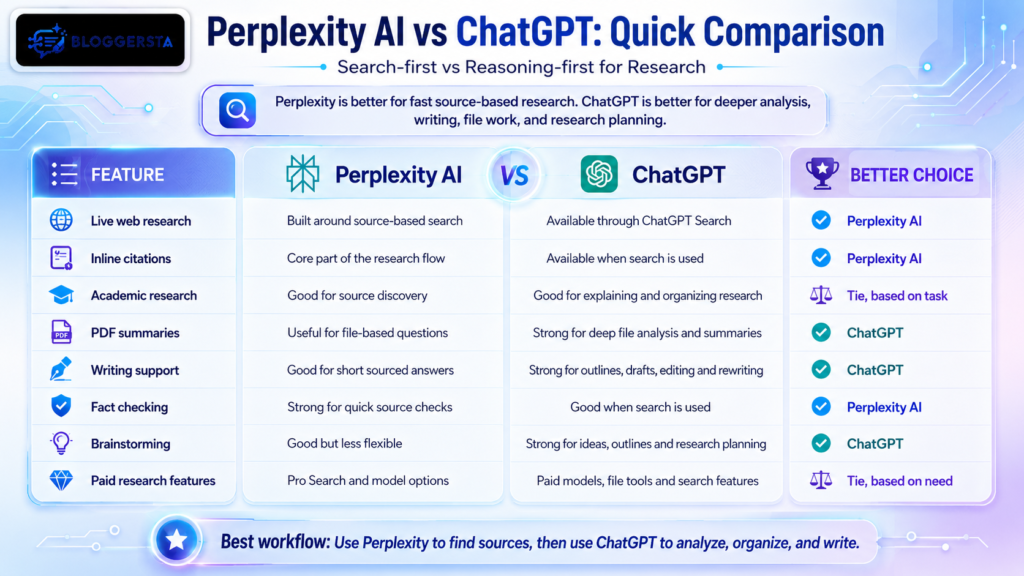
Perplexity AI vs ChatGPT: Quick Comparison
Perplexity AI works more like an answer engine, while ChatGPT works more like a general AI assistant. Perplexity is better when you need web sources quickly. ChatGPT is better when you need deeper thinking, writing help, uploaded file analysis, or step-by-step research support. The main difference between Chatgpt vs Perplexity AIis design: Perplexity is search-first, while ChatGPT is reasoning-first.
| Feature | Perplexity AI | ChatGPT | Better Choice |
| Live web research | Built around source-based search | Available through ChatGPT Search | Perplexity AI |
| Inline citations | Core part of the research flow | Available when search is used | Perplexity AI |
| Academic research | Good for source discovery | Good for explaining and organizing research | Tie, based on task |
| PDF summaries | Useful for file-based questions | Strong for deep file analysis and summaries | ChatGPT |
| Writing support | Good for short sourced answers | Strong for outlines, drafts, editing and rewriting | ChatGPT |
| Fact checking | Strong for quick source checks | Good when search is used | Perplexity AI |
| Brainstorming | Good but less flexible | Strong for ideas, outlines and research planning | ChatGPT |
| Paid research features | Pro Search and model options | Paid models, file tools and search features | Tie, based on need |
What Is Perplexity AI Best For?
Perplexity AI is best for users who want fast answers with source links. It is useful for checking current facts, comparing products, scanning the web, finding starting points and building a quick source list before deeper research. That makes it a strong choice when you need best AI tool for research speed with visible references.
It works like a search engine that gives structured answers. Instead of only listing links, it builds a short explanation and adds Perplexity AI citations next to key claims. This helps you verify information without clicking through many pages first.
- Best for: Fast web research with visible sources.
- Best user: Students, bloggers, analysts, marketers and researchers.
- Research strength: Gives source links that make verification faster.
- Best use case: Finding credible starting sources for a topic.
- Caution: Open the cited sources before using them in serious work.
Also Read: What is Jasper AI? A Simple Guide for Beginners and Marketers
What Is ChatGPT Best For?
ChatGPT is best for deeper analysis, writing support, summaries, outlines, file work, research planning and explanation. It can be especially useful after you already have sources and need help understanding, comparing, or organizing them. That makes ChatGPT for research stronger when the task is about meaning, not just speed.
It is designed as a general assistant, not just a search tool. You can ask it to compare two papers, build an outline, rewrite a section, or explain a complex idea in simpler terms. It is also stronger when you upload notes, PDFs, or data files.
- Best for: Analysis, summaries, outlines, writing support and file work.
- Best user: Students, researchers, writers, business users and content creators.
- Research strength: Explains complex ideas and organizes messy notes.
- Best use case: Turning research material into a clear structure.
- Caution: Use search or verified sources when accuracy matters.
Also Read: 7 Best AI Research Tools to Find Information Faster
Which Tool Gives Better Citations?
Perplexity AI is usually better for citation-first research because sources are part of the answer experience. ChatGPT can also show citations when web search is used, but its main strength is broader reasoning and content support. That makes Perplexity AI citations more central to the workflow than in ChatGPT.
Perplexity builds answers with links next to claims, so you can quickly open the original page. ChatGPT can add links, but they may depend on how you use its search feature and model settings.
- Perplexity AI: Better for quick cited answers and source discovery.
- ChatGPT: Better for explaining, grouping and rewriting researched material.
- Best practice: Check every source before citing it.
- Academic tip: Cite the original source, not the AI tool.
- Warning: A citation link does not always mean the answer is fully correct.
Which Tool Is Better for Academic Research?
Perplexity AI is better for finding sources quickly, while ChatGPT is better for understanding, summarizing and organizing academic material. Neither tool should replace reading the original paper, textbook, or official report. For Perplexity AI for academic research, the main value is fast source discovery, not final answers.
You can use Perplexity to locate papers, reports and references. Then you can use ChatGPT to explain theory, make outlines, compare arguments and summarize notes. This split helps you move faster without losing control of the content.
- Use Perplexity AI for: Finding current sources, papers, reports and references.
- Use ChatGPT for: Explaining theory, making outlines, comparing arguments and summarizing notes.
- Use both for: Literature review planning, topic understanding and research direction.
- Avoid: Copying AI answers into assignments.
- Better habit: Keep a research log with links and notes.
Also Read: Galaxy.ai Vs ChatGPT: Real Difference and Which One Should You Use?
Which Tool Is Better for Live Web Research?
Perplexity AI is usually better for live web research because it is built around search and cited answers. ChatGPT can search the web too, but Perplexity’s search-first layout often makes source checking faster for quick research tasks. In ChatGPT Search vs Perplexity, Perplexity wins on speed and citation clarity for many users.
Perplexity gives you a short answer with links. ChatGPT can give more detailed explanations, but you may need to enable search or use a paid plan for full web access.
- Perplexity AI is better for: Fast current answers and source discovery.
- ChatGPT is better for: Expanding, explaining and using sources in a larger task.
- Best workflow: Search in Perplexity, then analyze sources in ChatGPT.
- Caution: Do not trust any AI search result without reading the source.
Perplexity AI vs ChatGPT: Which Tool Is Better for PDFs and Long Documents?
ChatGPT is often better for long document analysis when the user wants summaries, comparisons, outlines, patterns, or detailed questions from uploaded files. Perplexity can also work with files, but it is especially useful when file analysis needs to be combined with web research.
ChatGPT can read large PDFs and answer specific questions about claims, methods and limitations. Perplexity can ask questions about files, but its search strength shines when you mix file content with fresh web results.
- Use ChatGPT for: Deep PDF summaries, document comparison and structured notes.
- Use Perplexity AI for: Combining uploaded material with current web sources.
- Best student use: Upload notes or a paper and ask for key arguments.
- Best research use: Ask for claims, limitations and source gaps.
- Caution: Check page numbers and original wording before quoting.
Which Tool Is Better for Writing Research Content?
ChatGPT is usually better for writing research content because it can turn notes into outlines, summaries, drafts, explanations, tables and editing suggestions. Perplexity is better before the writing stage, when the user is still gathering source-based information. For Perplexity AI or ChatGPT for research, this split is key: Perplexity for sources, ChatGPT for writing.
You can use Perplexity to find sources and check facts. Then use ChatGPT to build outlines, explain points and improve clarity. After writing, ChatGPT can also help edit structure, flow and readability.
- Use Perplexity AI before writing: Find sources and check facts.
- Use ChatGPT during writing: Build outlines, explain points and improve clarity.
- Use ChatGPT after writing: Edit structure, flow and readability.
- Avoid: Asking either tool to write full academic work without your input.
- Better habit: Write your own argument, then use AI for support.
Perplexity AI vs ChatGPT Pricing: Which Is Worth Paying For?
The better paid plan depends on the user’s need. Perplexity Pro is useful for users who need deeper search and research workflows. ChatGPT paid plans are useful for users who need stronger models, file analysis, writing help, coding and broad AI support. In Perplexity AI compared to ChatGPT, the choice is about focus: search vs broad assistant power.
Try free first with the same research topic. If you need more web depth and Pro Search, Perplexity may be better. If you need file work, writing and coding, ChatGPT may give more value.
- Pay for Perplexity if: Your main need is research, cited answers and web discovery.
- Pay for ChatGPT if: Your main need is analysis, writing, files, coding and planning.
- Try free first: Test both tools with the same research topic.
- Check before publishing: Pricing, rate limits and model access can change.
- Best value: Pick the tool that saves the most time in your real workflow.
Best Workflow: Use Perplexity AI and ChatGPT Together
The strongest research workflow is often not choosing one tool or Perplexity AI compared to ChatGPT. Use Perplexity AI to find sources and current facts, then use ChatGPT to explain, compare, summarize and organize the material into notes, outlines, or drafts. This Perplexity AI vs ChatGPT combo gives you speed and depth.
- Search the topic in Perplexity AI.
- Open and save the best sources.
- Copy verified notes into ChatGPT.
- Ask ChatGPT to group ideas by theme.
- Create an outline or summary.
- Check every claim before publishing or submitting.
This workflow reduces weak research and helps you keep control of the final output. It also makes your work more credible because you verify sources yourself.
Final Verdict: Perplexity AI or ChatGPT for Research?
Perplexity AI is better for source-first research, live web answers and quick fact-checking. ChatGPT is better for deep analysis, writing, uploaded files and turning research into clear content. Most researchers will get the best results by using both. In perplexity ai vs chatgpt, the winner depends on your task.
Use Perplexity when you need sources fast, use ChatGPT when you need to understand and shape the material and always verify the original source before citing it.
FAQs
Is Perplexity AI more accurate than ChatGPT for academic research?
Perplexity AI is often better for source-based research because it searches the live web and shows citations with its answers. That makes verification easier. ChatGPT can also be useful for academic research, especially for explaining papers, summarizing notes and organizing arguments.
Can ChatGPT search the live internet like Perplexity AI?
Yes, ChatGPT can search the web when its Search feature is used. Perplexity AI is more search-first by design, while ChatGPT is broader and better suited for analysis, writing, file work and research planning after sources are collected.
Which tool is better for reading and summarizing long PDFs?
ChatGPT is usually better for deep PDF analysis, document summaries, comparisons and structured notes. Perplexity AI is useful when you want to combine uploaded files with external web research and source discovery.
Does Perplexity AI invent or fake academic citations?
Perplexity AI reduces the risk of fake citations by linking answers to web sources, but users should not assume every cited answer is perfect. Always open the original source, check the author, date, publisher and claim before using it in academic work.
Is the premium version of Perplexity worth it for researchers?
Perplexity Pro can be worth it for researchers who use AI search daily and need deeper search, follow-up research and stronger model access. For users who need writing, file analysis, coding and broader AI support, a paid ChatGPT plan may be more useful.