
According to the latest data, YouTube Shorts currently receives over 70 billion views per day, and a 50% increase in the number of channels publishing YouTube Shorts over the last year. That measure illustrates the saturation of the short-form video market. Meanwhile, generative AI is helping to produce video at a much more rapid, cost-effective, and accessible rate for nearly anyone.
So, Can AI make viral videos?
Quick Answer
| AI can contribute to making videos go viral; there is no guarantee that AI make viral videos. It may help facilitate ideation, scripting, visuals, editing, repurposing, and performance analysis. But it’s viewers who make the show work, though. A weak idea can result in a poor AI video, but a simple video can be a success if it is timely, useful, surprising, or relatable. While AI helps in production, it cannot reliably produce authentic emotion, trust, originality, cultural insight, or a compelling reason to share. |
If you’re still wondering when to make videos from scratch rather than editing old videos, read our post, AI Video Generator vs AI Video Editor: What’s the Difference?
7 Secrets Behind Viral Video Views
Before you start looking into the seven secrets, keep in mind that viral performance is typically a combination of several things that work together, not one single thing. Here are some principles that will help you to decipher what makes those viewers stop, watch, engage, and share.
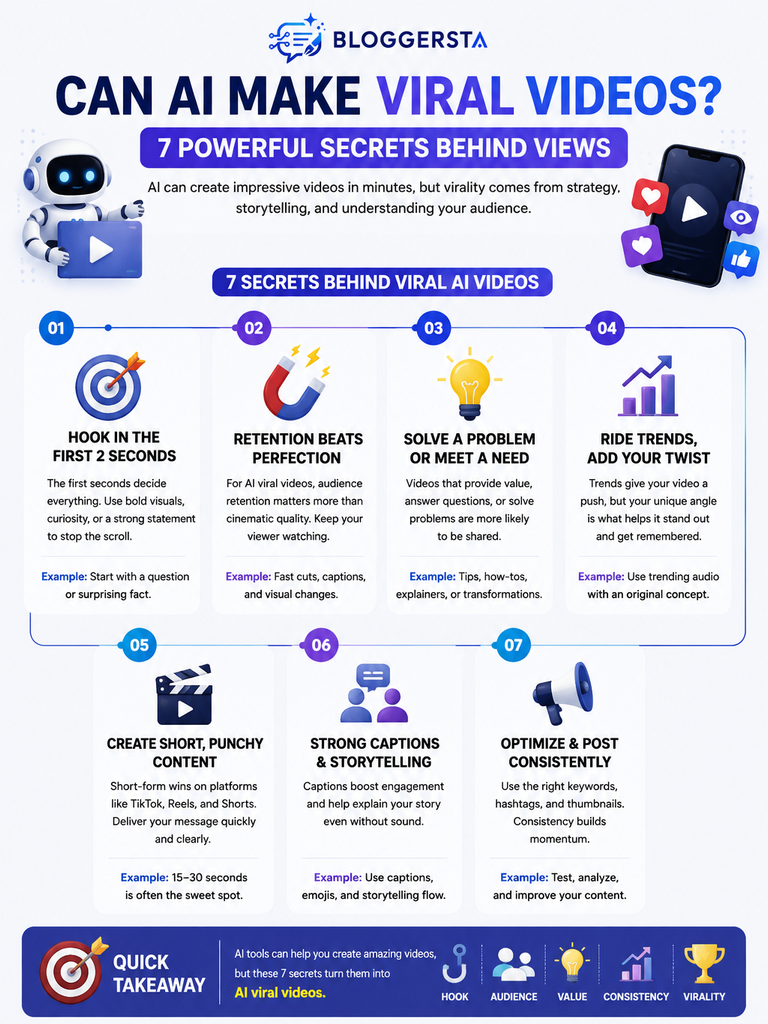
1. Start With a Hook That Creates Curiosity
The hook is what gives the viewers a reason to keep watching. Compare:
“It’s with AI video generators that we’re talking about today.”
With:
“This AI video looks real until you notice one tiny detail.”
The second creates an information gap. AI can generate multiple video hooks, but you still need to choose one that fits your audience and delivers on its promise.
Before publishing, ask:
- Does the opening create a question?
- Is the promise relevant?
- Does the video deliver the payoff quickly?
Aim for credible curiosity, not exaggerated clickbait.
2. Retention Matters More Than Visual Quality
AI makes polished visuals easier to create, but attractive footage cannot replace strong storytelling. Viewer retention depends on what happens after the opening.
Use a simple structure:
Hook → Tension → Development → Payoff
Avoid long introductions, repetitive visuals, slow explanations, and weak endings. Tools such as Revid AI can help speed up short-form production and editing.
The goal is not to create more videos. It is to test better variations and learn what keeps viewers watching.
3. Emotion Encourages Sharing
Views indicate attention; shares indicate it was worthy of being shared. People post content because it is helpful, humorous, surprising, relatable, or relevant to their identity.
Hence, emotionally driven stories can outperform technically amazing videos. Your content does not need to affect everyone. It needs to make the right audience care enough to share or respond.
4. Use Trends Without Losing Originality
Incorporating trends can be useful for getting your video into an ongoing discussion, but if you’re using them too much, it will feel like it is the same thing. Learn the elements of a successful video (hook, pacing, tension, payoff) and re-create a video using your own idea.
Use this workflow:
Observe → Adapt → Differentiate → Test
Trends can create momentum, but originality gives viewers a reason to remember your video.
5. Make Videos Rewatchable
Rewatchability can come from a hidden detail, quick transformation, unexpected ending, visual puzzle, or seamless loop.
A useful structure is:
Unexpected opening → Fast development → Hidden detail → Payoff
AI can help you test different endings and scene orders, but your judgment determines which version deserves another view.
6. Avoid Producing Average Content at Scale
It is simple to generate more than one draft with AI, but quantity doesn’t equal quality. If you need one “perfect” video for AI, create a few ideas, explore hooks, and try out various endings.
Do not use AI to create content; use AI to test your content ideas. This also enables the broader AI video automation workflow process without compromising creativity.
7. Build a Feedback Loop
AI becomes most useful when it helps you learn from published content.
Use this process:
Create → Publish → Measure → Improve → Test Again
Analyze what types of hooks grab attention, what topics garner shares, where viewers drop off, and whether the conclusion inspires re-watching. If you’re looking to repurpose blogs, podcasts, or webinars, Pictory AI can help you convert content into shorter video formats.
The goal is not just faster production. It is about understanding the content your viewers are interested in and creating better videos to better serve them.
How Viral Content Differs Across TikTok, Reels, and Shorts
A video that works great on one site might not on another. It is not the video per se. There are different audiences, content cultures, and consumption patterns on each platform.
| Platform | Strong Opportunity | What to Emphasize |
| TikTok | Trends and participation | Fast hooks, novelty, relatability |
| Instagram Reels | Sharing and discovery | Visual appeal, emotion, identity |
| YouTube Shorts | Broad discovery | Retention, storytelling, payoff |
TikTok
The real-time and cultural nature of TikTok content can be beneficial. Don’t emulate popular formats; take the framework and give it a new idea.
Instagram Reels
Reels are particularly suited to content with strong visual identity and sharing potential. Ask yourself who would send this video to someone else.
YouTube Shorts
Shorts offer enormous discovery potential. According to the company, YouTube has already shared over 70 billion Shorts views. This is particularly important for storytelling and retention in light of the fact that users have many options to choose from.
If you’re creating content across several platforms, how AI is changing short-form video generation can help you find tools suited to Shorts, Reels, TikTok, and other social formats.
Real-World Example: AI Can Remove Production Friction
YouTube’s introduction of Dream Screen illustrates how AI is changing the production side of Shorts. The feature allows creators to generate image or video backgrounds from text prompts.
Imagine a creator explaining a historical event that happened in an impossible environment. Previously, visualizing that scene could require stock footage, filming, animation, or expensive production work.
AI can now reduce that friction.
But it does not decide why the audience should care.
It does not determine the strongest opening. It cannot fully understand which cultural reference will resonate with a specific niche. It cannot guarantee that the ending will feel satisfying.
That is the important distinction:
AI reduces production friction. Human judgment creates meaning.
Adobe’s creator research reinforces this shift. With 86% of surveyed creators already using creative generative AI, AI-assisted production is becoming increasingly normal. The competitive advantage, therefore, moves away from simply having access to AI.
It moves toward knowing what to make with it.
A Practical AI Viral Video Workflow
If you want to create stronger AI viral videos, avoid beginning with a tool. Start with the audience and work forward.
1. Find Audience Tension
Start with a problem, question, misconception, desire, or emerging conversation. Strong ideas usually contain some form of tension.
2. Generate Several Angles
Ask AI for multiple hooks and concepts rather than accepting its first suggestion. Explore curiosity, emotion, education, controversy, and surprise.
3. Build the Hook First
Create several opening versions before producing the complete video. The strongest opening should create curiosity while remaining honest.
4. Design the Retention Path
Know what happens after the hook. Build toward a clear payoff instead of filling the middle with unnecessary information.
5. Generate the Assets
Use AI for visuals, voiceovers, captions, backgrounds, B-roll, and repetitive editing tasks where appropriate.
6. Add the Human Layer
Include your perspective, examples, humor, experiences, or distinctive observations. This helps prevent the content from feeling interchangeable.
7. Publish and Learn
Track performance instead of judging the video solely by its view count. Use audience behavior to shape your next experiment.
Your source material does not have to start as a video. You can also turn text, URLs, PDFs, and audio into AI videos, which makes this workflow useful for bloggers, podcasters, educators, and marketers working with existing content.
Why Some AI Videos Look Impressive but Fail
There is a growing category of AI content that looks polished but feels empty.
It usually combines attractive visuals, synthetic narration, generic information, and a predictable ending. The production may be impressive, yet the viewer has no compelling reason to continue.
Common problems include:
- The AI demo problem: The video showcases what the tool can create instead of giving viewers something valuable.
- The predictable-content problem: Everything looks polished, but nothing surprises the viewer.
- The trend-copy problem: The creator reproduces a popular format without introducing a fresh idea.
- The weak-payoff problem: The opening creates curiosity, but the ending does not reward it.
- The over-AI problem: Every visual, sentence, voice, and transition feels synthetic.
The solution is not always better technology. Sometimes the solution is a better idea.
The Simple Formula Behind Better AI Videos
If you remember only one framework from this article, use:
Hook + Curiosity + Emotion + Payoff + Rewatchability
Each element serves a different purpose.
- Hook earns attention.
Curiosity creates an information gap.
Emotion gives the content significance.
Payoff rewards the viewer.
Rewatchability creates another opportunity for attention.
AI can assist with all five. However, it should not replace the creative decisions behind them.
Conclusion
It can assist, but it cannot ensure virality.
AI can help accelerate ideation, visual creation, editing, repurposing, and testing. However, if everyone is creating quickly, then speed isn’t a help. If you still need to know who you are writing for, develop effective hooks, tell interesting stories, and try things out to see if it works, then this book is still for you.
Never use AI to create a viral video. Ask it to assist you in creating, testing, and developing thoughts people would like to see.
Begin with one problem from the audience, develop some “hooks,” and watch the audience react. That data can guide your next idea. AI is not a shortcut to virality. It is a quicker method to understand your audience’s desires.
FAQs
Can AI-generated videos go viral?
Yes. With strong hooks, retention, emotionally relevant content, and timely delivery, AI-generated videos can garner significant views. However, AI production is not a surefire way to go viral.
What makes an AI video go viral?
Hooks, relevance to audience, retention, emotional triggers, originality, shareability, and rewatchability are all effective performance components. The creative strategy will decide the appeal of the video, while AI can help with production.
Are AI videos better than traditional videos?
Not necessarily. AI videos can be faster and cheaper to produce. Older footage can offer more authenticity or personal connection. The best choice will depend on the audience, story, budget, and creative goal.
Should I use the same video for TikTok, Reels, and Shorts?
It is possible to employ the same core concept, but often it’s better to modify the presentation. Think about altering the starting, pacing, captions, framing, and context depending on the platform.
Does video quality matter for virality?
While quality is important, there are other factors of polish. An engaging concept and audience interaction can beat over-the-top video footage and a lack of storytelling.
How can I make AI videos feel less artificial?
Add human perspective. Use original examples, personal observations, distinctive storytelling, natural editing, and relevant experiences. Avoid publishing raw AI-generated output without meaningful creative direction.
Final Takeaway
AI has changed how quickly creators can make videos. It has not changed the fundamental reason people watch them. People watch because something earns their attention. They continue because the story gives them a reason. They share due to the significance of the material to them.
Speed up production and experimentation with AI. Exercise your own creativity to develop the concept, feeling, and viewpoint that viewers can’t get from a generic AI video. To get more in-depth how-to articles on how to use AI to make videos, edit videos, automate video creation, and video strategy, check out Bloggersta and build a workflow to make smarter videos, not faster.
One Response