
Short-form video has become a demanding publishing game. Creators need fresh ideas, strong hooks, quick edits, and frequent uploads.AI is changing how they manage that workload. Wistia’s 2026 State of Video research found that 62% of teams are already using AI in their video workflows or plan to start soon. AI users are also 57% more likely to produce 50–100 videos.
The bigger change, however, is not simply faster editing. What is AI short-form video creation changing?
Quick Answer
| AI is making short-form video production faster and more iterative. Creators can now use AI for video ideation, scripts, captions, editing, voiceovers, repurposing, and localization. The smartest creators are not handing over the entire process. They are giving repetitive tasks to AI while keeping creative decisions human. That balance explains where short-form creation is heading. |
How AI Is Changing Short-Form Video Creation
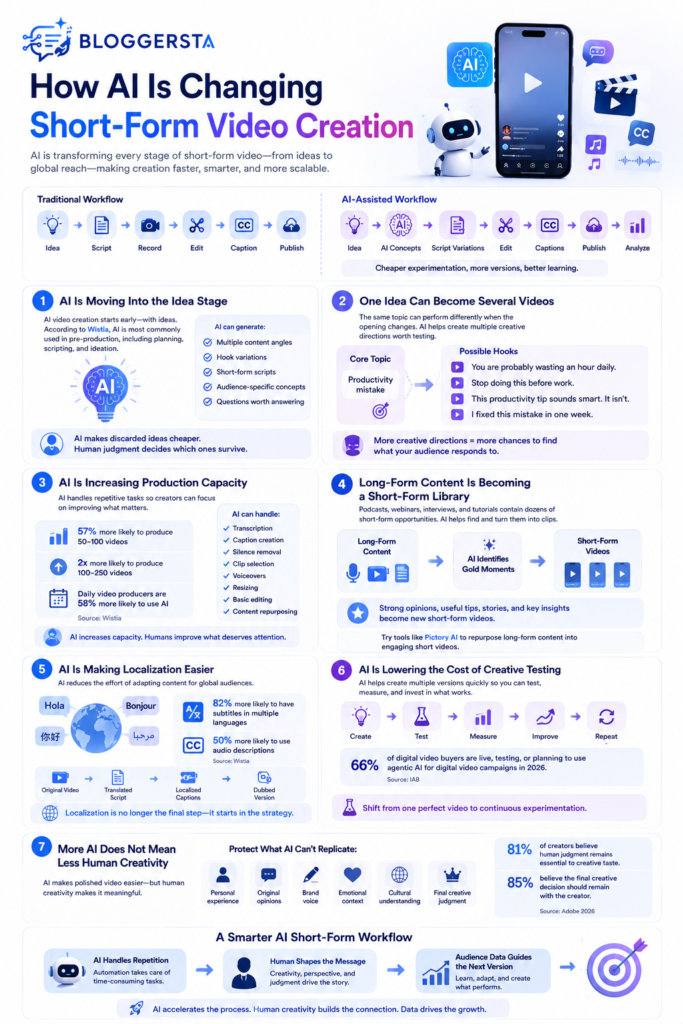
Traditional production often follows this path:
Idea → Script → Record → Edit → Caption → Publish
An AI-assisted workflow can become:
Idea → AI Concepts → Script Variations → Edit → Captions → Publish → Analyze
This difference creates cheaper experimentation. Creators can test several hooks before investing heavily in production. Brands can also create multiple versions of one concept without rebuilding everything from scratch.
1. AI Is Moving Into the Idea Stage
AI video creation does not begin with a video generator. It often begins with an idea. Wistia found that AI is most commonly used in pre-production, including planning, scripting, and ideation. That matters because weak ideas waste more time than slow editing.
A creator can ask AI to generate:
- Multiple content angles
- Hook variations
- Short-form scripts
- Audience-specific concepts
- Questions worth answering
The human then removes the generic ideas. This creates a useful principle for AI content creation: AI makes discarded ideas cheaper. Human judgment decides which ones survive.
2. One Idea Can Become Several Videos
Short-form success often depends on packaging. The same topic can perform differently when its opening changes.
For example:
| Core Topic | Possible Hook |
| Productivity mistake | “You are probably wasting an hour daily.” |
| Productivity mistake | “Stop doing this before work.” |
| Productivity mistake | “This productivity tip sounds smart. It isn’t.” |
| Productivity mistake | “I fixed this mistake in one week.” |
Instead of creating one script and hoping it works, creators can develop several creative directions first. This turns short-form video creation into a more experimental process where the opening itself becomes something worth testing.
3. AI Is Increasing Production Capacity
More content does not automatically mean better content. However, higher production capacity gives creators more opportunities to test ideas and identify what their audiences actually respond to.
Wistia found that AI users are 57% more likely to produce 50–100 videos and twice as likely to produce 100–250 videos. Daily video producers are also 58% more likely to use AI. These figures suggest that AI is becoming particularly valuable for teams operating at higher publishing volumes. AI can handle repetitive production tasks such as:
- Transcription
- Caption creation
- Silence removal
- Clip selection
- Voiceovers
- Resizing
- Basic editing
- Content repurposing
The goal is not to publish endlessly. Instead, creators can spend more time improving the content that deserves attention while letting AI handle mechanical production work.
4. Long-Form Content Is Becoming a Short-Form Library
One overlooked change is how creators reuse existing content. A podcast episode can contain dozens of potential short videos. The same applies to webinars, interviews, tutorials, product demonstrations, and detailed blog posts.
AI can help identify strong opinions, useful explanations, interesting stories, audience questions, practical tips, and contrarian statements. Those moments can then become individual clips or new short-form concepts.
This makes video repurposing one of the most practical AI applications for creators. For example, Pictory AI can help transform existing long-form content into shorter video assets. Human review remains important because an automated clip can be technically complete while still lacking context.
For more ideas, see Bloggersta’s guide to AI content repurposing tools for creators and marketers.
5. AI Is Making Localization Easier
Short-form video is increasingly global. AI is reducing some of the work involved in adapting content for different audiences without requiring creators to produce every version manually.
Wistia found that AI users are 82% more likely to have subtitles in multiple languages. They are also 50% more likely to use audio descriptions. This makes multilingual video localization more practical for smaller teams.
A single video can therefore become:
Original video → Translated script → Localized captions → Dubbed version
This creates opportunities for creators who previously could not justify separate production for every market. It also changes when localization happens. Instead of treating translation as a final step, creators can consider different audiences during the initial content strategy.
6. AI Is Lowering the Cost of Creative Testing
This may become one of AI’s most valuable advantages. Imagine a brand has three possible selling points. Traditionally, each angle could require separate scripting, editing, and production time. AI can help create early versions of all three.
The workflow becomes:
Create → Test → Measure → Improve → Repeat
That is different from trying to make one perfect video. IAB reports that 66% of digital video buyers are live, testing, or planning to use agentic AI for digital video campaigns in 2026. The organization also highlights uses such as creative testing and performance analysis.
The implication is significant. AI is shifting video production from a one-shot creative process toward continuous experimentation. Instead of asking which video is perfect, marketers can ask which version deserves more investment.
7. More AI Does Not Mean Less Human Creativity
There is a catch. AI makes polished video easier to produce. As more creators use similar tools, that accessibility can also make content feel increasingly similar.
Adobe’s 2026 research found that 81% of creators believe human judgment remains essential to creative taste. It also found that 85% believe the final creative decision should remain with the creator.
That means creators should protect the elements AI cannot reliably manufacture:
- Personal experience
- Original opinions
- Brand voice
- Emotional context
- Cultural understanding
- Final creative judgment
AI can accelerate the workflow. It should not flatten the creator’s identity.
A Smarter AI Short-Form Workflow
The most practical approach is simple:
AI handles repetition → Human shapes the message → Audience data guides the next version
This model keeps production efficient without turning every video into the same synthetic formula. Creators who need additional video production support can also explore Revid AI for creating and adapting social video content.
AI Is Changing Short-Form Video Editing
Editing is another area where AI is quietly reshaping the workflow. Traditional editing can involve hours of trimming footage, removing pauses, generating subtitles, resizing clips, and searching for suitable moments.
AI can compress many of these repetitive actions. Modern AI video editing workflows can assist with automatic transcription, caption generation, silence removal, scene detection, smart reframing, background cleanup, highlight identification, and audio enhancement.
This does not mean every edit should be automated. The strongest use is usually selective automation. Let AI handle mechanical work while the creator controls pacing, emphasis, and storytelling.
That distinction becomes important when creating videos for TikTok, Instagram Reels, or YouTube Shorts. For more editing-focused workflows, see Bloggersta’s guide to AI video editors for TikToks and Reels.
AI Is Making Personalization More Practical
Another emerging shift is personalized short-form content. Previously, creating different videos for different audience segments required separate production cycles. AI can reduce that burden by making variations easier to develop.
A single campaign might now have variations based on:
| Audience Variable | Possible Video Change |
| Age group | Different examples |
| Location | Local references |
| Language | Translated narration |
| Customer stage | Educational or promotional angle |
| Product interest | Feature-specific messaging |
| Platform | Different length and format |
This creates what could be called creative granularity. Instead of making one generic video for everyone, brands can make smaller variations for specific audiences.
That does not guarantee better performance. It does make testing more practical.
How to Build an AI Short-Form Video Workflow
You do not need ten AI tools to start. Begin with one repeatable workflow and improve it gradually.
Step 1: Choose One Content Source
Start with a blog post, podcast, webinar, product page, or original idea. A strong source gives AI enough context to produce useful variations.
Step 2: Generate Several Angles
Ask AI for different hooks, audience perspectives, and content structures. Avoid accepting the first idea automatically.
Step 3: Create the First Draft
Use AI for the script, captions, visuals, or voiceover where appropriate. Treat the first output as a working draft rather than a finished asset.
Step 4: Add Human Context
Rewrite generic sections and include real examples, personal observations, or audience-specific details. This is where much of the video’s personality develops.
Step 5: Produce Variations
Test different openings, lengths, visual treatments, or calls to action. Keep the central message consistent while changing the packaging.
Step 6: Publish and Measure
Track retention, engagement, clicks, and conversions. Do not judge every video purely by views because different objectives require different success metrics.
Step 7: Feed the Learning Into the Next Video
Use performance data to improve future hooks, topics, formats, and creative choices. The goal is a repeatable content production system that becomes more efficient with every publishing cycle.
For more AI-assisted video workflows, see Bloggersta’s guide on turning text, URLs, PDFs, and audio into AI videos.
The Biggest Shift: From Content Creation to Content Systems
This may be the most important change happening in AI short-form video creation. Previously, creators often thought in terms of individual videos. Now they can think in systems.
One research session can produce several ideas. One recording can produce multiple clips. One script can produce several hooks. One successful video can inspire multiple variations.
The unit of production is therefore becoming larger than the individual video.
A simple system might look like this:
One idea → 5 hooks → 3 video variations → 2 platforms → Performance data
That is more scalable than producing each video from scratch. It also changes the creator’s role. Instead of manually assembling every asset, the creator becomes the creative operator who decides what deserves attention.
Will AI Replace Short-Form Video Creators?
Probably not in the way many headlines suggest. AI can generate footage, draft scripts, imitate voices, and automate editing. It still struggles with context and genuine experience.
A human creator understands why a particular story matters to their audience. They know which joke fits their community and can recognize when a trend conflicts with a brand’s personality. Those judgments are difficult to reduce to a prompt.
The likely future is therefore not AI versus creator. It is creator plus AI versus creator without an efficient workflow. That distinction will matter as video production becomes increasingly accessible.
Conclusion
AI is changing short-form video creation by making production faster, experimentation cheaper, and content easier to repurpose. However, its biggest impact may not be AI-generated footage. The deeper shift is workflow compression.
Creators can move from one idea to multiple variations with fewer manual steps. Long-form content can become a source for short clips. Localization can happen faster while editing becomes less repetitive. At the same time, human judgment remains essential for originality, accuracy, storytelling, and brand identity.
The strongest creators will therefore use AI for speed while protecting the elements that make their content distinctive. If you create short-form videos regularly, start with one repetitive task, automate it, measure the result, and build from there.
That is a more sustainable way to approach AI short-form video creation in 2026.
For more practical AI content workflows, explore Bloggersta’s AI video guides and test tools such as Revid AI or Pictory AI based on your specific production needs.
Frequently Asked Questions
How is AI changing short-form video creation in 2026?
AI is reducing repetitive production work while making ideation, editing, repurposing, and localization faster. Creators can also produce more variations for testing.
Can AI create an entire short-form video?
AI can assist with most production stages, including scripting, visuals, voiceovers, editing, and captions. However, human review remains important for accuracy, storytelling, brand voice, and authenticity.
Will AI replace short-form video editors?
AI will likely automate more repetitive editing tasks. Editors can therefore spend more time on pacing, storytelling, creative direction, and quality control.
What is the biggest benefit of AI video creation?
The biggest benefit is workflow efficiency. AI can lower the time and effort required to create, adapt, and test multiple video concepts.
Is AI-generated video good for social media?
It can be useful when the content remains relevant and authentic. Generic AI videos may struggle when audiences expect personality, originality, or genuine experience.
How should beginners start using AI for short-form video?
Start with one repetitive task such as captions, transcription, clip selection, or script ideation. Expand only after the workflow proves useful.
What is the future of AI short-form video creation?
AI systems will likely become more connected across ideation, generation, editing, localization, publishing, and performance analysis. Human creative direction will remain important.
Ready to Build a Smarter Video Workflow?
AI does not need to replace your creative process. It can simply remove the repetitive work surrounding it.
Explore more practical AI tools, workflows, and creator-focused guides on Bloggersta to find a production approach that fits your content goals.
One Response