
Going global sounds exciting until a customer in Germany or Japan hits a problem, and something feels off about the reply. Too fast. Too robotic. That small moment of doubt is hard to walk back.
Language is what holds customer relationships together. According to CSA research, almost 76% of people prefer buying from sites that respond in their native language, and around 40% won’t bother at all if it’s not. Yet most companies treat translation as a “later” problem and simply push that behind hiring cycles and budget conversations that never arrive.
AI-powered multilingual support changes that. Your team doesn’t need to cover every time zone or language manually. The tools now exist to do it well, at scale, without losing the human feel that builds real trust.
This guide will tell you how a multilingual AI support works and what deployment looks like at different company sizes. This guide covers which platforms are worth watching in 2026 and the mistakes most teams make on day one.
Quick Answer: What is Multilingual AI Support?
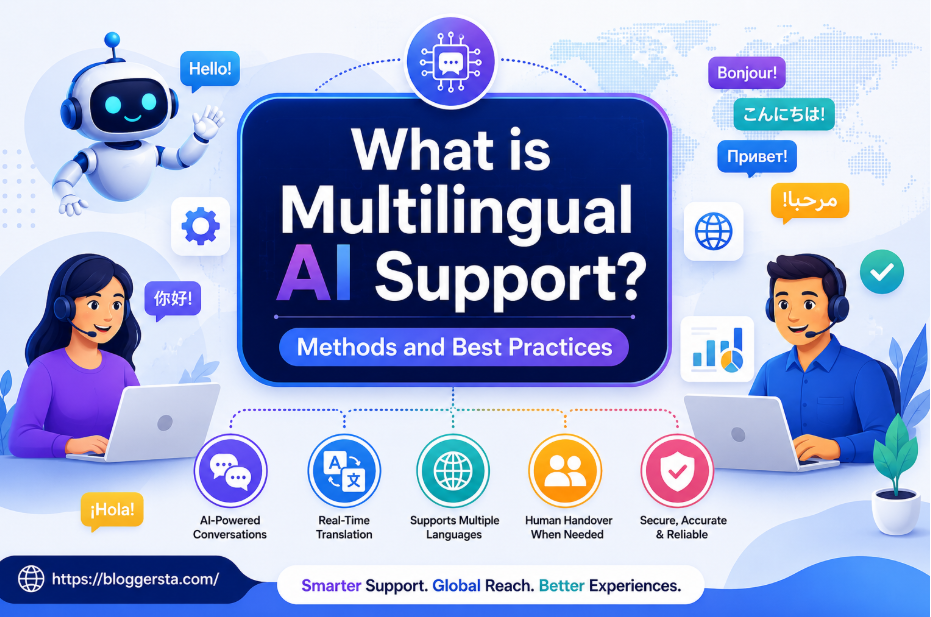
Multilingual AI support is an AI-powered system. It detects the language spoken by the customer and replies in the customer’s language automatically. This whole system works without any involvement of humans. It uses Natural Language Processing (NLP) and machine translation to handle customer queries across a number of languages, 24/7, at scale.
Key Benefits of Multilingual AI Support
- Supports customers in different languages instantly
- Helps businesses scale global customer service operations
- Reduces dependence on large multilingual support teams
Why Businesses Need Multilingual AI Support
When clients reach out, they want to feel heard — and they want a response fast, in the language they’re most comfortable with. In today’s global market, that’s not a luxury anymore; it’s an expectation. Businesses that lag behind on multilingual communication don’t just lose deals — they lose the trust it took months or years to build.
Hiring fluent speakers for every language across every department sounds like the obvious fix, but the costs add up quickly, and the logistics get complicated. Multilingual AI solves that problem in a more practical way — it meets clients in their own language, naturally and at scale, without the overhead of building out a multilingual team from scratch.
Meets Customer’s Expectations
Today’s customers look for real conversation in their own language. When reaching out by chat, mail, or phone, people seek quick help without waiting for translations. A smooth reply matters more than perfect grammar. Speed beats delay every single time. Getting answers fast feels right. Language gaps slow things down. No one likes holding on for a translator. Quick replies build trust quietly. Help should arrive like a friend showing up.
Companies that provide localized experiences usually achieve:
- Better customer retention
- Improved user satisfaction
- Higher international sales
Cost of Human-Only Language Support
Human-only support teams are difficult to scale globally. Businesses often struggle with staffing, training, scheduling, and language coverage.
| Support Type | Cost | Scalability | Availability |
| Human support agents | High | Limited | Shift- based |
| AI multilingual support | Lower | High | 24/7 |
Note: when you hire a human multilingual support team, it usually costs $25–$50/hour per language, while AI support tools average $50–$500/month for unlimited interactions.
Benefits for International Companies
A customer in Tokyo files a complaint at 11 PM. Without multilingual AI, that ticket sits until your Manila team starts at 9 AM. With it, they get a reply in under a minute. This is the advantage of using multilingual AI support. Faster response, customer satisfaction, 24/7 support coverage, and better localization.
How Multilingual AI Support Works
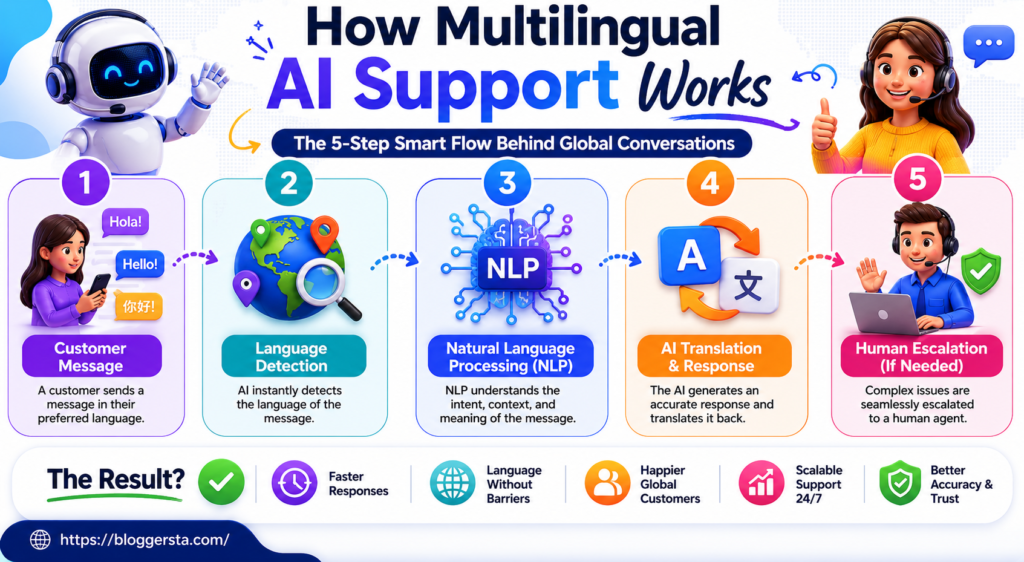
When someone types a message in French, hidden tools start working right away. These smart systems pull together different methods to make sense of words across languages. A response forms while matching meaning closely. Inside those first moments, layers of processing unfold quietly. Understanding comes through careful steps taken behind the scenes.
1. Language Detection
When a customer contacts, the AI support agent picks up the words to recognize the language they are speaking. Instantly, it matches those words and sounds with different languages and then comes up with one known language.
2. Natural language processing (NLP)
Multilingual AI support detects the language first. The customer’s message is analyzed by NLP models to understand the intent. The system is designed so that AI can detect whether a customer is asking a question, registering a complaint, or requesting a refund.
3. AI Translation Tools
Once a query lands, the translation system translates the text into AI processing language. After processing, the machine language is again converted into the language that clients understand. These smart programs handle clients with surprising precision.
4. Response Generation
Starting with what the customer means, the system builds replies using past chats, known questions, or help guides. These answers get changed into the person’s own language afterward.
5. Human Escalation
Sometimes things get complicated to be handled by an AI agent. Also, some customers demand to talk to a human representative. In that case, a human representative steps in to resolve the issue.
Multilingual AI System Workflow
- Customer sends a message
- AI detects the language
- NLP analyzes intent
- The translation engine processes the request
- AI generates a localized response
- Human support intervenes if necessary
Types of Multilingual AI Support Agents
Different businesses require different types of multilingual AI support agents depending on their customer service needs.
AI Chatbots
AI chatbots are the most common multilingual support tools; they answer FAQs, handle customer queries, and provide instant assistance on websites and apps.
Best for:
- E-commerce stores
- SaaS businesses
- Service websites
Voice AI Assistants
Voice AI systems can also support multilingual customer communication through phone calls or voice applications, according to their ease.
Best for:
- Call centers
- Telecom businesses
- Healthcare services
AI Email Support Agents
AI email assistants automatically analyze and respond to customer emails in multiple languages.
Best for:
- Ticket management systems
- Enterprise support teams
- B2B communication
Hybrid AI + Human Support Systems
Many businesses combine AI automation with human oversight. AI handles repetitive tasks while humans manage complex cases.
Best Methods to Deploy Multilingual AI Support Agent Quickly
Most companies need a quick way to launch an AI helper that speaks several languages. Instead of starting over, plugging smart tools into what they already have works faster. These ready-made models know how people talk across countries. They’ve learned common service questions, too. Getting them running usually takes less time than building something new. This significantly reduces setup time.
Benefits include:
- Faster deployment
- Lower training costs
- Better initial accuracy
Integrate AI With Existing CRM Tools
Businesses can connect AI support systems directly with customer relationship management platforms like Salesforce, HubSpot, or Zendesk.
This allows:
- Centralized support management
- Faster customer resolution
- Better tracking and analytics
Start With High-Traffic Languages
Instead of supporting every language immediately, businesses should prioritize languages used by their largest customer groups.
This approach improves:
- Budget efficiency
- Support quality
- Faster ROI
Train AI Using FAQs and Support Data
AI systems become smarter when trained using real customer interactions, support tickets, and knowledge bases.
Best Deployment Practices
Choose scalable AI tools that can grow with your business.
- Prioritize support automation.
- Monitor translation quality.
- Add human review layers to maintain quality controls.
- Optimize response accuracy.
Sometimes sorting emails becomes a huge task for people with a busy routine. You can also use an AI agent for writing your emails. Check our latest post on How to Use an AI Agent to Sort Emails?
Best Multilingual AI Support Platforms in 2026
Choosing the best multilingual AI support platform depends on your business size, budget, and customer service goals.
Zendesk AI
Zendesk offers multilingual AI chatbots, automated workflows, and translation support for enterprise customer service teams.
Best for:
- Large enterprises
- Global customer support operations
Intercom
Intercom focuses heavily on AI-powered conversational support and multilingual messaging automation.
Best for:
- SaaS businesses
- Startups
- Product-led companies
Freshdesk AI
Freshdesk provides affordable multilingual support tools for growing businesses.
Best for:
- Small and medium businesses
- E-commerce stores
Drift
Drift specializes in conversational AI and multilingual sales communication.
Best for:
- B2B businesses
- Lead generation
HubSpot Service Hub
HubSpot Service Hub integrates multilingual AI customer support with marketing and CRM tools.
Best for:
- Marketing-driven businesses
- Integrated customer support ecosystems
| Platform | AI Translation | Automation | Best for |
| Zendesk | Yes | Advanced | Enterprises |
| Intercom | Yes | Strong | SaaS |
| Freshdesk | Yes | Moderate | SMBs |
| Drift | Yes | Advanced | B2B |
| HubSpot | Yes | Strong | CRM integration |
Best Intranet Platforms With Multilingual AI Support
Internal communication is equally important for international businesses. Several platforms now offer AI-powered multilingual collaboration features.
Microsoft SharePoint
Microsoft SharePoint helps global teams share information across languages using AI-based translation tools.
Confluence
Confluence supports multilingual documentation and collaborative knowledge management.
Workvivo
Workvivo provides AI-powered employee communication features for distributed global teams.
Benefits of Multilingual Intranet Platforms
- Internal multilingual knowledge sharing: Employees access information in preferred languages.
- AI-powered employee search: Teams find localized documents quickly.
- Global workforce collaboration: Improves international communication.
- Translation support: Reduces misunderstandings across regions.
These platforms work best for the organization that needs multilingual AI support across its operations.
Common Challenges in Multilingual AI Support
Although AI support systems offer many benefits, businesses still face several implementation challenges.
Translation Accuracy Issues
AI translations may sometimes misunderstand context, slang, or industry-specific terminology.
Cultural Context Problems
Certain phrases or communication styles may not translate appropriately across cultures.
Low-Resource Languages
Some languages have limited training datasets, reducing AI accuracy.
Data Privacy and Compliance
Businesses handling international customer data must comply with privacy regulations such as GDPR and regional laws.
How Businesses Can Reduce These Challenges
- Maintain human oversight: Humans should review sensitive interactions.
- Regularly retrain models: Continuous learning improves accuracy.
- Use localized datasets: Train AI with region-specific examples.
- Test AI responses frequently: Monitor quality consistently.
Best Practices for Multilingual AI Support
Businesses that follow proven strategies achieve better AI performance and customer satisfaction.
1. Use Native-Language Testing
Test AI conversations with native speakers to identify translation or cultural issues.
2. Blend AI With Human Review
AI works best when combined with experienced human support teams.
3. Continuously Train Support Models
AI systems improve through ongoing customer interaction analysis.
4. Track Customer Satisfaction by Language
Monitor support quality separately for each language group.
5. Personalize Responses Regionally
Localization should include tone, formatting, and regional communication preferences.
6. Maintain Consistent Brand Voice
Customers should experience the same brand personality across all languages.
Future Trends in Multilingual AI Support
AI-powered customer service technology continues to evolve rapidly.
Real-Time Voice Translation
Tools like Google’s real-time interpreter and Microsoft’s live captions are already shrinking the gap between a conversation and its translation to under a few milliseconds.
Emotion-Aware AI
Future AI tools may recognize frustration, urgency, or satisfaction through tone analysis.
AI Personalization by Region
AI systems will increasingly adapt responses based on regional customer behavior.
Autonomous AI Support Teams
Advanced AI systems may soon handle entire customer workflows independently.
Emerging Trends
- AI avatars
- Multilingual voice bots
- Regional sentiment analysis
- Hyper-personalized customer responses
Also, check our latest post on What is Jasper AI? A Simple Guide for Beginners and Marketers
Conclusion
Right now, someone just left a chat because the reply came in the wrong language. It happens every hour, across every industry. The numbers add up quietly while dashboards show nothing.
That’s the real problem with ignoring multilingual support — it doesn’t crash loudly. It just erodes. Trust fades, customers drift, and teams that worked hard to build connections slowly lose them.
Some smaller companies are pulling ahead anyway. Not because they spent more, but because they stopped treating language as a translation task and started treating it as a customer experience decision.
The good news — multilingual AI support actually works now. Tools are easier to plug in, and results come down to setup quality, not budget size.
Start with your key markets. Build the foundation right. Keep humans involved where judgment matters. The space isn’t crowded yet — and that window won’t stay open forever.
Frequently Asked Questions
What does multilingual support in AI help with?
Multilingual support in AI helps businesses communicate with customers in different languages. It improves customer service, reduces response time, increases accessibility, and supports global business expansion.
Which AI tools offer multilingual support?
Several AI platforms offer multilingual support, including Zendesk, Intercom, Freshdesk, and HubSpot.
What is multilingual AI?
Multilingual AI refers to artificial intelligence systems capable of understanding, processing, and responding in multiple languages using technologies like machine learning and natural language processing.