

Product ideas are everywhere, but real demand is harder to prove. Retail e-commerce sales reached $326.7 billion in Q1 2026, rising 9.8% year over year. So, which AI tools can help you find products actually worth testing?
Quick Answer
The best AI tools for eCommerce product research include Jungle Scout and Helium 10 for Amazon validation, SparkToro for audience discovery, ChatGPT for qualitative research, Crayon for competitor tracking and Google Trends for demand signals. Triple Whale Moby analyzes store data while ViSenze studies visual discovery. Sell The Trend suits dropshipping while Perplexity handles broader market research.
10 Best AI Tools for eCommerce Product Research: Quick Comparison
Product research involves several moving pieces. One platform might reveal demand while another uncovers audience interests, competitive pressure, customer complaints or actual store performance.
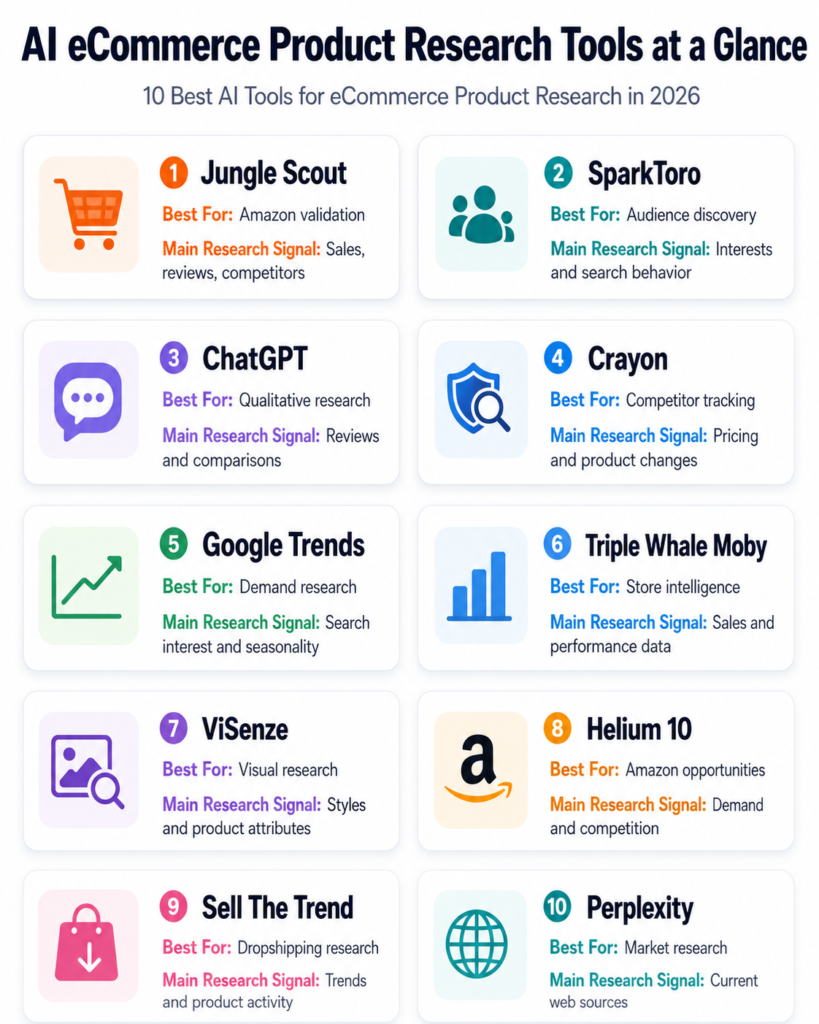
AI eCommerce Product Research Tools at a Glance
Don’t pick software because its dashboard looks clever. Start with the question you need answered first. Amazon sellers need marketplace data while established stores already have valuable first-party information. Meanwhile, a new DTC brand may need audience clues before touching inventory. The table below makes those differences easier to spot.
What Can AI Product Research Tools Actually Tell You?
AI product research tools can process market signals far faster manually. Still, each platform answers a different question. Smart research combines demand, competition, audience behavior, customer complaints, timing and product economics. One promising graph shouldn’t send you running toward a supplier with your wallet open.
- Demand: Is customer interest growing or fading?
- Competition: How crowded is the category?
- Pain points: What keeps frustrating current buyers?
- Market gaps: Which useful features are still missing?
- Seasonality: Does interest disappear after December?
- Audience fit: Who actually wants this product?
- Product performance: Which existing items make money?
AI speeds up research. It doesn’t prove future profitability.
Top AI Product Research Platforms
These ten platforms solve different research problems. Some hunt Amazon opportunities while others expose customer interests, visual trends, competitors, store performance or broader buying behavior.
1. Jungle Scout — Best AI Product Research Tool for Amazon Sellers
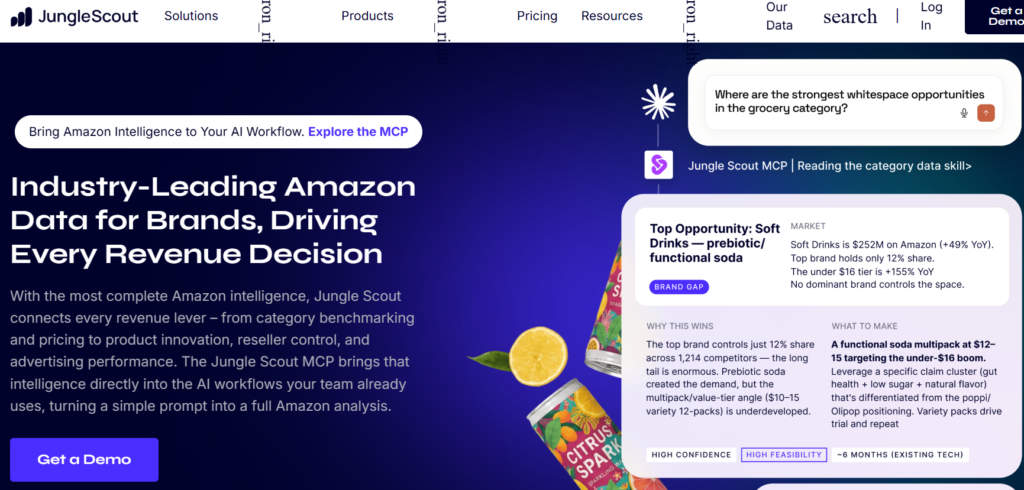
Jungle Scout brings Amazon research into one focused workspace. Its research tools cover sales velocity, product tracking, competitor intelligence and historical data. AI Assist can analyze product reviews for recurring complaints and opportunities.
That combination helps when an item looks promising but feels risky. However, sellers outside Amazon won’t use its strongest marketplace data.
2. SparkToro — Best for Finding Hidden Audience Demand
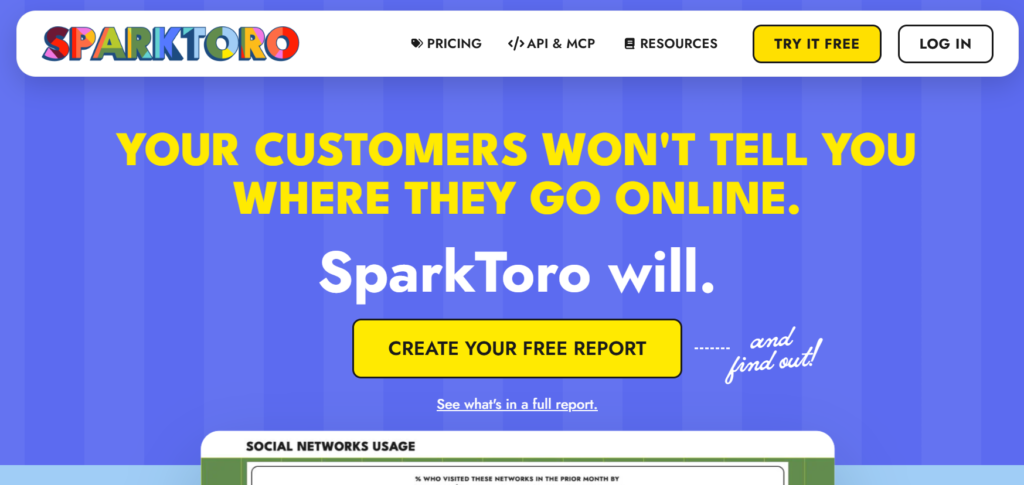
SparkToro answers a different question: what does your audience care about? It shows websites people visit, keywords they search, social platforms they use and Reddit communities they follow. It also surfaces podcasts and YouTube channels.
Imagine researching hiking accessories. SparkToro might reveal repeated interest around ultralight travel or foot care. Those clues can spark better product ideas than random marketplace scrolling.
3. ChatGPT Shopping Research — Best for Qualitative Product Research
ChatGPT Shopping Research works well when product choices need explanation rather than another spreadsheet. It can compare products, reviews, prices, features, alternatives and buyer constraints.
For sellers, that makes it useful for exploring customer expectations. Ask why buyers choose one material over another. Then compare common complaints. Just don’t treat its answer as proof of sales demand.
4. Crayon — Best AI Tool for Competitor Product Tracking

Crayon keeps an eye on competitors while you’re busy elsewhere. It tracks website changes, pricing updates, product releases, customer reviews and positioning changes. Its AI can also surface and summarize noteworthy competitor moves.
Suppose three competitors suddenly launch subscription bundles. That’s not automatic proof of demand. Still, it’s a signal worth investigating before the market moves without you.
5. Google Trends — Best Free Tool for Product Demand Trends

Google Trends remains one of the simplest free ecommerce product research tools available. It helps compare search interest across time while exposing regional patterns and seasonal swings. Google’s newer Explore experience also includes Gemini-powered capabilities for signed-in users.
Here’s the catch. Google Trends shows relative search interest, not actual product sales. Use it to test momentum rather than calculate revenue.
6. Triple Whale Moby — Best for Analyzing Store Product Data
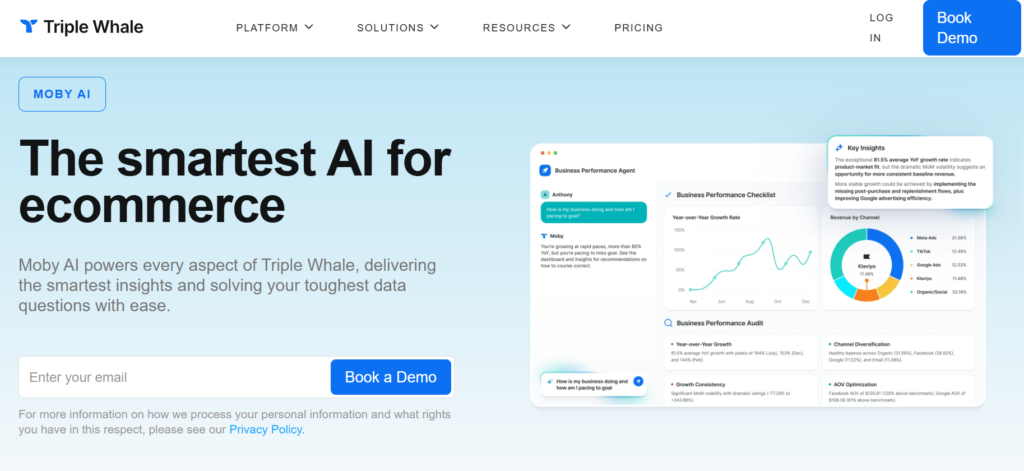
Triple Whale Moby becomes more useful after your store already generates data. You can ask questions about performance, uncover trends, build reports and forecast future results.
That’s a different form of product research. Instead of asking, “What should we sell?” you might ask, “Which SKU is growing profitably?” Established stores often need those answers more urgently.
7. ViSenze — Best for Visual Product Research and Discovery
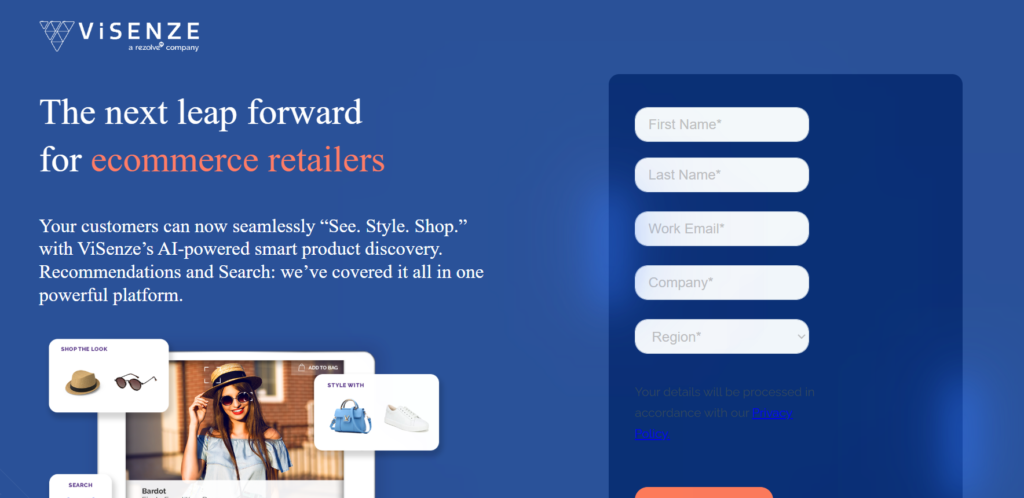
ViSenze uses visual AI for product discovery. Its technology can identify products through colors, styles, images and other visible attributes. It also combines image signals with text search.
That makes it interesting for fashion, homeware, jewelry and accessories. Visual similarity matters heavily there. However, it’s geared more toward retailers with catalogs than first-time sellers hunting one product.
8. Helium 10 Black Box — Best for Deep Amazon Product Filtering
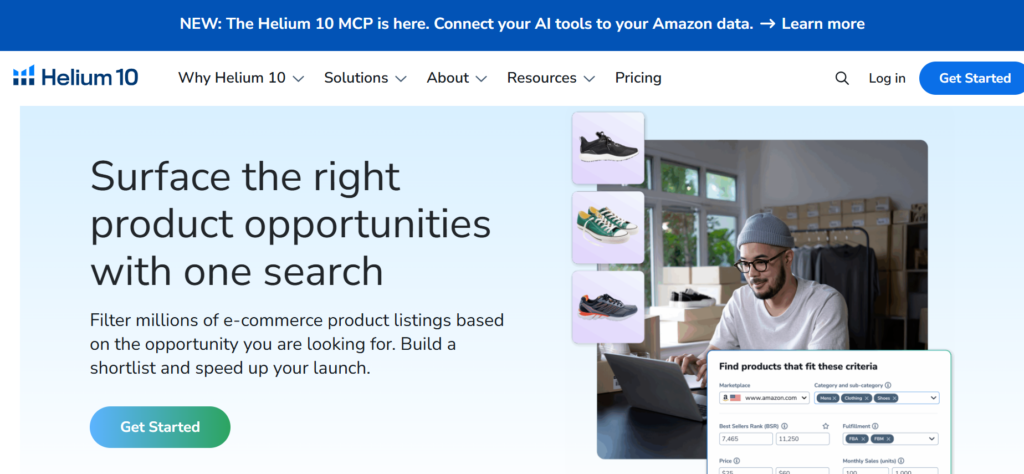
Helium 10 Black Box lets sellers narrow large product databases using sales, price, competition, reviews and other filters. It can also reveal historical sales or pricing patterns.
Jungle Scout gives Amazon sellers a broad research workflow. Helium 10 shines when you want deeper filtering. Anyone searching for an Amazon product research tool free can also test some Helium 10 research features before considering paid access.
9. Sell The Trend — Best AI Tool for Dropshipping Product Research
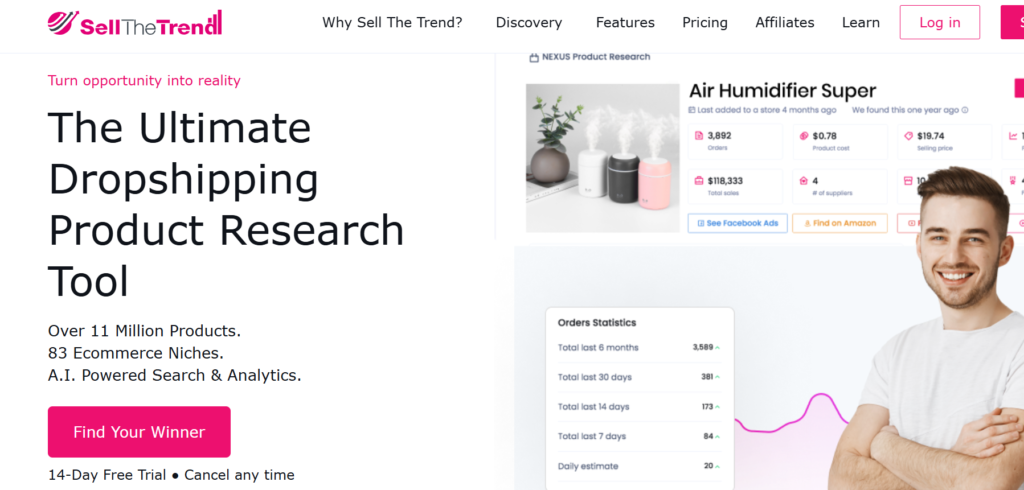
Sell The Trend focuses directly on dropshipping discovery. Its NEXUS AI research engine analyzes product activity, demand signals, saturation, store data, advertising activity and potential margins.
It’s useful when speed matters. Still, “winning product” labels deserve healthy skepticism. Check suppliers, delivery times, actual costs, returns and ad economics before spending real money.
10. Perplexity Research — Best for Citation-Backed Market Research
Perplexity Research suits broader questions that don’t fit a marketplace dashboard. Its Research mode performs multiple searches, reviews sources and builds a cited report. Free users currently receive limited Research access.
For example, spot a trend first. Then research competing products, customer complaints, regulations, materials and recent market commentary. That makes Perplexity a handy second-stage research partner.
Best AI Tools for eCommerce Product Research by Use Case
The best AI product research tool depends on your sales channel. Someone launching an Amazon private-label product needs different evidence from a fashion retailer. Matching software to the question keeps your research focused while saving money on unnecessary subscriptions.
- Best for Amazon research: Jungle Scout
- Best for deep Amazon filtering: Helium 10
- Best for audience discovery: SparkToro
- Best for qualitative research: ChatGPT
- Best for competitor tracking: Crayon
- Best free demand tool: Google Trends
- Best for store performance: Triple Whale Moby
- Best for visual discovery: ViSenze
- Best for dropshipping: Sell The Trend
- Best for web research: Perplexity
Best Free AI Tools for eCommerce Product Research
You don’t need five subscriptions before selling one product. Several AI tools for ecommerce product research free options can help validate early ideas. Just separate genuinely free access from limited usage and temporary trials. Free tools work best for discovery. Marketplace-specific data often costs money.
Free AI Tools List for Product Research
A useful best free AI tools for market research starter stack includes Google Trends for demand signals, ChatGPT for buyer-side comparisons, SparkToro for audience clues and Perplexity for sourced web research. SparkToro offers a first report free while Perplexity provides limited Research access.
This setup can answer plenty before paid software becomes necessary.
If you’re building a wider business stack, Bloggersta also covers AI tools that automate sales outreach.
How to Use AI Tools for eCommerce Product Research
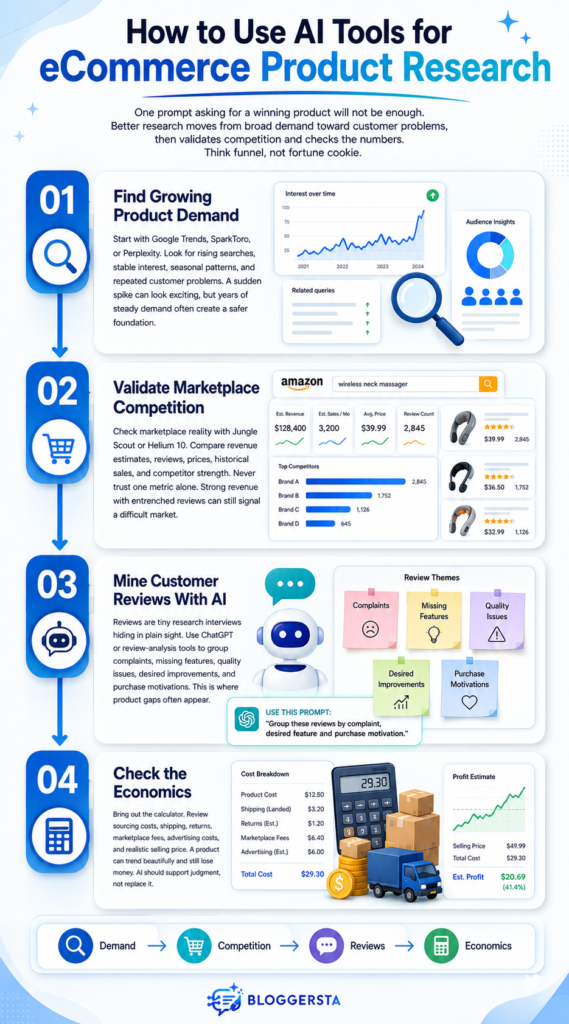
One prompt asking for a “winning product” won’t cut it. Better research moves from broad demand toward real customer problems. Then you validate competition and run the numbers. Think funnel, not fortune cookie.
Step 1: Find Growing Product Demand
Start with Google Trends, SparkToro or Perplexity. Look for rising searches, stable interest, seasonal patterns and repeated customer problems. A sudden spike can look exciting. Yet five years of stable demand often makes a safer foundation.
Step 2: Validate Marketplace Competition
Next, check marketplace reality. Amazon sellers can compare revenue estimates, reviews, prices, historical sales and competitor strength through Jungle Scout or Helium 10. Never trust one metric alone. Strong revenue with thousands of entrenched reviews may still signal a tough market.
Step 3: Mine Customer Reviews with AI
Reviews are tiny research interviews hiding in plain sight. Feed collected review themes into ChatGPT or use dedicated review analysis. Group complaints by missing features, quality problems, desired improvements and purchase motivations.
A useful prompt is:
“Group these reviews by complaint, desired feature and purchase motivation.”
That’s where interesting product gaps often hide.
Step 4: Check the Economics
Finally, bring out the calculator. Check sourcing costs, shipping, returns, marketplace fees, advertising costs and realistic selling price.
A product can trend beautifully and still lose money.
That’s why AI tools to find winning products should support judgment rather than replace it.
Frequently Asked Questions
Which AI Tool is Best for E-Commerce?
There isn’t one best AI tool for every ecommerce job. Jungle Scout and Helium 10 suit Amazon product research. Sell The Trend targets dropshipping. SparkToro helps with audience research while Triple Whale Moby analyzes existing store data. ChatGPT works well for flexible qualitative analysis. The best choice depends on the decision you’re trying to make.
Which AI is Best for Shopping Research?
ChatGPT Shopping Research is a strong option for conversational product comparisons. It can research products using merchant data and public retail information. It also compares features, reviews, prices and trade-offs. Sellers should still pair those findings with marketplace demand and financial data before buying inventory.
Can ChatGPT Do Market Research?
Yes. ChatGPT can support market research by summarizing reviews, comparing products, identifying customer pain points, analyzing supplied data and exploring competitor differences. Shopping Research can also gather current product information from retail sources. However, it shouldn’t replace customer interviews, sales data, supplier checks or financial validation.
Which AI Tool Should You Use for eCommerce Product Research?
The 10 best AI tools for eCommerce product research don’t compete for exactly the same job. Jungle Scout and Helium 10 serve Amazon sellers. SparkToro uncovers audiences while Google Trends checks demand. ChatGPT and Perplexity help investigate ideas. Triple Whale Moby makes more sense once your store has real performance data.
Start with one discovery tool. Add one validation tool. Then bring human judgment back into the room.
That’s usually smarter than collecting ten subscriptions and hoping one magically finds your next bestseller.