
Getting a voice actor for either YouTube videos, audiobooks, ads, or even social media clips is a lengthier and costlier process than most creators think! Home studio voiceover projects are simple, but they can easily stretch on for months due to recording sessions, script reviews, editing backlog, and building coordination with the studio.
This is why many creators nowadays are shifting to advanced AI voice generators. The latest voice tools, for instance, sound much more natural than the robotic text-to-speech software people relied on just a few years ago. Modern systems can manage emotional variations in a voice, smoother phoneme mapping, lower audio latency, more natural pauses, and even gentle breaths or gasps of air to make the narration far more human. In this guide, we compare 7 top tools based on voice realism, pronunciation accuracy, setup speed, pricing, and the safety of their AI voice cloning free trials for creators.
- op AI Voice Generators for Realistic Voiceovers (2026)
- We tested each tool for voice quality, voice cloning, and emotional expression.
- Best AI Voice Generators for Videos, Audiobooks, and Content Creation.
Understanding Vocal Inflection: What Makes a Realistic Text-to-Speech Engine Tick?
The voice tools that AI is using today sound far more natural than even the earliest text-to-speech systems because these systems do not just read word-for-word. Up until the modern era of AI, our models understood rhythm, natural pauses, pitch variation and even how a person breathes — creating what felt like human (and not robot) speech
The Anatomy of Realistic Prosody
Prosody is the natural rhythm and emotion of speech. AI voices sound monotone and robotic without it.
- Pitch (Intonation): The natural rise and fall of a voice — just like in real human conversation
- Duration (Rhythm): Incorporates breaks, gaps, and real-life timing.
- Energy, Stress & Volume: This makes the most important words and emotions stand out.
Neural Voice Generation Process
Deep learning enables modern AI voice systems to convert text into natural-sounding speech.
- Linguistic Analysis: Breaks down the text into phonetic sounds and speech patterns.
- Acoustic Modeling: Determines the pitch, tone, and speaking style for each word and sentence.
- Neural Vocoding: Converts those patterns into natural audio.
Emotional Awareness and Voice Cloning
Today’s AI voice generators capture nuances like enthusiasm and empathy and adjust their delivery to match them. Many applications now include voice cloning features and help users refine accents and speaking styles, even allowing them to customize tone and maintain consistent voice-overs.
- Looking for more content creation tools? Check out our guide to the 7 Best AI Writing Tools for Bloggers (Tried & Tested)
Best AI Audio Synthesis Tools for Voice, Music, and Audio Editing
AI audio synthesis: AI voice synthesizers capture, clone, and alter voices, music, and sound effects based on deep learning methods. These tools can be invaluable to creators and offer results on par with professional voiceovers, music, and audio edits without requiring dedicated editing software.
| Software Name | Best Content Match | Latency | Pricing Tier | Free Plan? |
| ElevenLabs | YouTube voiceovers, audiobooks, dubbing | Fast | $5/month | Yes |
| Murf AI | Business presentations and e-learning | Medium | $19/month | Yes |
| Play.ht | Podcasts and long-form narration | Fast | $31/month | Yes |
| Lovo AI (Genny) | Marketing and social media content | Fast | $24/month | Yes |
| Speechify | Articles, PDFs, audiobook-style content | Fast | $139/year | Yes |
| Resemble AI | Gaming, animation, interactive media | Medium | $0.006 per second | Limited |
| Inworld AI | Virtual assistants and game characters | Very Fast | enterprise pricing on request | Yes |
Reviewing the 7 Most Lifelike AI Voice Generators
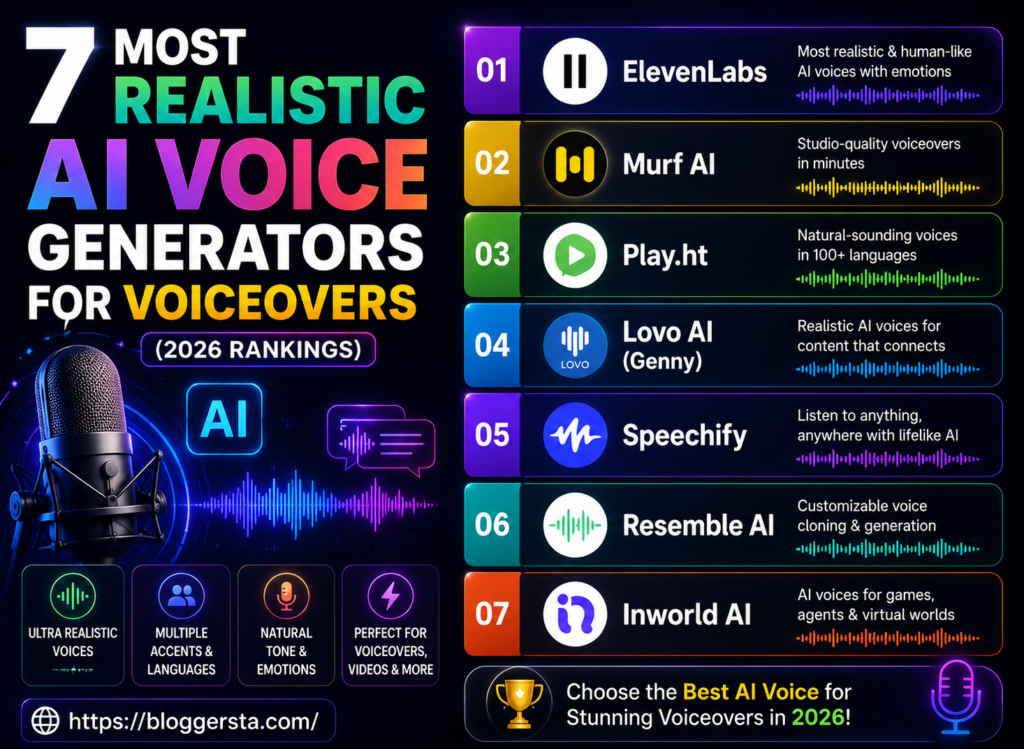
Modern AI voice tools now create natural-sounding voiceovers instead of robotic, computerized speech. Modern platforms are so advanced that they can reproduce natural vocal inflections and emotional tones of voice, deliver realistic pauses, and produce dynamic, human-like breaths at a professional level.
We will assess 7 highly credible AI voice generators based on voice quality, emotional range, customization options, price, and the performance of actual content creation using AI voice generation technologies.
1. ElevenLabs
One of the best AI voice generators available, ElevenLabs is currently one of the most realistic options. Before generating audio, the model understands full-sentence context, emotional delivery, and speaking style, helping the narration sound much more natural and human-like.
Pros: Great support for multiple languages with very high-quality voice cloning and emotional intonation.
Cons: Output can occasionally sound overdramatic on longer scripts, and higher-tier plans are expensive for solo creators.
2. Murf AI
Murf AI is more of a voiceover production studio than just a text-to-speech tool. Very handy for video creators working with presentations, training videos, and professional business content.
Pros: Easy-to-use interface with strong syncing tools for videos and presentations.
Cons: Emotional depth and realism feel slightly weaker compared to ElevenLabs.
3. PlayHT
PlayHT is designed for creators, developers, and publishers who need to produce large quantities of audio quickly. This allows for scaling whilst using its API system and batch generation tools.
Pros: Fast processing and excellent for bulk audio generation.
Cons: Longer narrations can occasionally sound less expressive.
4. Lovo AI (Genny)
Lovo AI features hundreds of character voices for different styles (and tailored emotional presets) and combines an AI voice generator with built-in content creation tools.
Pros: Ideal for marketers, YouTubers and social media creators.
Cons: The interface can feel crowded for users who only need simple voiceovers.
5. Speechify
Speechify focuses heavily on natural listening flow, making it ideal for turning articles, PDFs, and documents into audiobook-style narration.
Pros: Smooth pacing and comfortable listening experience for long sessions.
Cons: Limited advanced customization compared to creative AI voice studios.
6. Resemble AI
Resemble AI has gained immense popularity in the fields of gaming, animation, and interactive media, as it retains your true emotional tone in speech generated by artificial intelligence.
Pros: Strong phoneme-level controls and realistic vocal adjustments.
Cons: Slightly steeper learning curve for beginners.
7. Inworld AI
Inworld AI specializes in real-time conversational AI voices, which are used primarily for virtual assistants, gaming characters, and animated interactive experiences.
Pros: Extremely fast responses with very low audio latency.
Cons: Better suited for live interaction than polished cinematic voiceovers.
Ethical Audio Protocols: Protecting Your Digital Voice Footprint
- Always Get Written Permission Before Voice Cloning: Before uploading any third-party voice sample into an AI voice generator, make sure you have proper written legal consent. Using someone’s voice without permission can create copyright, privacy, and identity misuse issues, especially for commercial projects.
- Choose Platforms With Voice Watermarking Protection: Leading-edge AI voice tools must offer advanced voice watermarking or authenticity-tracking solutions. These security layers minimize the risk of deepfake misuse, unsanctioned cloning, and imitation through false audio.
- Check Who Owns the Generated Audio: Always check out the terms of service from the platform you’re generating content on before doing so. Some AI tools retain ownership of the audio generated from the text, voice clones, and any uploaded recordings, while others return full ownership to the creator.
- Protect Your Voice Data Securely: Explore using platforms that offer encrypted storage, security processes with compliance tracking, and more careful handling of voice data.
- Want more AI writing tips? Read our guide on How to Bypass AI Detection: 5 Free AI Text Humanizers (Tested & Ranked)
Frequently Asked Questions (FAQs)
1. What are AI Voice Generators?
AI voice generators are software tools that use artificial intelligence to convert written text into spoken audio. They are used across YouTube videos, podcasts, audiobooks, advertisements, and business presentations.
2. Are there completely free AI voice generators?
Some Free plans or trial versions offered by some platforms are:
- ElevenLabs
- Play.ht
- Murf AI
- Speechify
Free plans usually come with limited voice credits or fewer export features.
3. Can I use these voice-overs for YouTube or commercial projects?
Yes, many AI voice generators include commercial licenses, allowing you to use voiceovers for YouTube videos, ads, and client work.
4. What is AI Voice Cloning?
AI voice cloning: You can reproduce a real human voice simply from short samples of audio. It can copy:
- Tone and speaking style
- Accent and pronunciation
- Emotional delivery and pacing
5. Do AI voiceovers sound fake or robotic?
The AI voice of modern tools sounds human-like compared to text reading systems we have seen in older days. By now, premium platforms can generate realistic pauses, emotions, breathing effects, and smooth vocal inflections, which are very human-like.
Conclusion: Launching Your Audio Strategies via Automated Narration
AI voice technology has certainly come a long way. The phonetic sounds that once came across as mechanical and robotic now feel authentically natural — marked by real pauses, emotion, and smooth verbal articulation so close to a true narrator that you can rarely distinguish the two.
The best AI voice generator for you will depend on your use case. Nobody can beat ElevenLabs for emotional depth and quality. Play. ht is the most suitable for high-volume content creation. When it comes to marketers and social creators, Lovo AI works well. Best For Interactive and gaming applications, Resemble AI & Inworld AI
Get the free plan for ElevenLabs or Murf AI today, try it with an authentic script, and see and hear the differences yourself. Once you work out the right voice, scaling your content goes so much quicker and more consistently.