

You asked ChatGPT to write something. It came back generic. You asked again. Still generic. So you figured the tool just isn’t that good.
It’s not the tool.
It’s the prompt.
Prompt engineering sounds like a technical skill that requires knowing how AI models work under the hood. It doesn’t. It’s just the practice of writing clearer, more specific instructions so the AI gives you something actually useful. Any blogger can learn it in an afternoon. And once you do, the same tool you’ve been using starts producing output you’d actually consider publishing.
Why Prompts Matter So Much
Think about it this way. You hire a freelance writer. You send them one email: “Write me a blog post about AI tools.” What comes back? Probably something safe, generic, and not quite what you wanted.
Now you send them a proper brief. Topic. Target keyword. Audience. Tone. Word count. Sections you want covered. Things to avoid. What comes back is a lot closer to what you needed.
The AI is the writer. Your prompt is the brief. A weak brief gets a generic article. A strong brief gets something useful.
That’s all prompt engineering is. Writing better briefs.
The 5 Components of a Strong Prompt

Every useful prompt has some combination of these five things:
1. Task What exactly do you want the AI to produce? Be specific. Not “write something about SEO” but “write a 200-word introduction for a beginner’s guide to on-page SEO.”
2. Context What does the AI need to know to do this well? The audience. The website it’s for. The topic’s angle. The keyword you’re targeting. Background it won’t have on its own.
3. Format How should the output be structured? A list? A paragraph? A table? An outline with H2s? If you don’t specify, you get whatever format the AI defaults to.
4. Tone How should it sound? Conversational and friendly? Formal and authoritative? Concise and direct? “Like a friend explaining it over text” produces something very different from “professional and informative.”
5. Constraints What should it avoid? Word count limits. Specific phrases to leave out. Topics not to cover. Formats not to use. AI tools do better when you tell them what NOT to do as well as what to do.
You don’t always need all five. But for important outputs, hitting all five gets you a draft that needs editing rather than a draft that needs rewriting.
Weak Prompt vs Strong Prompt: Real Examples

Writing a Blog Introduction
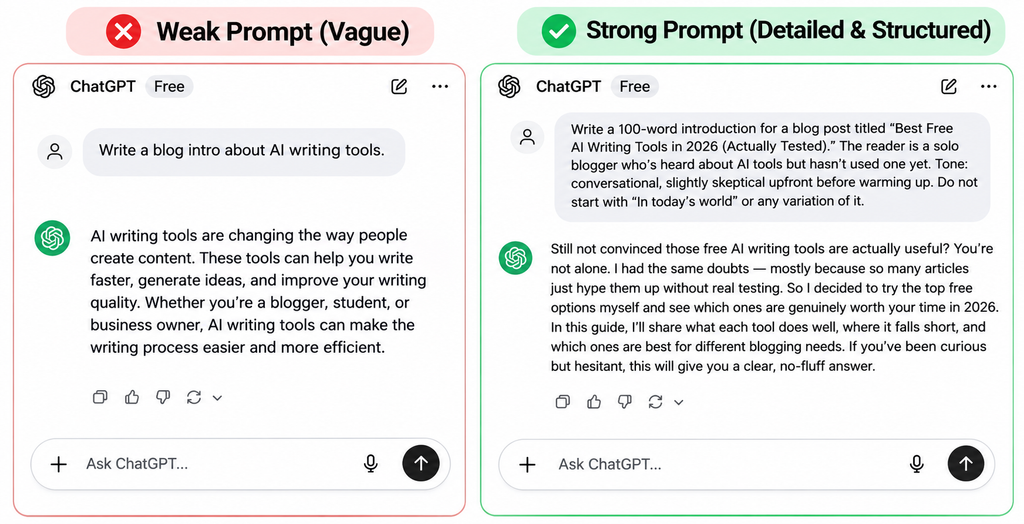
Weak prompt:
Write a blog intro about AI writing tools.
What you get: A generic 3-sentence intro that could have come from any article on any website. Mentions “the age of AI.” Uses the phrase “rapidly changing landscape.” Tells you nothing specific.
Strong prompt:
Write a 100-word introduction for a blog post titled “Best Free AI Writing Tools in 2026 (Actually Tested).” The reader is a solo blogger who’s heard about AI tools but hasn’t used one yet. Tone: conversational, slightly skeptical upfront before warming up. Do not start with “In today’s world” or any variation of it. Do not use the phrase “rapidly changing landscape.” The first sentence should hook with a specific claim or question.
What you get: An intro with a specific hook, written for a real reader, in the tone you actually want. Still needs editing. But it’s a starting point, not a throwaway.
Generating a Blog Outline
Weak prompt:
Give me an outline for a blog post about prompt engineering.
Strong prompt:
Create a detailed blog post outline for the keyword “what is prompt engineering.” Target reader: beginner blogger who uses ChatGPT but gets generic outputs and doesn’t know why. Article goal: teach them a practical framework for writing better prompts, with real before/after examples. Include: H1 title, intro approach (2 sentences), 6-8 H2 sections with 1-sentence descriptions, an FAQ section with 5 questions, and a conclusion angle. Do not include a section on “the history of prompt engineering” — keep it practical.
What you get: An outline built for your specific reader, with the sections you actually need, minus the filler you specifically ruled out.
Expanding a Section
Weak prompt:
Write about the tone component of prompts.
Strong prompt:
Write the section titled “Tone” for a blog post about prompt engineering for beginners. This section explains why specifying tone in a prompt matters and gives 3 concrete examples of tone instructions: conversational, formal, and “like a friend explaining over text.” Word count: 120-150 words. Tone of this section itself: direct, no fluff. Include one sentence the reader can copy directly into their next prompt.
What you get: A focused section with examples and a practical takeaway — not a generic definition of what “tone” means.
Prompt Engineering for Bloggers: The Prompts You’ll Actually Use

You don’t need to memorize a framework. You need a few reusable prompt structures for the tasks you do most often.
Blog outline:
Create a detailed outline for the keyword “[keyword].” Target reader: [describe]. Differentiation angle: [what makes your take different from what’s ranking]. Include: H1, intro approach, H2 sections with descriptions, FAQ (5 questions), conclusion angle. Word count target: [X] words. Exclude: [any section you don’t want].
Section expansion:
Write the section “[H2 heading]” for a blog post targeting “[keyword].” Reader: [describe]. Tone: [specify]. Word count: 150-200 words. Include one concrete example. Avoid: generic advice, passive voice, filler phrases.
FAQ generation:
Write 5 FAQ questions and answers for a blog post about [topic]. Reader: [describe]. Tone: [specify]. Each answer: 50-80 words. Make the questions reflect what a real beginner would actually search or wonder — not textbook definitions.
Rewriting a weak section:
The following section sounds too generic and formal. Rewrite it in a more conversational tone for a blogger audience. Keep the core information. Add one specific example. Reduce the word count by 20%. Here is the section: [paste section].
Headline options:
Write 10 headline options for a blog post about [topic] targeting the keyword “[keyword].” Mix: listicles, how-tos, questions, and “without [common problem” formats. Reader: [describe]. Tone: [conversational/professional].
Save these. Adjust the variables per article. They work.
Common Prompt Mistakes to Stop Making
Asking for too much in one prompt. “Write a full 2,000-word blog post with an intro, 6 sections, a FAQ, and a conclusion in one go” almost always produces something flat. Break it into stages.
Not specifying the reader. “Beginners” and “experienced marketers” need completely different explanations of the same concept. If you don’t say who the reader is, the AI picks someone generic.
Forgetting to say what to avoid. AI tools default to common patterns: starting with “In today’s world,” using phrases like “it’s worth noting,” ending with “in conclusion.” If those patterns annoy you in the output, rule them out in the prompt.
Accepting the first output without pushing back. Prompting is a conversation. If the first response isn’t right, say specifically what was wrong: “This intro is too formal — rewrite it with a more casual, direct tone and cut the first sentence.” One round of feedback almost always improves the output.
Using the same prompt for every task. The prompt structure for a FAQ is different from the one for an intro, which is different from the one for a comparison section. Prompts are task-specific.
A Note on AI Detection and Prompt Engineering
Here’s something worth knowing. The reason a lot of AI-generated content reads as obviously AI-written isn’t because AI is bad at writing. It’s because most people use vague, unconstrained prompts that let the AI fall back on its default patterns.
Those patterns are recognizable because they show up in a huge percentage of AI-generated content: the same sentence openers, the same paragraph structures, the same hedging phrases.
When you write tight, specific prompts with tone constraints, banned phrases, format requirements, and reader context, the output breaks those patterns. Not because you’ve tricked the AI. Because you’ve given it enough direction to do something less generic.
Better prompts, less generic output. That’s the connection.
Related: How to Write SEO Blog Posts with AI (Without Getting Penalized) — the full workflow that puts prompt engineering into a publishing process.
FAQ
Do I need technical skills to learn prompt engineering? None. If you can write a clear email brief to a freelancer, you can write a good prompt. The skill is clarity, not code.
Is prompt engineering just for ChatGPT? No. The same principles apply to any AI writing tool: Gemini, Claude, Copilot, Jasper, Writesonic. Better instructions always produce better output regardless of the model.
How long should a prompt be? Long enough to be specific. A one-sentence prompt for a complex task gets a generic response. A 5-10 sentence prompt that covers task, context, format, tone, and constraints gets something usable. Don’t pad it with unnecessary detail — every word should do work.
Can prompt engineering make AI content undetectable? Specific, well-constrained prompts produce less generic output, which reads more naturally. But the goal shouldn’t be “undetectable” — it should be “actually useful and well-written.” Edit the output, add your own experience, and the question of detection becomes less relevant.
What’s the fastest way to get better at prompt engineering? Write a prompt. Read the output critically. Identify specifically what was wrong: too formal? Wrong format? Missing an example? Too long? Then rewrite the prompt fixing that one thing and compare the output. You’ll learn faster by iterating on real prompts than by reading about prompt engineering theory.
Wrapping Up
You don’t need a certification in AI to write better prompts. You need to stop treating AI like a vending machine and start treating it like a writer who needs a proper brief.
Task. Context. Format. Tone. Constraints. Those five things, applied consistently, change the quality of what comes back. Not sometimes. Every time.
Save the prompt templates from this article. Use them on your next article. Adjust them when the output isn’t what you needed. Within a few rounds, you’ll have a set of prompts that work for your blog specifically.
That’s prompt engineering. No jargon required.
Keep Going
- How to Use ChatGPT to Write a Blog Post (Step-by-Step) — put these prompts into an actual blog writing workflow
- Best Free AI Writing Tools in 2026 (Actually Tested) — which tools respond best to detailed prompts
- How to Write SEO Blog Posts with AI (Without Getting Penalized) — the full workflow from keyword to publish
- The AI Content Writing Checklist: 15 Things to Do Before You Hit Publish — every article needs this check before it goes live